 Tendata AI
  Exhibition
 B2B Platforms
 Standalone Website
 Social Media
 Emails
 Import News
 2026-02-06
In 2024, Austria purchased goods from international markets valued at approximately US$204.4 billion. This represents a 24.2% increase compared to US$164.6 billion recorded in 2020. However, on a year-over-year basis, Austria's import spending declined by 6.7% from US$219.1 billion in 2023.
Using the average 2024 exchange rate, Austria's currency—the euro—showed only a slight 0.02% appreciation against the US dollar compared to 2023. The marginal strengthening of the euro made imports priced in US dollars somewhat cheaper for Austrian buyers.

Main Sources of Austria's Imports
Recent trade data indicates that 74% of Austria's imports originated from key supplier countries, including:
· Germany (32% of total imports)
· China (8.2%)
· Italy (6.5%)
· Czech Republic (4.3%)
· United States (4.1%)
· Switzerland (4%)
· Poland (3.2%)
· Netherlands (2.9%)
· France (2.7%)
· Hungary (2.5%)
· Slovakia (1.9%)
· Spain (1.7%)
From a regional standpoint, European partners supplied 74.3% of Austria's imports by value in 2024. Asia accounted for 18.7%, while North America contributed 4.7%. Smaller shares came from Africa (1.3%), Latin America excluding Mexico and the Caribbean (0.8%), and Oceania (0.2%), led by Australia and New Zealand.
Austria, an EU member since January 1, 1995, sourced 67.1% of its imports from fellow European Union countries.
With a population of roughly 9.13 million, Austria's total imports equated to about US$22,400 per person in 2024—lower than the US$24,800 per capita recorded in 2023.
Austria's Top 10 Imported Products
The following categories generated the highest import values for Austria in 2024, along with their share of total imports:
1. Machinery including computers: US$25.8 billion (12.6%)
2. Vehicles: US$22.4 billion (11%)
3. Electrical machinery and equipment: US$20.7 billion (10.1%)
4. Mineral fuels including oil: US$15.3 billion (7.5%)
5. Pharmaceuticals: US$11.7 billion (5.7%)
6. Plastics and plastic articles: US$8.2 billion (4%)
7. Optical, technical and medical apparatus: US$5.9 billion (2.9%)
8. Articles of iron or steel: US$5.9 billion (2.9%)
9. Aluminum: US$4.6 billion (2.2%)
10. Iron and steel: US$4.4 billion (2.1%)
Together, these ten product groups represented 61.1% of Austria's total import value.
Among them, pharmaceuticals was the only category to record growth between 2023 and 2024, rising 3.5%. The sharpest declines were seen in mineral fuels including oil (-22.6%), followed by iron and steel (-14.7%), and electrical machinery and equipment (-10.7%).
Note: The product data above is based on the 2-digit Harmonized Tariff System (HTS) classification.
Identifying Buyers in Austria's Import Market
For businesses looking to enter Austria's import sector, locating trustworthy buyers is crucial. Using platforms like Tendata, companies can apply keyword searches and HS code filters to identify verified importers, monitor purchasing behavior, and access essential contact details—greatly accelerating market entry.
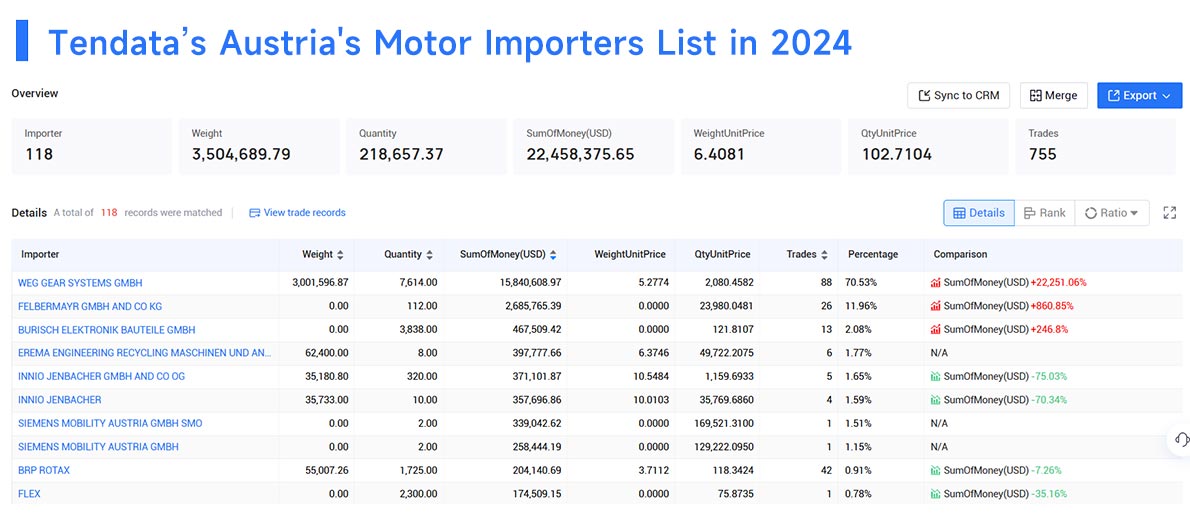
For instance, when analyzing motor demand, Tendata highlights leading buyers in Austria during 2024, including:
1. WEG GEAR SYSTEMS GMBH (70.53%, US$15.84 million)
2. FELBERMAYR GMBH AND CO KG (11.96%, US$2.69 million)
3. BURISCH ELEKTRONIK BAUTEILE GMBH (2.08%, US$0.47 million)
4. EREMA ENGINEERING RECYCLING MASCHINEN UND ANLAGEN GES M B H (1.77%, US$0.4 million)
5. INNIO JENBACHER GMBH AND CO OG (1.65%, US$0.37 million)
6. SIEMENS MOBILITY AUSTRIA GMBH SMO (1.51%, US$0.34 million)
7. BRP ROTAX (0.91%, US$0.2 million)
8. FLEX (0.78%, US$0.17 million)
9. IPS GMBH (0.56%, US$0.13 million)
10. ELIN MOTOREN GMBH (0.44%, US$0.1 million)
Whether you are an experienced exporter or a newcomer exploring new markets, leveraging Austrian import data can help uncover valuable opportunities. For deeper insights into Austria's import statistics or tailored trade data solutions, consider requesting a free online demo through Tendata.
Category
Leave Message for Demo Request or Questions