
 Tendata AI
  Exhibition
 B2B Platforms
 Standalone Website
 Social Media
 Emails
 Import News
 2026-02-24
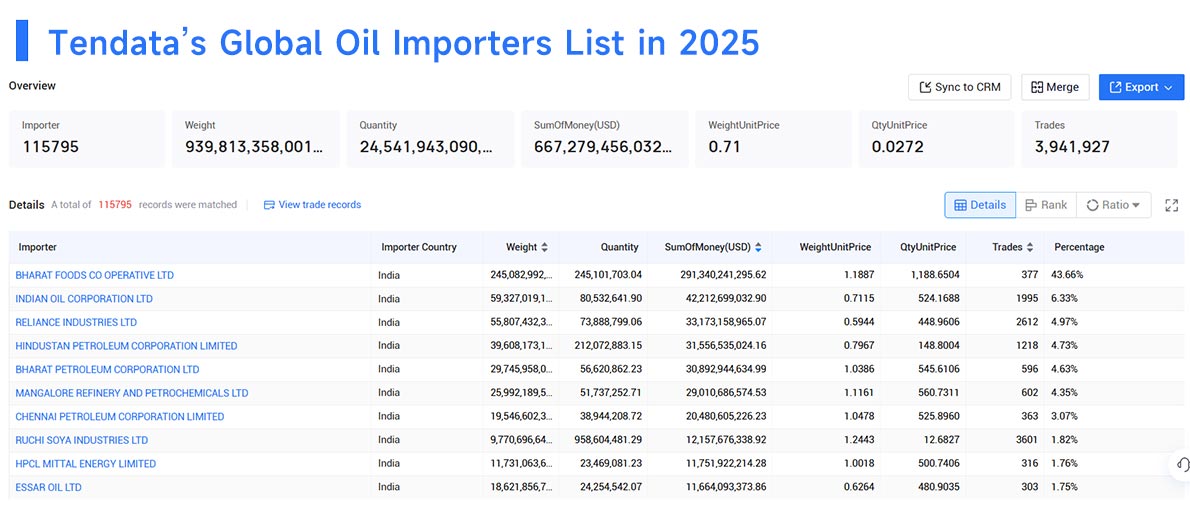
The global oil import market remained one of the most significant sectors in international trade in 2025, driven by growing energy demand, expanding industrial production, and the continuous development of refining and petrochemical industries. According to trade data, the oil import sector involved 115,795 importers, generating a total import value of approximately US$667.28 billion across nearly 3.94 million trade transactions worldwide.
With total import weight reaching over 939.81 billion units and an average weight unit price of US$0.71, the oil import industry continues to demonstrate massive scale and strong strategic importance in the global economy.

Overview of the Oil Import Market in 2025
· Total Import Value: US$667,279,456,032
· Total Import Weight: 939,813,358,001
· Average Weight Unit Price: US$0.71
· Number of Importers: 115,795
· Total Trades: 3,941,927 transactions
The large number of importers highlights the extensive global dependence on oil for transportation, manufacturing, energy production, and chemical processing. However, despite the broad participation, a significant share of total imports is concentrated among large national oil companies and major refiners.
Main Oil Importers in 2025
According to Tendata, the following companies ranked among the main oil importers globally:
1. Bharat Foods Co Operative Ltd – 43.66% | US$291,340.24 million
2. Indian Oil Corporation Ltd – 6.33% | US$42,212.70 million
3. Reliance Industries Ltd – 4.97% | US$33,173.16 million
4. Hindustan Petroleum Corporation Limited – 4.73% | US$31,556.54 million
5. Bharat Petroleum Corporation Ltd – 4.63% | US$30,892.94 million
6. Mangalore Refinery and Petrochemicals Ltd – 4.35% | US$29,010.69 million
7. Chennai Petroleum Corporation Limited – 3.07% | US$20,480.61 million
8. Ruchi Soya Industries Ltd – 1.82% | US$12,157.68 million
9. HPCL Mittal Energy Limited – 1.76% | US$11,751.92 million
10. Essar Oil Ltd – 1.75% | US$11,664.09 million
The dominance of large Indian energy and refining companies reflects the country’s massive energy consumption and its role as a major hub for refining and petroleum product distribution.
Key Characteristics of the Global Oil Import Industry
1. High market concentration among large refiners
Major energy corporations and national oil companies account for a large proportion of total imports due to their extensive refining capacity and supply chain infrastructure.
2. Strategic importance for national economies
Oil imports are closely tied to national energy security, industrial growth, and transportation networks.
3. Volatility driven by geopolitical and economic factors
Oil prices and trade volumes are heavily influenced by global supply conditions, political developments, and energy policy changes.
4. Expanding downstream industries
Petrochemicals, plastics, manufacturing, and logistics sectors continue to drive sustained demand for imported oil.
Opportunities and Trends in the Oil Import Market
Refining expansion: Growing refinery capacity in emerging economies is increasing demand for imported crude oil.
· Energy diversification: Countries are balancing traditional oil imports with renewable energy investments.
· Supply chain optimization: Data-driven procurement and logistics management help companies control costs and reduce risks.
· Regional trade partnerships: Long-term contracts and regional alliances are reshaping global oil trade routes.
· Digital trade intelligence: Import data analysis enables suppliers to identify high-volume buyers and optimize export strategies.
Conclusion
The global oil import market in 2025 represents a massive, strategically critical, and highly concentrated sector with total trade exceeding US$667 billion. Despite the participation of more than 115,000 importers, the majority of oil imports are controlled by large energy companies and major refiners.
As energy demand continues to rise worldwide, companies engaged in oil import and export activities must focus on efficient supply chains, risk management, strategic sourcing, and data-driven decision-making. Understanding global oil import trends will remain essential for businesses seeking to navigate the evolving energy landscape and maintain long-term competitiveness in international trade. ⛽
Category
Leave Message for Demo Request or Questions