
 Tendata AI
  Exhibition
 B2B Platforms
 Standalone Website
 Social Media
 Emails
 Import News
 2026-03-09
In 2025, Germany purchased goods valued at approximately US$1.539 trillion from international markets. This figure represents an 8.2% increase compared with 2021, when Germany's import value totaled about $1.423 trillion.
On a year-to-year basis, the overall value of Germany's Import transactions grew by 8.8%, rising from $1.414 trillion in 2024 to the 2025 total.
Using the average exchange rate in 2025, Germany continued to use the euro, which appreciated 4.4% against the US dollar between 2024 and 2025. Because of this stronger European currency, products priced in US dollars became relatively cheaper for German buyers when converted into euros during 2025 compared with the previous year.
Globally, Germany's Import demand accounted for 6.3% of total world imports, which were estimated at $24.259 trillion in 2024, increasing from 5.9% a year earlier.
Within the domestic economy, Germany recorded an average consumer inflation rate of 2.086% in 2025, slightly lower than the 2.489% average in 2024.
By product value, the five largest items in Germany's Import basket in 2025 were passenger cars, auto parts and accessories, packaged medicines, crude petroleum, and blood fractions including antisera. Combined, these five categories made up 15.9% of Germany's total import expenditure for the year.
Germany's Main Imported Products Suppliers
According to the most recent country-level statistics, 70.8% of goods imported by Germany were supplied by exporters from the following economies: mainland China (35.6% of the German total), the United States (7.5%), the Netherlands (5.2%), Poland (5.1%), Italy (4%), France (2.8%), the Czech Republic (2.7%), Switzerland (2.16%), Austria (2.16%), Belgium (1.8%), Spain (1.7%), and the United Kingdom (1.3%).
From a geographic perspective, European countries provided over three-fifths (61%) of Germany's total imports in 2025. Meanwhile, suppliers located in Asia accounted for 26.1% of Germany's purchases, and North America contributed 8.3% of imported goods.
Smaller shares came from Africa (2.6%), Latin America excluding Mexico but including the Caribbean (1.6%), and Oceania (0.4%), with Australia being the main contributor in that region.
As one of the largest members of the European Union, Germany sourced 51.8% of its imports from fellow EU countries in 2025, slightly lower than 52.7% in 2024.
Considering Germany's population of about 84.9 million, the country's $1.539 trillion in imports equates to roughly $18,150 worth of imported goods per person in 2025. This per-capita figure increased from about $16,800 in 2024.

Germany's Top 10 Imports
The product groups below generated the highest import values for Germany in 2025. Each category also shows its share of the nation's total imports.
1.Electrical machinery and equipment: US$219.3 billion (14.3%)
2.Machinery including computers: $189.2 billion (12.3%)
3.Vehicles: $156.6 billion (10.2%)
4.Mineral fuels including oil: $115.8 billion (7.5%)
5.Pharmaceuticals: $83.1 billion (5.4%)
6.Optical, technical and medical apparatus: $54.3 billion (3.5%)
7.Plastics and plastic articles: $50.8 billion (3.3%)
8.Organic chemicals: $40.1 billion (2.6%)
9.Gems and precious metals: $36.1 billion (2.3%)
10.Articles made from iron or steel: $29.3 billion (1.9%)
Together, these top ten product categories represented 63.3% of the total value of Germany's Import purchases from foreign markets.
The fastest-expanding import categories between 2024 and 2025 were gems and precious metals (up 61.9%), followed by machinery including computers (up 9.3%) and optical, technical or medical equipment (up 9%).
The only major category that experienced a decline was organic chemicals, which recorded a 3.4% decrease compared with 2024.
It should be noted that these statistics are presented at the two-digit Harmonized Tariff System (HTS) level. More detailed product analysis can be obtained by examining the four-digit HTS classification.
Top 10 Germany Import Companies in 2025
For companies seeking to enter the Germany import market, finding trustworthy buyers is a crucial step. By using Tendata's analytical tools, including keyword searches and HS code filters, businesses can quickly identify thousands of verified importers, analyze purchasing patterns, and obtain contact details—greatly accelerating market entry.
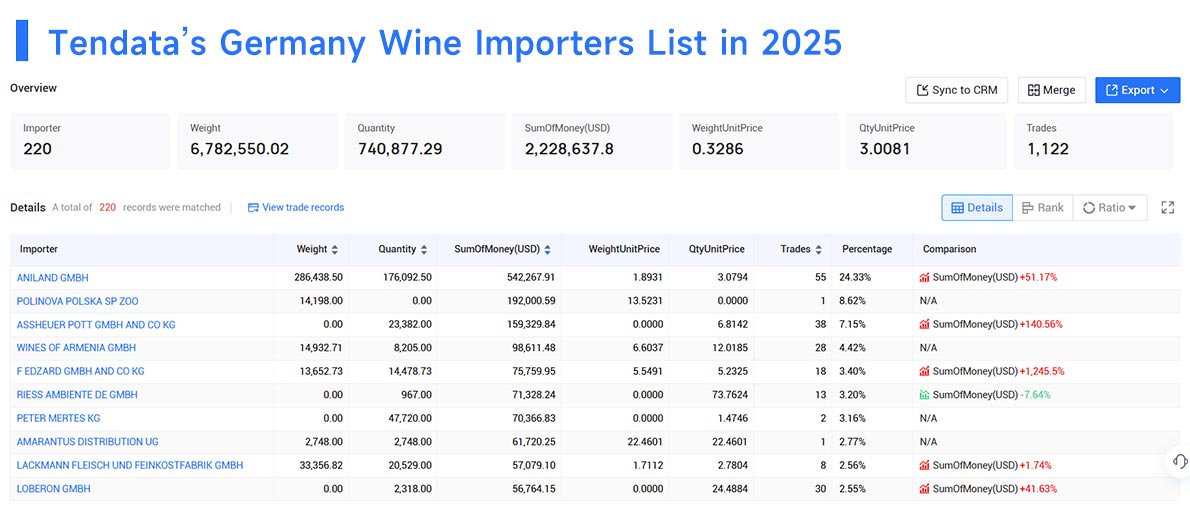
For instance, when studying wine demand in Germany, Tendata's system can instantly identify the top 10 buyers in the German market in 2025.
1.ANILAND GMBH (24.33%)
2.POLINOVA POLSKA SP ZOO (8.62%)
3.ASSHEUER POTT GMBH AND CO KG (7.15%)
4.WINES OF ARMENIA GMBH (4.42%)
5.F EDZARD GMBH AND CO KG (3.4%)
6.RIESS AMBIENTE DE GMBH (3.2%)
7.PETER MERTES KG (3.16%)
8.AMARANTUS DISTRIBUTION UG (2.77%)
9.LACKMANN FLEISCH UND FEINKOSTFABRIK GMBH (2.56%)
10.LOBERON GMBH (2.55%)
Whether you are an experienced trader or just entering international commerce, analyzing Germany's Import data can reveal significant opportunities. For further insights into Germany import statistics or trade data, you can contact Tendata to request a free online demonstration.
Category
Leave Message for Demo Request or Questions