
 Tendata AI
  Exhibition
 B2B Platforms
 Standalone Website
 Social Media
 Emails
 Import News
 2026-03-25
Keypoints
· The global citrus import market in 2025 remains active and widely distributed, with 10,959 importers across 105 countries, generating a total trade value of $1.41 billion from 125,655 transactions.
· Import demand is highly concentrated. Colombia, Ukraine, and Mexico together account for over 60% of total citrus imports, with Colombia alone contributing nearly 29% of global value.
· Mid-tier markets such as Brazil and India show stable and growing demand, while countries like Russia, Vietnam, and Peru represent diversified regional consumption.
· Product structure is led by mandarins and oranges, with HS codes such as 0805219000 and 0805501000 ranking highest, indicating strong global preference for easy-to-consume citrus varieties.

The global citrus import market plays a vital role in supporting food supply chains, retail distribution, and the fresh produce industry worldwide. From everyday fruits like oranges and mandarins to a wide range of specialty citrus varieties, citrus imports help balance seasonal gaps, meet consumer demand, and stabilize market supply across regions. Understanding the top citrus importing countries provides valuable insight into global demand patterns, sourcing strategies, and evolving trade dynamics.
This blog explores key citrus import markets based on global trade data, highlighting the top citrus importing countries, citrus importers, major HS codes, and other important trends shaping the international citrus trade.
Global Citrus Import Data: 2025 Overview
The global citrus import market in 2025 shows steady demand across a wide geographic base, supported by strong consumption in both developed and emerging economies. According to Tendata, a total of 10,959 importers were actively sourcing citrus products from 105 countries, reflecting a highly fragmented yet globally connected supply network. The total import value reached $1.41 billion, generated from 125,655 trade transactions, indicating frequent, small-to-medium volume shipments rather than highly concentrated bulk trades.
This structure suggests that the citrus import market is driven by consistent retail and distribution demand, especially in regions with limited domestic production. The relatively high number of transactions compared to total value also points to stable replenishment cycles and ongoing demand throughout the year. Overall, the citrus trade landscape in 2025 remains dynamic, with diversified sourcing channels and a broad base of active buyers shaping global import flows.
List of Major Citrus Importing HS Codes
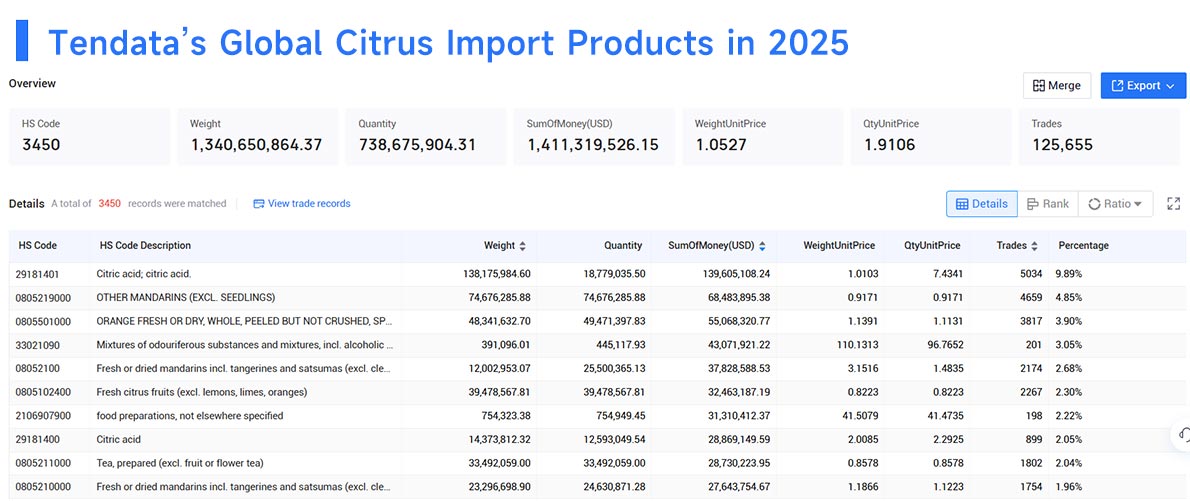
According to Tendata global trade data, here is the list of top citrus HS Codes in 2025:
1.HS Code:805219000(4.85%, $0.07 Billion):OTHER MANDARINS (EXCL. SEEDLINGS)
2.HS Code:805501000(3.9%, $0.06 Billion):ORANGE FRESH OR DRY, WHOLE, PEELED BUT NOT CRUSHED, SPLITTEN OR SLICED
3.HS Code:8052100(2.68%, $0.04 Billion):Fresh or dried mandarins incl. tangerines and satsumas (excl. clementines)
4.HS Code:805102400(2.3%, $0.03 Billion):Fresh citrus fruits (excl. lemons, limes, oranges)
5.HS Code:805210000(2.04%, $0.03 Billion):Fresh or dried mandarins incl. tangerines and satsumas (excl. clementines)
>>Get A Free Demo<<
Top Citrus Importing Countries
According to Tendata global trade data, below is the list of major citrus importing countries in 2025:
1.Colombia(28.94%, $408.44 Million)
2.Ukraine(21.66%, $305.64 Million)
3.Mexico(13%, $183.54 Million)
4.Brazil(8.97%, $126.55 Million)
5.India(5.39%, $76.09 Million)
6.Russia(3.66%, $51.7 Million)
7.Argentina(2.95%, $41.67 Million)
8.Vietnam(2.64%, $37.27 Million)
9.Peru(2.1%, $29.67 Million)
10.Kazakhstan(1.42%, $20.02 Million)
>>Get A Free Demo<<
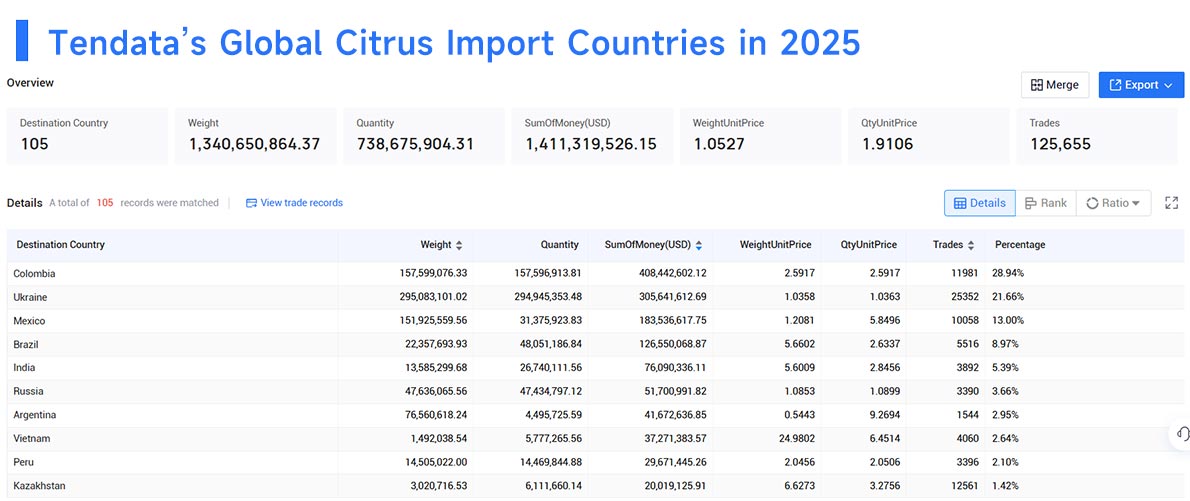
The global citrus import market in 2025 is notably concentrated among a group of high-demand countries, many of which rely on imports to balance seasonal supply gaps and domestic production limits. Based on Tendata, Colombia leads the global citrus import landscape, accounting for 28.94% of total imports, with a value of $408.44 million. It is followed by Ukraine (21.66%, $305.64 million) and Mexico (13%, $183.54 million), forming a strong top tier that together represents more than 60% of global import value.
A second tier of importers includes Brazil (8.97%) and India (5.39%), both large consumer markets where rising demand and processing needs continue to drive steady import volumes. Meanwhile, countries such as Russia, Argentina, Vietnam, Peru, and Kazakhstan contribute smaller yet stable shares, reflecting diversified regional demand across Eastern Europe, Latin America, and Asia.
This distribution highlights a key characteristic of the citrus trade: demand is geographically widespread but value is concentrated, with a few leading markets dominating global import flows. As global citrus production and trade continue to expand over time , these top importing countries play a critical role in shaping pricing trends, sourcing strategies, and supplier competition in the international citrus market.
Top Global Citrus Importers in 2025
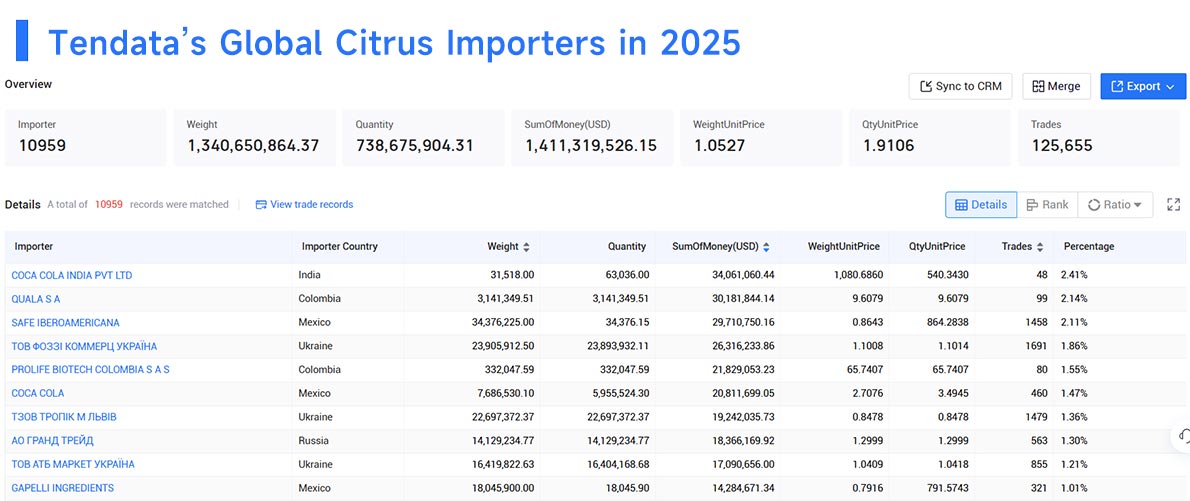
According to Tendata global trade data, here is the list of top citrus importers worldwide in 2025:
1.COCA COLA INDIA PVT LTD(2.41%, $34.06 Million)
2.QUALA S A(2.14%, $30.18 Million)
3.SAFE IBEROAMERICANA(2.11%, $29.71 Million)
4.ТОВ ФОЗЗІ КОММЕРЦ УКРАЇНА(1.86%, $26.32 Million)
5.PROLIFE BIOTECH COLOMBIA S A S(1.55%, $21.83 Million)
6.COCA COLA(1.47%, $20.81 Million)
7.ТЗОВ ТРОПІК М ЛЬВІВ(1.36%, $19.24 Million)
8.АО ГРАНД ТРЕЙД(1.3%, $18.37 Million)
9.ТОВ АТБ МАРКЕТ УКРАЇНА(1.21%, $17.09 Million)
10.GAPELLI INGREDIENTS(1.01%, $14.28 Million)
>>Get A Free Demo<<
How to Find Citrus Import Data with Tendata
Finding accurate and actionable citrus import data is essential if you want to identify real buyers and expand into global markets. Traditional methods—such as search engines or trade directories—often provide limited or outdated information. In contrast, platforms like Tendata give you access to real customs-based trade data and structured insights that reflect actual market activity.
With Tendata, you can analyze citrus import data across 228+ countries and over 10 billion trade records, covering detailed shipment information, buyer profiles, and supplier relationships . This allows you to go beyond surface-level research and understand how the market actually operates. For example, you can track import volume, transaction frequency, pricing trends, and sourcing countries, helping you identify high-demand markets and optimize your export strategy.
More importantly, Tendata enables you to directly find active citrus importers based on real purchasing behavior, not assumptions. You can see which companies are importing consistently, how often they buy, and who their current suppliers are. This makes it easier to target high-quality buyers and approach them at the right time.
In practice, using citrus import data through Tendata helps you move from broad market research to precise customer development. Instead of guessing where opportunities are, you can clearly identify who is buying, what they need, and when they are most likely to purchase, making your outreach more efficient and increasing your chances of closing deals.
Final Words
For exporters, success depends on moving beyond general market research. The real advantage lies in identifying who is actively buying, how often they purchase, and what products they focus on. By using tools like Tendata and using real trade data, businesses can pinpoint reliable citrus importers, track demand trends, and approach the right buyers with better timing.
In a market that is both competitive and data-driven, those who act on accurate insights will find it much easier to secure long-term customers and grow their global citrus trade.
FAQ
1. What is the current size of the global citrus import market?
In 2025, the global citrus import market reached approximately $1.41 billion, with 10,959 importers across 105 countries and over 125,000 trade transactions. This reflects steady global demand and frequent purchasing cycles.
2. Which countries import the most citrus products?
The top citrus importing countries include Colombia, Ukraine, and Mexico, which together account for more than 60% of total import value. Other important markets are Brazil, India, and Russia, showing consistent regional demand.
3. What are the most traded citrus products globally?
The market is mainly driven by mandarins and oranges. Key HS codes such as 0805219000 (other mandarins) and 0805501000 (fresh or dried oranges) rank among the top categories, indicating strong consumer preference for these products.
4. How can I find reliable citrus importers?
The most effective way is to use customs-based trade data platforms like Tendata. Instead of relying on outdated directories, you can access real shipment records to identify companies that are actively importing citrus products.
5. What insights can Tendata provide for citrus import analysis?
Tendata offers detailed data such as import volumes, transaction frequency, pricing trends, supplier relationships, and buyer activity. This helps you understand which markets are growing, who the key buyers are, and when they are most likely to purchase.
6. How does Tendata help improve export success?
By using Tendata, you can target high-quality buyers with proven purchasing history, track their sourcing patterns, and approach them at the right time. This reduces guesswork, improves conversion rates, and helps build long-term business relationships in the citrus trade.
Category
Leave Message for Demo Request or Questions