
 Tendata AI
  Exhibition
 B2B Platforms
 Standalone Website
 Social Media
 Emails
 Import News
 2026-03-27
Keypoints
· Strong Market Scale with High Liquidity
The global herb import market reached $5.54 billion in 2025, supported by 39,050 importers across 138 countries and over 1.11 million transactions. This reflects a highly active and liquid trade environment with frequent cross-border purchasing.
· Fragmented Buyer Structure with Broad Participation
Unlike highly concentrated industries, the herb import market is widely distributed among tens of thousands of buyers, indicating low entry barriers and continuous demand across multiple regions and industries.
· High Transaction Frequency, Small-Batch Trade Pattern
The large number of transactions relative to total value suggests that herb imports are typically conducted in smaller, high-frequency shipments, which is common for agricultural and perishable products requiring flexible sourcing.
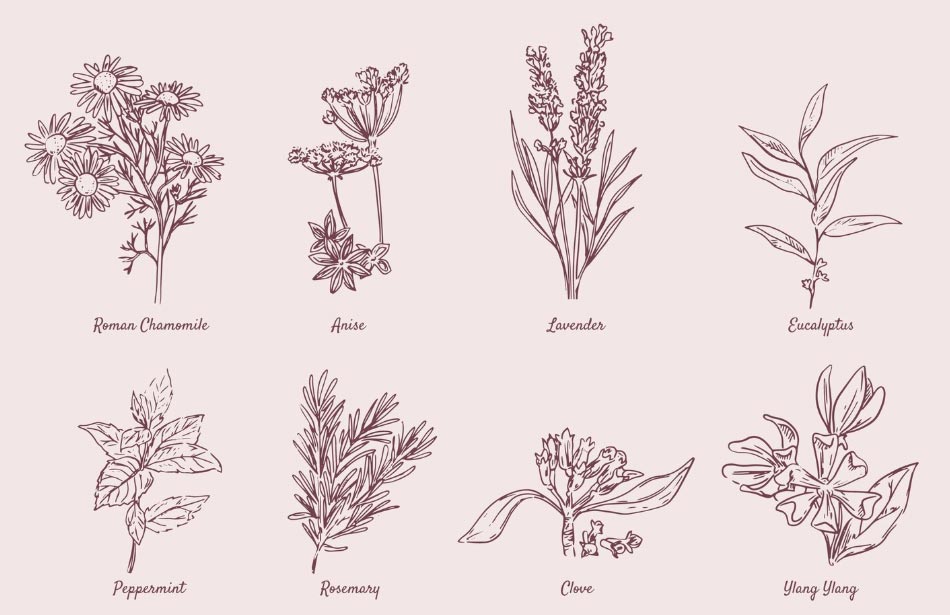
The global herb import market plays a vital role in supporting the food industry, healthcare, cosmetics, and nutraceutical sectors worldwide. From raw culinary herbs to high-value medicinal and functional plant ingredients, herb imports contribute significantly to global trade flows and supply chain stability. Understanding the top herb import countries provides valuable insight into consumption patterns, regional demand shifts, and evolving trade dynamics.
Global Herb Import Data: 2025 Overview
The global herb import market in 2025 demonstrates strong scale and high transaction frequency, reflecting its critical role in food, healthcare, and natural ingredient supply chains. According to Tendata trade data, the market includes 39,050 importers across 138 countries, generating a total import value of $5.54 billion from 1,110,554 transactions. This indicates a highly fragmented yet active trading environment, where demand is widely distributed across regions and supported by continuous cross-border procurement.
Top Herb Importing Countries
According to Tendata global trade data, below is the list of major Herb importing countries in 2025:
1.Kenya(56.62%,$3,135.87 million)
2.India(11.13%,$616.45 million)
3.Uruguay(6.00%,$332.29 million)
4.Democratic Republic of the Congo (5.29% ,$292.78 million)
5.Colombia (4.98%,$275.75 million)
6.Ukraine(2.46%,$136.08 million)
7.Vietnam(2.38%,$131.91 million)
8.Mexico(21.43%,$79.13 million)
9.Cameroon (21.35%,$74.87 million)
10,Brazil(1.15%,$63.85 million)
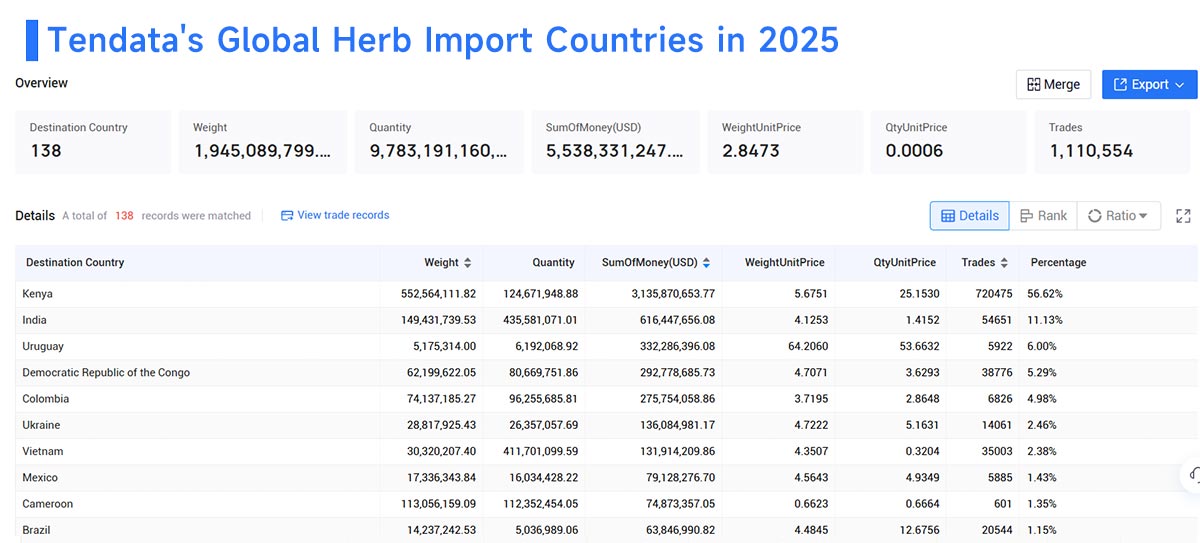
Similar to the structure used in “Top Chemical Exporting Countries in 2026”, the global herb import landscape shows a highly concentrated yet regionally diverse demand pattern driven by rising consumption of natural and plant-based products. According to Tendata trade data, Kenya dominates the global herb import market in 2025 with a substantial 56.62% share, reaching $3,135.87 million, far ahead of other countries. India ranks second with 11.13% ($616.45 million), followed by Uruguay (6.00%) and the Democratic Republic of the Congo (5.29%), highlighting strong demand across both Africa and South Asia. Emerging markets such as Colombia (4.98%), Ukraine (2.46%), and Vietnam (2.38%) are also becoming increasingly important import destinations. Meanwhile, countries like Mexico, Cameroon, and Brazil contribute smaller but notable shares, reflecting a broadening global demand base.
Top Global Herb Importers in 2025
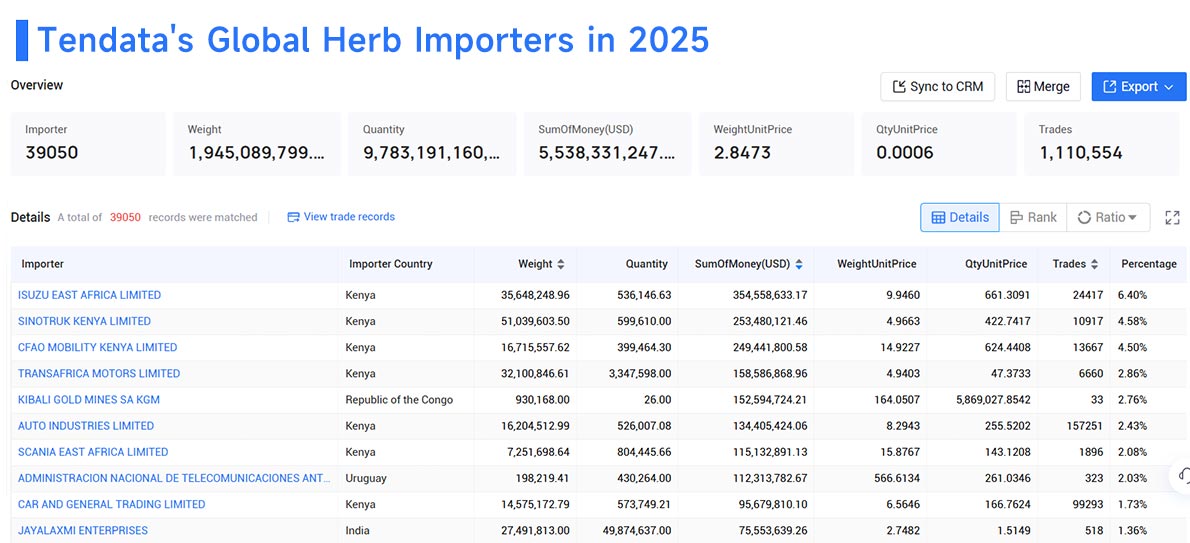
According to Tendata global trade data, here is the list of top Herb importers worldwide in 2025:
1.ISUZU EAST AFRICA LIMITED(6.40%,$354.56 million)
2.SINOTRUK KENYA LIMITED(4.58%,$253.48 million)
3.CFAO MOBILITY KENYA LIMITED(4.50%,$249.44 million)
4.TRANSAFRICA MOTORS LIMITED(2.86%,$158.59 million)
5.KIBALI GOLD MINES SA KGM(2.76%,$152.59 million)
6.AUTO INDUSTRIES LIMITED(2.43%,$134.41 million)
7.SCANIA EAST AFRICA LIMITED(2.08%,$115.13 million)
8.ADMINISTRACION NACIONAL DE TELECOMUNICACIONES ANTEL(2.03%,$112.31 million)
9.CAR AND GENERAL TRADING LIMITED (1.73%,$95.68 million)
10.JAYALAXMI ENTERPRISES(1.36%,$75.55 million)
How to Find Herb Import Data with Tendata?
Tendata provides a comprehensive solution for analyzing herb import data across 200+ countries and regions. Through its platform, users can quickly identify active herb importers, track shipment records, analyze purchasing frequency, and evaluate supplier relationships. Instead of relying on fragmented public sources, Tendata aggregates multi-country customs data into a unified system, allowing exporters to filter by HS code, country, company name, or product keywords.
More importantly, Tendata enables deeper insights beyond basic trade statistics. Users can uncover which companies are consistently importing herbs, their sourcing countries, transaction volumes, and buying cycles, helping sales teams prioritize high-potential leads. Combined with contact enrichment and CRM-style management features, it shortens the path from market research to actual customer acquisition.
In practice, this means businesses can move from “guessing buyers” to data-driven targeting, improving outreach efficiency and increasing conversion rates in the highly fragmented global herb import market.
FAQ
1. What is the current scale of the global herb import market?
The global herb import market is large and highly active. In 2025, it includes 39,050 importers across 138 countries, generating over $5.54 billion in total trade value and more than 1.11 million transactions. This reflects a fragmented but liquid market with continuous cross-border demand.
2. How does Tendata improve customer acquisition in the herb trade?
By turning raw trade data into actionable insights, Tendata helps exporters move from broad prospecting to precise, data-driven targeting. This reduces wasted outreach, shortens the sales cycle, and improves conversion rates in a competitive and fragmented herb import market.
Category
Leave Message for Demo Request or Questions