
 Tendata AI
  Exhibition
 B2B Platforms
 Standalone Website
 Social Media
 Emails
 Import News
 2026-03-30
Keypoints
· Moderate Market Size with Stable Demand
The global auto part import market in 2025 includes 1,532 importers across 61 countries, generating a total trade value of USD 988.01 million from 28,682 transactions. This reflects a stable and demand-driven market, supported by continuous vehicle production and aftermarket replacement needs.
· High Transaction Frequency Indicates Repeat Purchasing Behavior
With over 28,000 transactions, the auto part import market shows frequent procurement cycles, meaning buyers tend to purchase repeatedly rather than in one-off deals. This is a typical feature of industries tied to manufacturing and maintenance, where parts are continuously required.
· Diverse Product Structure Across Mechanical and Electronic Parts
Auto part imports cover a wide range of categories, from core mechanical components (e.g., gearboxes, structural parts) to electrical systems and wiring, reflecting the increasing complexity and electrification of modern vehicles.
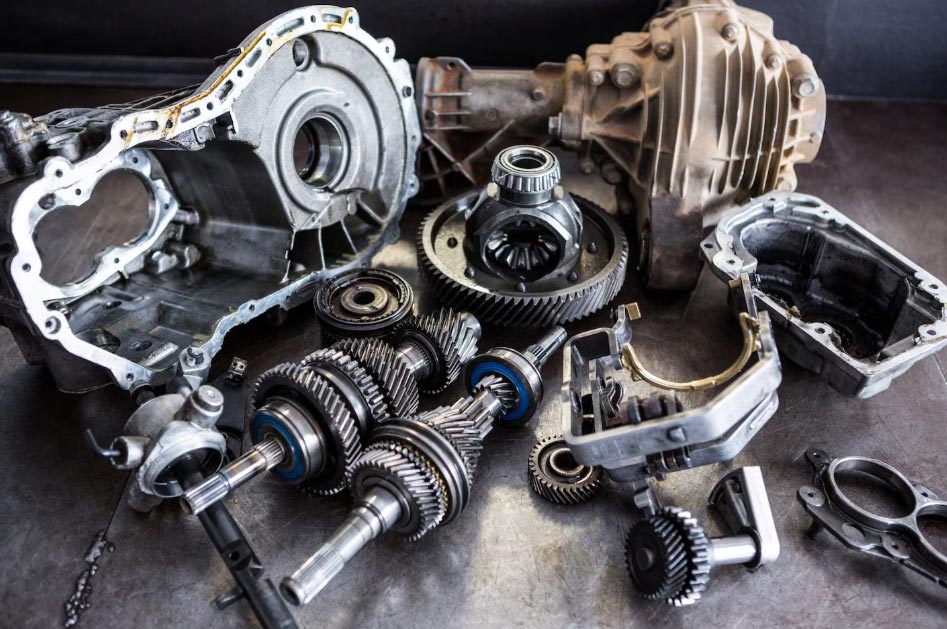
The global auto part import market plays a crucial role in supporting automotive manufacturing, aftermarket services, transportation systems, and industrial supply chains worldwide. From essential mechanical components such as engines, gearboxes, and structural parts to high-value electronic systems and smart vehicle technologies, auto parts imports are fundamental to keeping the global automotive ecosystem running efficiently. Understanding the top auto part importing countries provides valuable insight into global demand distribution, supply chain dependencies, and evolving trade dynamics. This blog explores the auto parts import market based on global trade data, highlighting key importing countries, major buyers, import data trends, relevant HS codes, and other critical market insights.
Overview of the Global Auto Part Import Market
The global auto parts import market remains a core pillar of international manufacturing supply chains, driven by the continuous expansion of automotive production, aftermarket demand, and cross-border sourcing.
According to the provided dataset, the auto parts import sector in 2025 includes 1,532 importers across 61 countries, generating a total trade value of USD 988.01 million from 28,682 transactions, indicating a moderately concentrated yet highly active trading network.
Global Auto Part Import Data: 2025 Analysis
Based on the provided dataset, the 2025 auto parts import landscape includes 1,532 importers across 61 countries, generating a total trade value of USD 988.01 million from 28,682 transactions. This indicates a moderately concentrated yet highly active trading network, where a relatively limited number of buyers drive frequent transactions. Such a pattern reflects consistent procurement cycles, especially in regions with established automotive assembly and repair ecosystems.
The auto parts import market is characterized by high transaction frequency, stable demand driven by aftermarket needs, and strong linkage to global manufacturing hubs. For exporters, this means that leveraging trade data is essential to identify active buyers, monitor purchasing cycles, and align supply strategies with real-time market demand.
List of Major Auto Part Importing HS Codes
1.HS Code:87080000(0.44%, $0.43 Billion):Parts and accessories of the motor vehicles of headings 87.01 to 87.13
2.HS Code:87084080(0.23%, $0.22 Billion):Gear boxes and parts thereof, for tractors, motor vehicles for the transport of ten or more persons, motor cars and other motor vehicles principally designed for the transport of persons, motor vehicles for the transport of goods and special purpose motor vehicles.
3.HS Code:85360000(0.04%, $0.04 Billion):Electrical apparatus for switching or protecting electrical circuits, or for making connections to or in electrical circuits (for example, switches, relays, fuses, surge protectors, plugs, sockets, lampholders and other connectors, junction boxes), n.e.s.
4.HS Code:84000000(0.03%, $0.03 Billion):Nuclear reactors, boilers, machines, devices and gear
5.HS Code:87084000(0.02%, $0.02 Billion):Gear boxes and parts thereof, for tractors, motor vehicles for the transport of ten or more persons, motor cars and other motor vehicles principally designed for the transport of persons, motor vehicles for the transport of goods and special purpose motor vehicles.
6.HS Code:87089990(0.02%, $0.02 Billion):Other parts and accessories of motor vehicles of headings 87.01 to 87.05 and 87.09 to 87.13; other parts and accessories of motor vehicles of subheading 8708.29; other parts and accessories of tractors, motor vehicles for the transport of ten or more persons, motor cars and other motor vehicles principally designed for the transport of persons, motor vehicles for the transport of goods and special purpose motor vehicles.
7.HS Code:87082900(0.02%, $0.01 Billion):Other parts and accessories of motor vehicles of headings 87.01 to 87.05 and 87.09 to 87.13; other parts and accessories of motor vehicles of subheading 8708.29; other parts and accessories of tractors, motor vehicles for the transport of ten or more persons, motor cars and other motor vehicles principally designed for the transport of persons, motor vehicles for the transport of goods and special purpose motor vehicles.
8.HS Code:85440000(0.01%, $0.01 Billion):Insulated winding wire; co-axial cable and other co-axial conductors whether or not fitted with connectors; optical fibre cables, made up of individually sheathed fibres, whether or not assembled with electric conductors or fitted with connectors
9.HS Code:87089400(0.01%, $0.01 Billion):Other parts and accessories of motor vehicles of headings 87.01 to 87.05 and 87.09 to 87.13; other parts and accessories of motor vehicles of subheading 8708.29; other parts and accessories of tractors, motor vehicles for the transport of ten or more persons, motor cars and other motor vehicles principally designed for the transport of persons, motor vehicles for the transport of goods and special purpose motor vehicles.
10.HS Code:84710000(0.01%, $0.01 Billion):Automatic data processing machines and units thereof; magnetic or optical readers, machines for transcribing data onto data media in coded form and machines for processing such data, n.e.s.
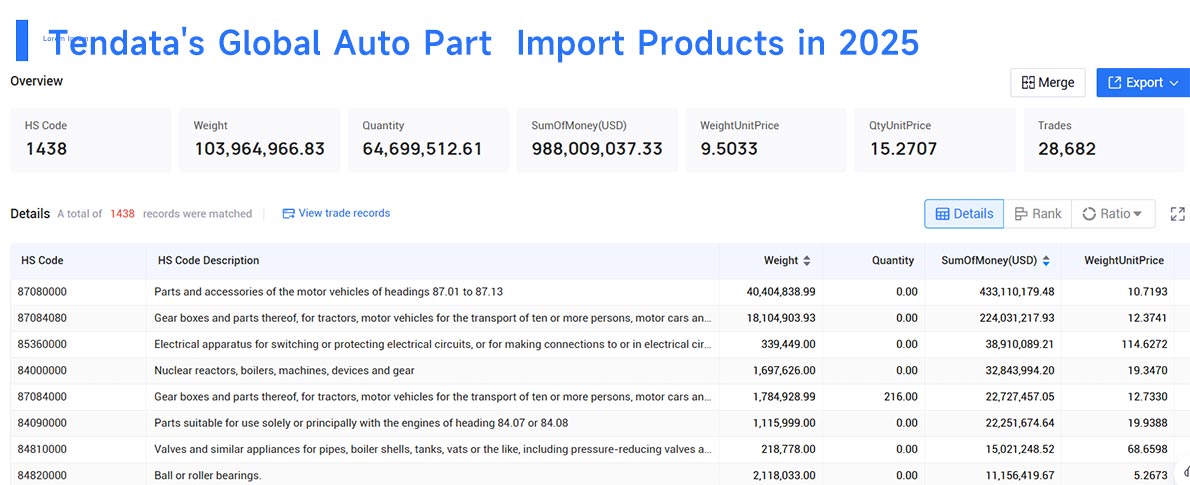
Understanding HS codes is essential for analyzing the structure of the global auto part import market, as they reveal how demand is distributed across different product categories within the automotive supply chain.
At the core of the market is HS Code 87080000, which accounts for 0.44% of total imports (USD 0.43 billion). This category covers a broad range of vehicle parts and accessories, making it the backbone of international auto parts import. Its dominance reflects the continuous need for replacement parts, OEM components, and aftermarket supply across global automotive markets.
Transmission-related components also play a critical role. HS Code 87084080 (USD 0.22 billion, 0.23%) and HS Code 87084000 (USD 0.02 billion) both focus on gearboxes and related parts, highlighting the importance of drivetrain systems in vehicle manufacturing and maintenance. These products are typically high-value and technologically complex, often sourced from specialized suppliers.
Electrical and electronic components are another key segment. HS Code 85360000 (USD 0.04 billion) includes circuit protection and connection devices such as relays, switches, and connectors, while HS Code 85440000 (USD 0.01 billion) covers automotive wiring and cable systems. Together, these categories reflect the increasing electrification of vehicles and the growing importance of electronic architecture in modern cars.
In addition, broader machinery and integrated systems are represented by HS Code 84000000 (USD 0.03 billion), indicating demand for complex mechanical assemblies used in automotive production environments. Meanwhile, categories like HS Code 87089990, 87082900, and 87089400 collectively capture specialized and miscellaneous vehicle parts, serving niche functions across braking, steering, and structural systems.
Finally, the presence of HS Code 84710000 (automatic data processing machines) signals the rising integration of digital and computing technologies in the automotive sector, particularly in diagnostics, smart systems, and vehicle electronics.
Overall, the HS code breakdown shows that the auto parts import market is highly diversified, spanning mechanical systems, electronic components, and digital technologies. This layered structure reflects the complexity of modern automotive supply chains and provides clear direction for exporters to target high-demand product categories with consistent global demand.
Top Auto Part Importing Countries
1.Brazil(95.99%,$948,377,126.07)
2.Ukraine(0.78%,$7,657,591.13)
3.Colombia(0.77%,$7,644,199.95)
4.India(0.73%,$7,166,393.76)
5.Peru(0.49% ,$4,883,717.65)
6.Pakistan(0.27% ,$2,621,561.57)
7.Indonesia(0.21%,$2,069,900.10)
8.Vietnam(0.13%, $1,324,885.04)
9.Kazakhstan(0.12%,$1,166,523.68)
10.Ecuador(0.11%,$1,096,767.08)
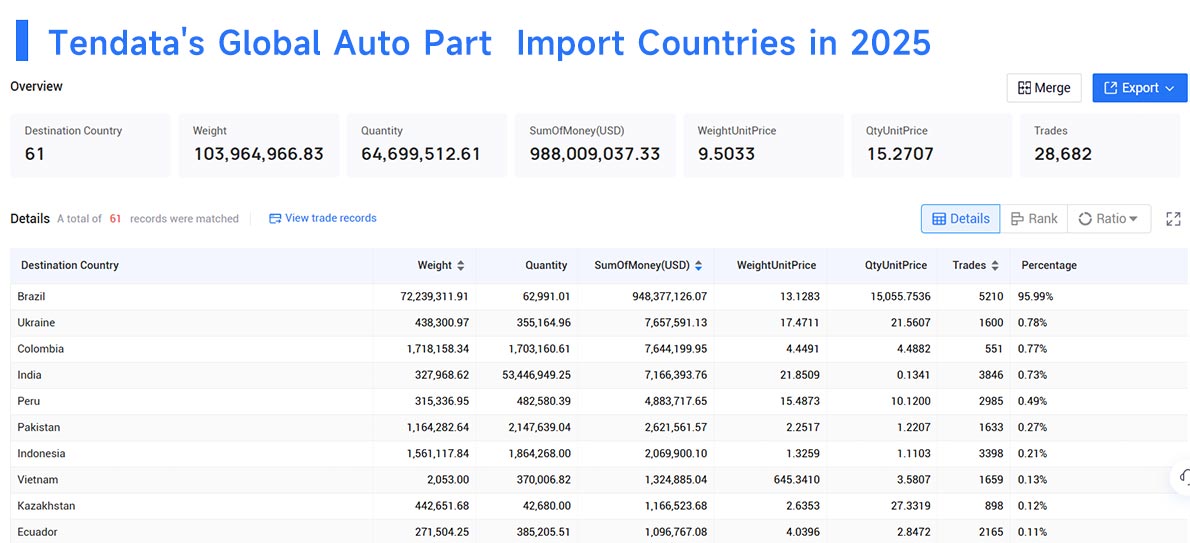
Brazil stands out as the overwhelming leader, contributing 95.99% of total imports, valued at $948.38 million. This reflects Brazil’s strong domestic automotive industry and its heavy reliance on imported components to support vehicle assembly, maintenance, and aftermarket services. The scale also indicates a centralized demand hub, where supply chains are deeply integrated with international suppliers.
Following Brazil, the market becomes significantly fragmented. Countries such as Ukraine (0.78%), Colombia (0.77%), and India (0.73%) form the second tier of importers, each with import values slightly above $7 million. These markets reflect emerging or recovering automotive sectors, where import demand is driven by infrastructure development, vehicle fleet expansion, and growing aftermarket needs.
Mid-tier importers including Peru, Pakistan, and Indonesia show steady but smaller demand, indicating localized supply chains with selective dependence on foreign auto components. Meanwhile, countries like Vietnam, Kazakhstan, and Ecuador represent niche markets with growing potential, often linked to industrialization and rising vehicle ownership.
Overall, the global auto parts import landscape is defined by extreme concentration at the top and long-tail demand across emerging markets, highlighting clear opportunities for exporters to prioritize high-volume destinations like Brazil while strategically developing smaller, high-growth markets.
Top Global Auto Part Importers in 2025
1.VOLKSWAGEN DO BRASIL S A(20.69%, $204.47 Million)
2.GENERAL MOTORS DO BRASIL LTDA(13.20%, $130.41 Million)
3.STELLANTIS AUTOMOVEIS BRASIL LTDA(7.82%, $77.27 Million)
4.VOLKSWAGEN DO BRASIL INDUSTRIA DE VEICULOS AUTOMOTORES LTDA(6.70%, $66.21 Million)
5.NISSAN COMERCIO REPRESENTACAO DE BIJUTERIAS LTDA(5.56%, $54.89 Million)
6.RENAULT COMERCIO DO VESTUARIO LTDA(5.18%, $51.18 Million)
7.JCB DO BRASIL LTDA(4.86%, $48.00 Million)
8.CH ROBINSON WORLDWIDE LOGISTICA DO BRASIL LTDA(4.68%, $46.20 Million)
9.MOBIS BRASIL FABRICACAO DE AUTO PECAS LTDA(3.35%, $33.11 Million)
10.SCHAEFFLER BRASIL LTDA(2.58%, $25.53 Million)
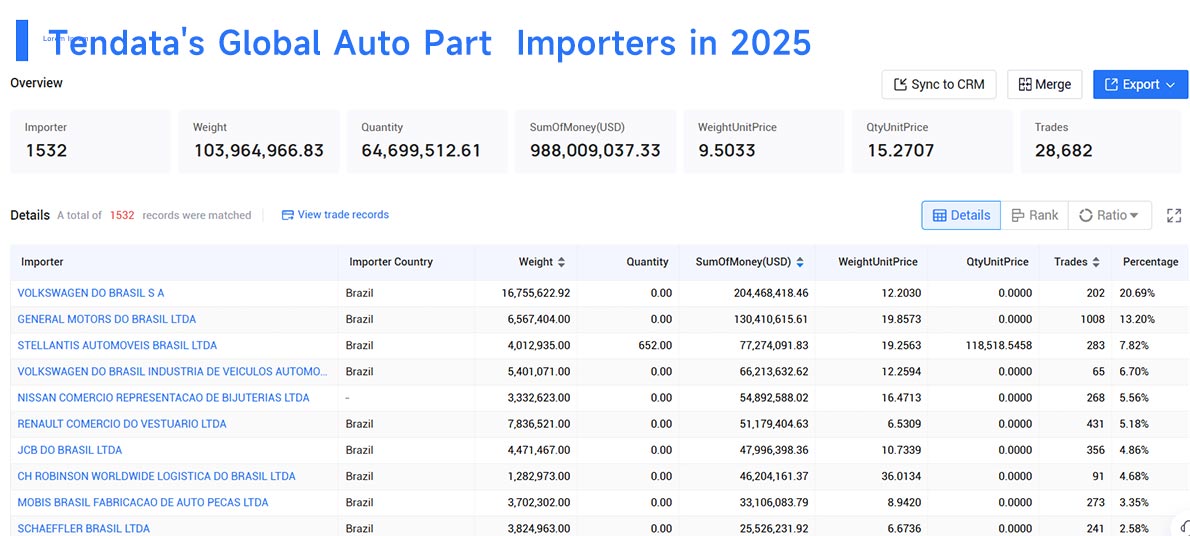
How to find Auto Parts Products Import Data?
To effectively analyze the auto part import market and identify real buyers, structured trade data platforms are essential. Similar to how chemical import data is accessed, the process typically starts with searching by product keywords or HS codes, such as HS 8708 (auto parts), to retrieve detailed shipment records. These records provide critical insights including importer names, shipment volumes, prices, origin countries, and transaction frequency, allowing exporters to understand who is buying, how often, and at what scale.
With platforms like Tendata, this process becomes more advanced and actionable. Instead of just raw data, Tendata integrates multi-country customs data across 200+ markets.
More importantly, Tendata allows users to filter buyers based on criteria such as recent activity (e.g., last 3–12 months imports), purchase volume, and product specifications, helping exporters avoid inactive or low-quality leads.
In practice, this means you can move from simply “finding import data” to pinpointing high-probability buyers and building a targeted sales pipeline. For companies in the auto parts industry, leveraging such trade data is no longer optional—it is a critical step to improve conversion rates, reduce blind prospecting, and scale efficiently in global markets.
Final Words
The global auto part import market demonstrates a stable yet highly structured trade landscape, supported by 1,532 importers across 61 countries, with a total value of USD 988.01 million generated from 28,682 transactions. This reflects a market driven by consistent demand from automotive production, maintenance, and aftermarket replacement cycles. At the same time, the strong concentration in key importing countries highlights the importance of focusing on high-volume markets while also exploring emerging regions with growth potential.
From HS code analysis to country-level demand distribution, the data clearly shows that the auto parts import industry is deeply integrated into global supply chains, where purchasing behavior is frequent, repeat-driven, and closely tied to industrial activity. For exporters, success in this market depends on accurately identifying active buyers, understanding procurement cycles, and aligning product offerings with real demand.
FAQ
Q1: What is auto part import data and why is it important?
Auto part import data refers to detailed records of cross-border transactions of automotive components, typically organized by HS codes, countries, and time periods. It helps businesses track market demand, pricing trends, and buyer activity, making it a critical tool for global trade analysis and decision-making.
Which HS codes are commonly used in auto part imports?
Most auto parts fall under HS Code 8708, covering parts and accessories of motor vehicles. Additional related codes include gearboxes, electrical components, and wiring systems. Correct HS classification is essential because it determines tariffs, compliance requirements, and trade statistics accuracy.
How can I find reliable auto parts importers?
You can identify reliable buyers by analyzing shipment-level data such as import frequency, purchase volume, and supplier relationships. Consistent import activity over recent months (e.g., 3–12 months) is a strong indicator of active and trustworthy buyers. Trade data platforms make it easier to filter and validate these importers efficiently.
Category
Leave Message for Demo Request or Questions