
 Tendata AI
  Exhibition
 B2B Platforms
 Standalone Website
 Social Media
 Emails
 Import News
 2026-03-31
Keypoints
·Large-Scale Market with Strong Trade Liquidity
The global import coffee beans market reached $1.35 billion in 2025, supported by 3,303 importers across 99 countries and over 60,000 transactions, indicating a highly active and liquid trade environment with frequent procurement cycles.
·Strong Growth Driven by Global Consumption
Coffee remains one of the most widely consumed beverages globally, with the market valued at approximately $249 billion in 2025 and continuing to grow steadily . This sustained demand directly drives expansion in the import coffee beans trade.
·Highly Concentrated Product Structure (Green Coffee Dominance)
More than 50% of imports are concentrated in unroasted, non-decaffeinated coffee categories (e.g., HS Code 0901 series), showing that import coffee beans trade is primarily focused on upstream raw materials rather than finished products.
·Asia as the Core Demand Hub
Major importing countries such as India and Vietnam together account for nearly 70% of total imports, highlighting Asia as the primary growth engine in the import coffee beans market due to rising consumption and processing demand.
Overview of the Global Coffee Beans Import Market
This article provides a data-driven overview of the global import coffee beans market in 2025, analyzing key importing countries, major HS code structures, and overall market dynamics. Based on Tendata trade data, it highlights Asia’s dominance, the concentration in green coffee bean imports, and the role of emerging markets in shaping future demand. The article also explores how businesses can use import coffee beans data to identify real buyers, understand procurement patterns, and develop targeted market strategies—making it a practical guide for exporters seeking growth in the global coffee trade.

Global Coffee Beans Import Data: 2025 Analysis
The global import coffee beans market in 2025 demonstrates a robust and highly active trade structure, supported by rising global consumption and expanding processing demand. According to Tendata global trade data, the market includes 3,303 importers across 99 destination countries, generating a total trade value of $1.35 billion from 60,173 transactions. This reflects a highly liquid market with frequent trade flows and strong buyer participation across multiple regions.
The relatively high number of transactions indicates that the import coffee beans market is characterized by continuous procurement cycles, diversified buyers, and stable supply chain movement. At the same time, the wide coverage of 99 destination countries suggests a globally distributed demand network, with both mature markets and emerging economies contributing to growth.
List of Major Coffee Beans Importing HS Codes
According to Tendata global trade data, here is the list of top coffee beans HS Codes in 2025
1.HS Code:9011130(30.79%, $0.42 Billion):Coffee (excluding roasted and decaffeinated)
2.HS Code:9011190(20.88%, $0.28 Billion):Coffee, other, neither roasted nor decaffeinated
3.HS Code:9011149(7.81%, $0.11 Billion):Coffee (excluding roasted and decaffeinated); Coffee, Robusta, other
4.HS Code:9011120(6.88%, $0.09 Billion):Coffee, not roasted, not decaffeinated
5.HS Code:9011139(3.91%, $0.05 Billion):Coffee (excluding roasted and decaffeinated); Coffee, Robusta, parchment
6.HS Code:9011129(1.08%, $0.01 Billion):Coffee (excluding roasted and decaffeinated); Coffee, Arabica, Cherry
7.HS Code:9011119(0.58%, $0.01 Billion):Coffee, whether ground or in green coffee form; roasted coffee substitutes
8.HS Code:9011100(0.47%, $0.01 Billion):Coffee, not roasted or decaffeinated (HS Code: 0901.10)
9.HS Code:9011200(0.36%, $0.00 Billion):Decaffeinated coffee (excluding roasted)
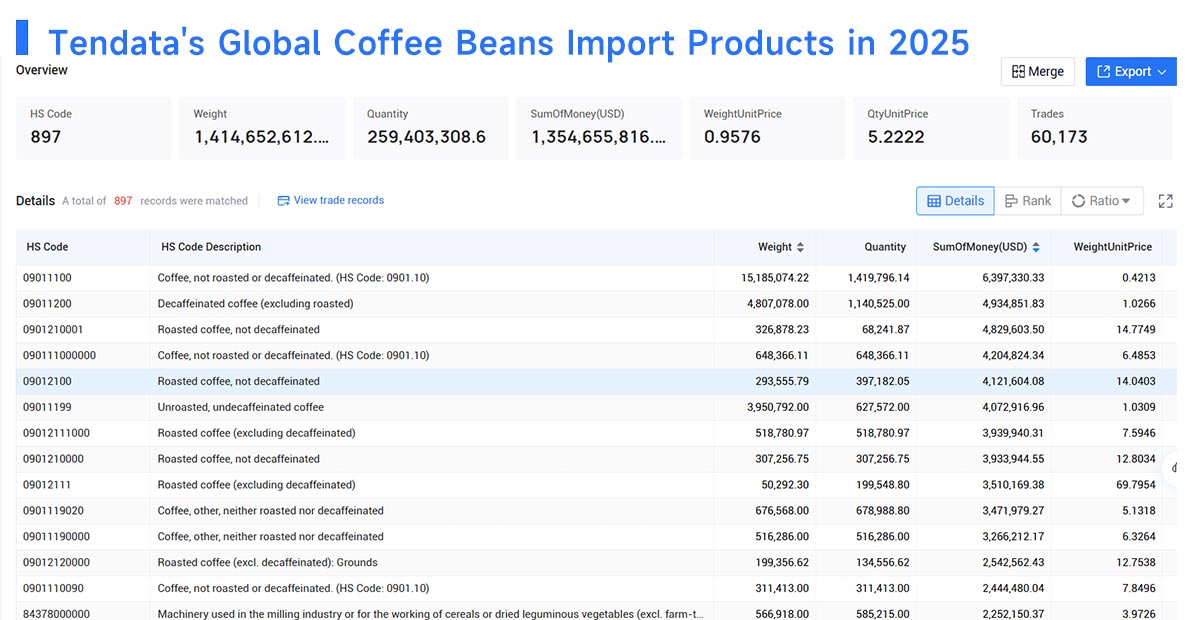
The global import coffee beans market in 2025 is strongly defined by a concentrated HS code structure, with the majority of trade focused on unroasted and non-decaffeinated coffee categories. According to Tendata global trade data, HS Code 9011130 (30.79%, $0.42 billion) and HS Code 9011190 (20.88%, $0.28 billion) together account for over 50% of total imports, highlighting that green coffee beans remain the dominant traded form, primarily used for roasting and further processing in destination markets.
In addition, Robusta-related categories such as HS Code 9011149 and 9011139 contribute a significant share, reflecting strong demand for cost-effective coffee used in instant coffee and mass-market blends. Meanwhile, niche segments like Arabica cherry (HS Code 9011129) and decaffeinated coffee (HS Code 9011200) hold relatively smaller shares but indicate diversification in consumer preferences and product offerings.
Top Coffee Beans Importing Countries
According to Tendata global trade data, below is the list of major coffee beans importing countries in 2025:
1.India(35.55%, $481.62 Million)
2.Vietnam(34.15%, $462.62 Million)
3.Philippines(11.15%, $151.06 Million)
4.Russia(5.28%, $71.47 Million)
5.Indonesia(4.59%, $62.14 Million)
6.Malaysia(1.88%, $25.41 Million)
7.Brazil(1.80%, $24.36 Million)
8.Ukraine(1.27%, $17.25 Million)
9.Armenia(0.92%, $12.46 Million)
10.Kazakhstan(0.47%, $6.37 Million)
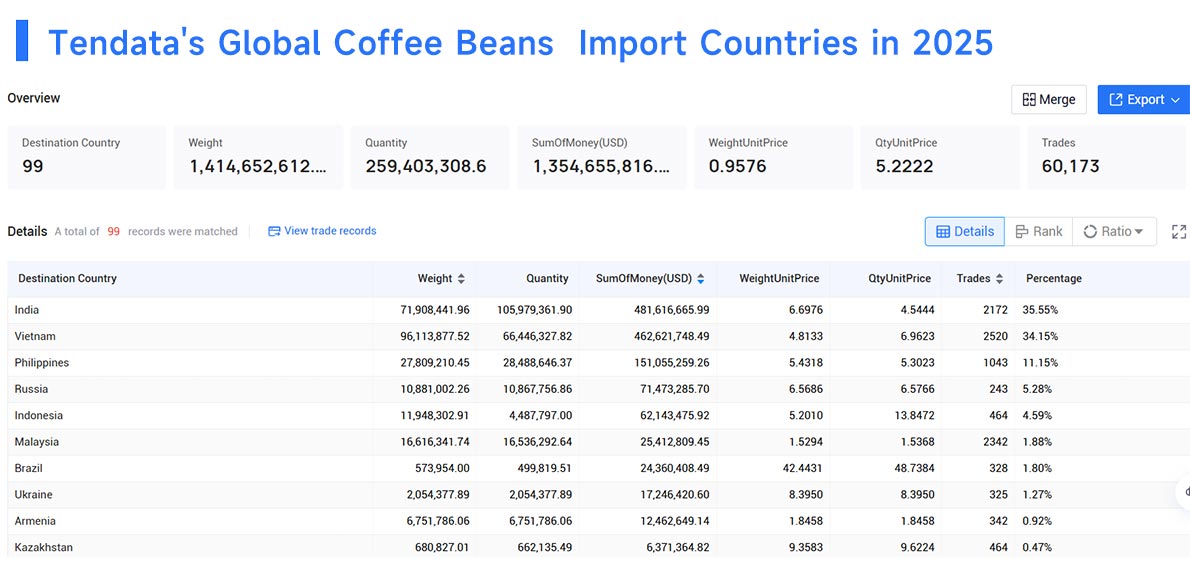
The global import coffee beans market in 2025 reflects a highly concentrated demand structure, increasingly driven by rapid consumption growth across Asia and emerging markets. According to Tendata global trade data, India leads global imports with a 35.55% share ($481.62 million), closely followed by Vietnam at 34.15% ($462.62 million), together accounting for nearly 70% of total imports. This highlights Asia as the core demand center, supported by rising coffee consumption, expanding café culture, and downstream processing industries.
Other key importing countries such as the Philippines, Russia, and Indonesia further reinforce the regional clustering trend, while markets like Malaysia and Brazil maintain stable but smaller shares. Emerging economies including Ukraine, Armenia, and Kazakhstan demonstrate growing participation, indicating new opportunities in developing regions.
This structure aligns with broader global coffee trends, where consumption continues to expand alongside a market expected to exceed $249 billion in 2025, driven by lifestyle changes and increasing demand for specialty coffee . At the same time, Asia’s coffee demand has been rising steadily, reshaping global trade flows and shifting the center of gravity toward emerging markets.
Top Global Coffee Beans Importers in 2025
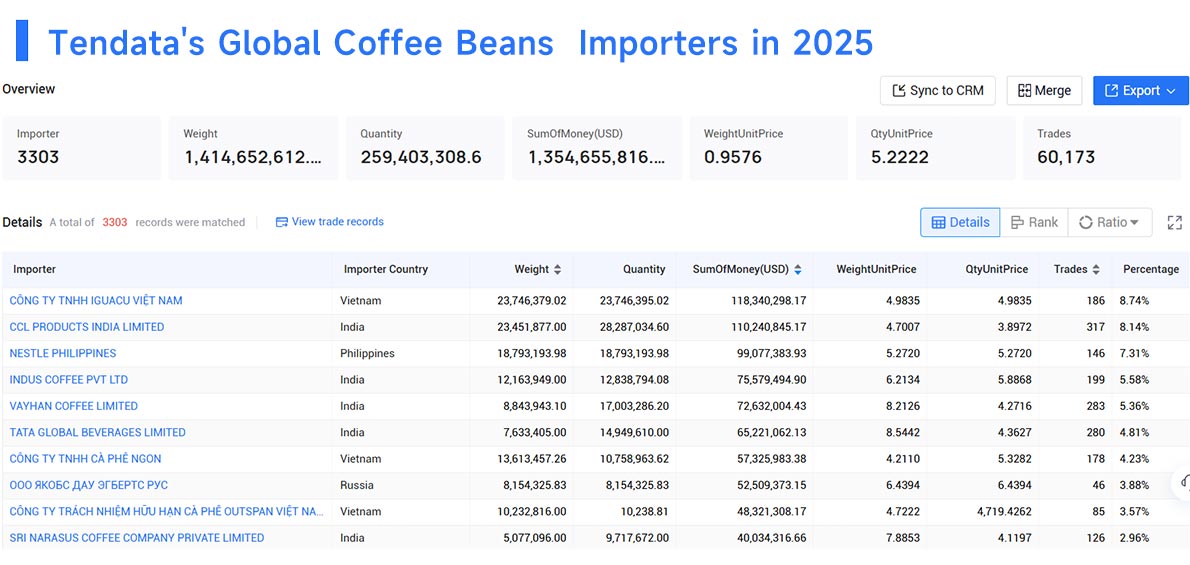
According to Tendata global trade data, here is the list of top coffee beans importers worldwide in 2025:
1.CÔNG TY TNHH IGUACU VIỆT NAM(8.74%, $118.34 Million)
2.CCL PRODUCTS INDIA LIMITED(8.14%, $110.24 Million)
3.NESTLE PHILIPPINES(7.31%, $99.08 Million)
4.INDUS COFFEE PVT LTD(5.58%, $75.58 Million)
5.VAYHAN COFFEE LIMITED(5.36%, $72.63 Million)
6.TATA GLOBAL BEVERAGES LIMITED(4.81%, $65.22 Million)
7.CÔNG TY TNHH CÀ PHÊ NGON(4.23%, $57.33 Million)
8.OOO ЯКОБС ДАУ ЭГБЕРТС РУС(3.88%, $52.51 Million)
9.CÔNG TY TRÁCH NHIỆM HỮU HẠN CÀ PHÊ OUTSPAN VIỆT NAM(3.57%, $48.32 Million)
10.SRI NARASUS COFFEE COMPANY PRIVATE LIMITED(2.96%, $40.03 Million)
How to find Coffee Beans Products Import Data?
To effectively analyze the global import coffee beans market, businesses must rely on standardized HS code systems and comprehensive trade data platforms. In international trade, coffee products are primarily classified under HS Code 0901, which covers coffee “whether or not roasted or decaffeinated,” including green beans, roasted coffee, and related products . This standardized classification is essential for tracking global trade flows, comparing markets, and identifying demand patterns across countries.
To obtain accurate import coffee beans data, companies can use official customs databases or advanced trade intelligence platforms. While public sources provide aggregated statistics, platforms like Tendata offer deeper insights by integrating multi-country customs records, shipment-level details, and company information. With Tendata, users can search by HS code (e.g., 0901) or keywords to quickly identify active importers, analyze transaction frequency, and track pricing and sourcing trends.
More importantly, Tendata transforms raw import coffee beans data into actionable intelligence. It allows businesses to uncover real buyers, monitor competitors, and understand procurement cycles across different markets. By combining trade data with company profiles and contact information, Tendata enables exporters to move beyond basic data lookup and build precise, data-driven market entry and customer acquisition strategies in the global coffee industry.
Final Words
Strong demand from Asia and emerging markets, combined with high-frequency trading activity and diversified buyer structures, highlights the dynamic nature of the import coffee beans landscape. However, factors such as price volatility, supply risks, and climate challenges are also reshaping global trade patterns, making market intelligence more important than ever.
For businesses, the key takeaway is clear: success in the import coffee beans market depends on a data-driven approach. Using platforms like Tendata to identify real buyers, track procurement cycles, and monitor shifting demand trends enables companies to transform raw trade data into actionable strategies—ultimately securing long-term growth in an increasingly competitive global coffee industry.
FAQ
1.How does Tendata help analyze import coffee beans markets?
Tendata integrates multi-country customs data and provides shipment-level insights for import coffee beans, enabling users to quickly identify top importing countries, analyze transaction volumes (over 60,000 trades), and understand buyer distribution across nearly 100 markets. This transforms raw trade data into clear, actionable insights.
2.Can Tendata help find real coffee importers?
Yes. Tendata connects import coffee beans shipment data with detailed company profiles and contact information, allowing exporters to identify active buyers, track their purchasing frequency, and directly reach decision-makers—significantly improving lead generation efficiency.
3.Why is trade data important in the import coffee beans business?
The import coffee beans market is highly competitive and driven by frequent procurement cycles. Using data tools like Tendata helps businesses monitor demand trends, evaluate market entry opportunities, and build targeted strategies—turning fragmented trade data into scalable global growth.
Category
Leave Message for Demo Request or Questions