
 Tendata AI
  Exhibition
 B2B Platforms
 Standalone Website
 Social Media
 Emails
 Import News
 2026-04-07
Keypoints
·Large and fragmented importer base: With 42,961 active importers and 891,757 transactions, China auto imports demonstrate a highly decentralized structure, where demand is spread across thousands of buyers rather than concentrated among a few dominant players.
·Broad global trade coverage: Imports span 113 destination countries, indicating that China auto imports maintain strong global integration and diversified sourcing channels across multiple regions.
·Shift toward high-value and technology-driven imports: Despite lower volumes, total import value remains significant (over $8.41 billion in the dataset), showing that China auto imports are increasingly focused on premium vehicles, electric systems, and advanced automotive components.

The global tissue import market plays a vital role in supporting hygiene, healthcare, hospitality, and consumer goods industries across the world. From basic household tissue products to higher-value processed paper goods, tissue import flows are essential for maintaining stable supply chains and meeting growing consumption demand. Understanding tissue import patterns provides valuable insight into global demand distribution, sourcing strategies, and evolving trade dynamics. At the same time, similar to analyzing China auto imports, examining detailed trade data allows businesses to uncover real buyer activity, shipment frequency, and market opportunities. This analysis explores key tissue import trends based on global trade data, highlighting major importing countries, active buyers, HS Code structures, and other critical insights shaping the global tissue import market.
China Auto Imports Data: 2025 Overview
he global landscape of China auto imports reflects a dynamic and evolving automotive trade ecosystem, shaped by both domestic industrial upgrades and shifting global demand. According to Tendata-based trade data, the China auto imports market involves approximately 42,961 active importers, covering 113 destination countries, with a total trade value reaching $8.41 billion across 891,757 transactions. This indicates a highly active and fragmented import structure, where frequent shipments and diversified buyers play a critical role in sustaining market flow.
From a structural perspective, China auto imports are no longer driven by volume alone but increasingly by high-value components and specialized automotive products, including power electronics, converters, and advanced materials. This aligns with broader industry trends, where China’s automotive sector is transitioning toward technology-intensive development, supported by strong domestic production capabilities and innovation.
List of Major China Auto Importng HS Codes
According to Tendata global trade data, here is the list of top auto HS Codes in 2025:
1.HS Code:39199090(12.58%, $1058.20 Million):Self-adhesive tapes/plates/strips of plastic (other than cellophane), in rolls, n.e.s.
2.HS Code:85044090(8.98%, $755.41 Million):STATIC CONVERTERS: OTHERS (EXCL. THOSE FOR A.V. RECEIVERS)
3.HS Code:39191090(3.42%, $287.59 Million):POLYMERIC SELF-ADHESIVE PLATES, SHEETS, FILM, FOIL, TAPE, STRIPS AND OTHER FLAT FORMS, IN ROLLS WITH A WIDTH OF NO MORE THAN 20 CM
4.HS Code:84864000(2.66%, $224.18 Million):Machines and apparatus specified in Note 9 to chapter 84
5.HS Code:85044010(2.63%, $221.62 Million):Electric inverters (excl. those for motor speed regulation)
6.HS Code:98016022(2.50%, $209.94 Million):Motor vehicles for the transport of persons, value ≥ $15,000,000, excluding subheading 9801.90; ikd
7.HS Code:85044021(2.24%, $188.61 Million):Static converters: DC bridge rectifiers
9.HS Code:39199010(2.20%, $185.15 Million):Self-adhesive plastic plates/sheets/film/tape/strip >20 cm wide; plastic stickers
9.HS Code:87038018(2.08%, $174.87 Million):Motor cars and other motor vehicles principally designed for the transport of persons
10.HS Code:85044029(2.05%, $172.08 Million):Static converters: other rectifiers (excl. electric traction)
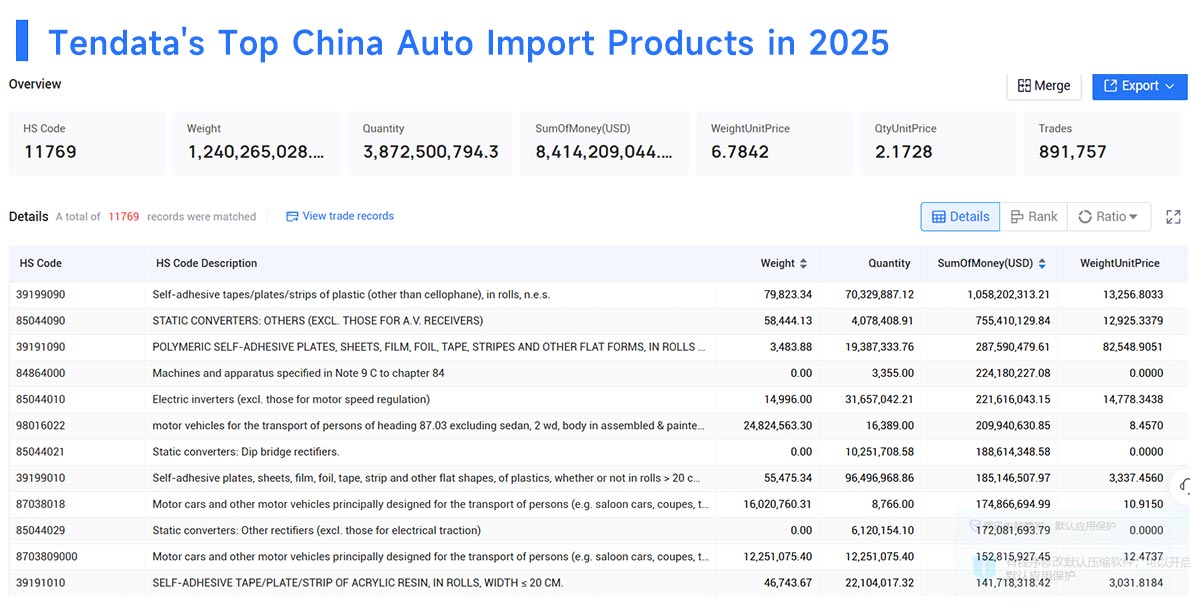
According to Tendata and global trade data insights, China auto imports reflect a highly structured and value-driven market, where demand is concentrated in high-end vehicles, specialized automotive components, and advanced electronic systems. In 2024, China imported approximately $38.3 billion worth of cars, highlighting its continued reliance on premium foreign brands despite strong domestic production capacity . Meanwhile, import volumes have shown a long-term decline—from over 1.2 million units in 2017 to around 700,000 units in 2024—indicating a shift toward localized manufacturing and supply chain optimization .
From an HS code perspective, the structure of China Auto Imorts is not limited to complete vehicles (HS Code 8703), but increasingly includes high-value supporting products such as static converters (HS 850440), electric inverters, and self-adhesive polymer materials used in automotive manufacturing. This reflects a broader industry trend: China is transitioning from a traditional vehicle importer to a technology-driven automotive ecosystem, where imports are focused on core components, luxury segments, and cutting-edge technologies.
Top China Auto Importng Countries
According to Tendata global trade data, below is the list of major auto importing countries of destination in 2025:
1.Brazil(51.11%, $4300.34 Million)
2.India(13.36%, $1123.84 Million)
3.Indonesia(6.64%, $558.45 Million)
4.Vietnam(4.59%, $386.56 Million)
5.Colombia(3.59%, $302.28 Million)
6.Ukraine(2.73%, $230.12 Million)
7.Uzbekistan(2.72%, $228.72 Million)
8.Kazakhstan(2.19%, $184.06 Million)
9.Pakistan(1.79%, $150.23 Million)
10.Panama(1.43%, $120.42 Million)
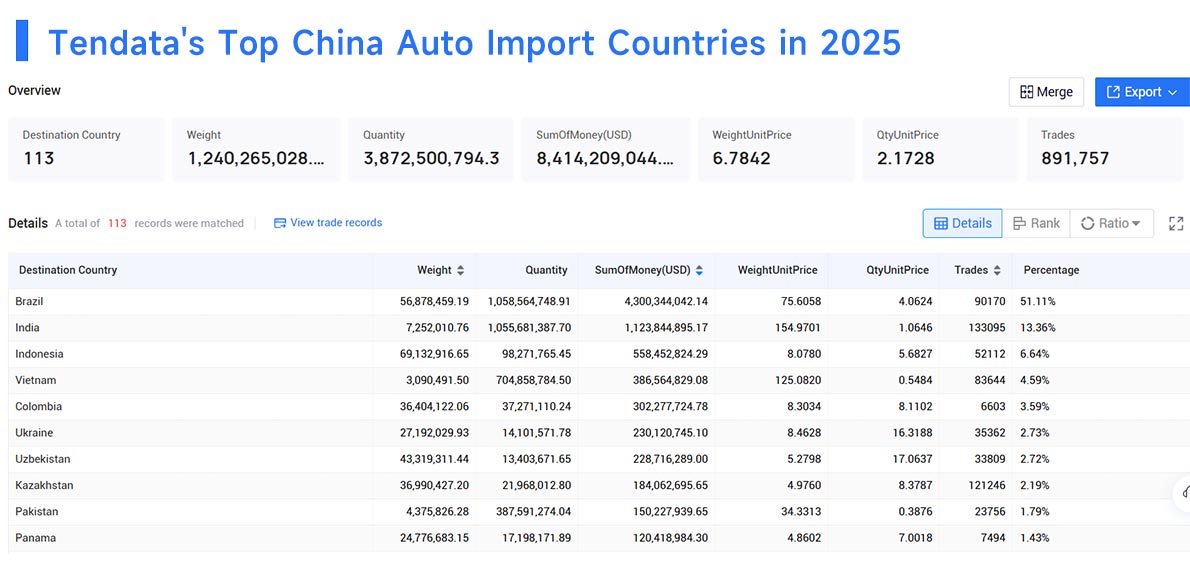
In terms of destination distribution, China Auto Imorting demand is heavily concentrated in emerging and developing markets, with Brazil (51.11%), India (13.36%), and Indonesia (6.64%) leading as the top import destinations. These markets collectively account for the majority share, highlighting strong demand from Latin America and South & Southeast Asia. Secondary markets such as Vietnam, Colombia, and Ukraine further reflect diversified geographic penetration, while countries like Kazakhstan, Pakistan, and Kenya indicate growing automotive demand in frontier markets.
From a global trade perspective, the structure of China Auto Imorts aligns with broader industry trends: while China’s domestic automotive production continues to dominate, imports are increasingly focused on high-value vehicles and advanced components, including electric systems and power electronics. At the same time, overall vehicle imports into China have declined significantly—falling to around 480,000 units in 2025, continuing a multi-year downward trend —as domestic brands and EV manufacturers rapidly gain competitiveness.
Top China Auto Importers in 2025
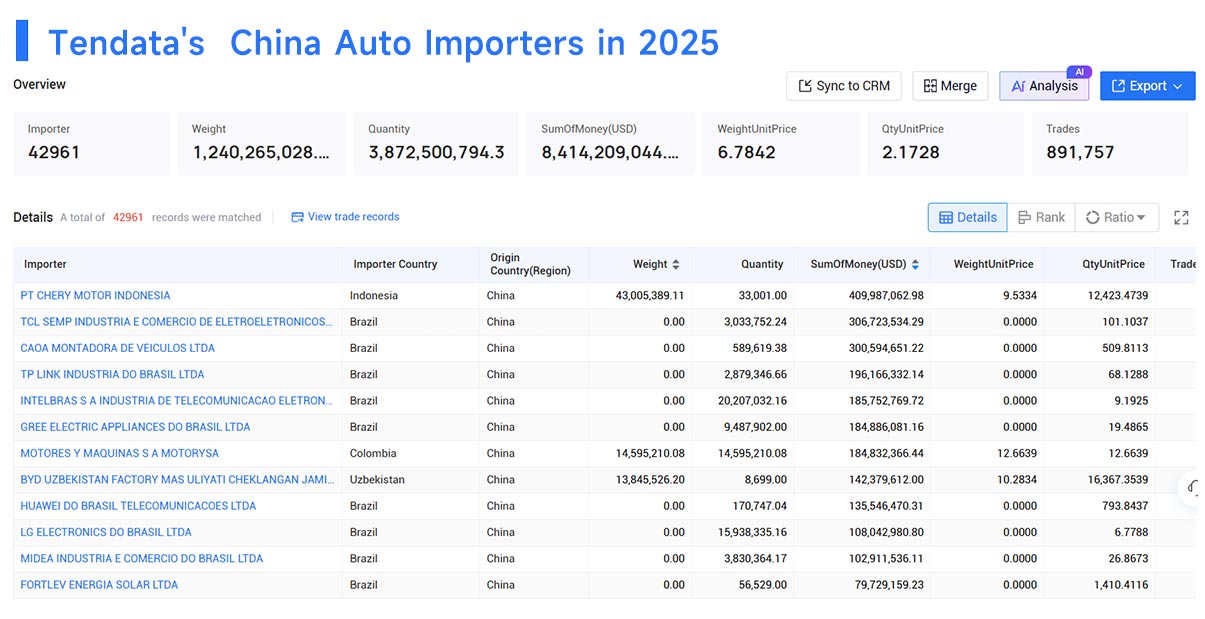
According to Tendata global trade data, here is the list of top auto importers worldwide in 2025:
1.PT CHERY MOTOR INDONESIA(4.87%, $409.99 Million)
2.TCL SEMP INDUSTRIA E COMERCIO DE ELETROELETRONICOS S A(3.65%, $306.72 Million)
3.CAOA MONTADORA DE VEICULOS LTDA(3.57%, $300.59 Million)
4.TP LINK INDUSTRIA DO BRASIL LTDA(2.33%, $196.17 Million)
5.INTELBRAS S A INDUSTRIA DE TELECOMUNICACAO ELETRONICA(2.21%, $185.75 Million)
6.GREE ELECTRIC APPLIANCES DO BRASIL LTDA(2.20%, $184.89 Million)
7.MOTORES Y MAQUINAS S A MOTORYSA(2.20%, $184.83 Million)
8.BYD UZBEKISTAN FACTORY MAS ULIYATI CHEKLANGAN JAMIYATI(1.69%, $142.38 Million)
9.HUAWEI DO BRASIL TELECOMUNICACOES LTDA(1.61%, $135.55 Million)
10.LG ELECTRONICS DO BRASIL LTDA(1.28%, $108.04 Million)
How to Find China Auto Imports Data with Tendata?
To effectively analyze China auto imports, traditional research methods such as search engines or B2B platforms are no longer sufficient, as they often provide fragmented and surface-level insights. Instead, businesses need access to real, transaction-based data to understand what is truly happening behind China auo imported flows—who is buying, what products are moving, at what price, and through which supply chains.
This is where Tendata becomes essential. Tendata integrates global customs data, port data, and logistics records to provide a complete and verified view of China auto imports, including key fields such as importer names, HS codes, shipment values, trade frequency, and supplier relationships. Through its platform, users can simply input automotive-related keywords or HS codes (such as 8703 or 850440) to track real import trends, identify active buyers, and uncover high-value opportunities in the market.
More importantly, Tendata enables businesses to go beyond basic statistics by offering deep insights into buyer behavior, such as procurement cycles, long-term sourcing patterns, and decision-maker contacts. This allows exporters to accurately target real buyers behind China auo imported transactions, rather than relying on guesswork or low-quality leads.
Final Words
In conclusion, the evolution of China auto imports reflects a clear structural transformation within the global automotive trade landscape. While China remains one of the world’s largest automotive markets, its reliance on imported vehicles is steadily declining, with total imports dropping to around 480,000 units in 2025, marking a significant year-on-year decrease . At the same time, import value remains substantial—reaching approximately $38.3 billion—indicating that China auto importing is increasingly focused on high-end vehicles, advanced components, and technology-intensive products rather than volume-driven demand .
Against this backdrop, data-driven tools like Tendata play a critical role in helping businesses decode the real dynamics behind China auto imports. By integrating multi-source customs data, shipment records, and supply chain intelligence, Tendata enables companies to move beyond macro-level trends and access granular insights such as importer activity, procurement frequency, pricing patterns, and supplier networks. This allows exporters to precisely identify high-value buyers and align their strategies with actual China auto importing demand.
Ultimately, as China continues to shift from an import-driven market to a production- and export-led automotive powerhouse, success in this space depends on precision targeting rather than broad market entry.Using platforms like Tendata ensures that businesses can track real transactions, validate demand, and capture opportunities within the increasingly sophisticated and competitive ecosystem of China auto imports.
FAQ:Insight into China Auto Imports
1.How can I find reliable and detailed data on China auto imports?
To accurately analyze China auto imports, relying on general statistics or public customs summaries is often insufficient. These sources usually lack critical details such as importer names, transaction prices, and shipment frequency. Platforms like Tendata solve this problem by aggregating real customs records and bill of lading data, allowing users to access verified, transaction-level insights including buyers, suppliers, HS codes, and trade values.
2.What kind of insights can Tendata provide for China auto imports?
Tendata enables businesses to go beyond basic trade volumes and understand the full structure of China auto imports, including who is importing, what products are being traded, and how often transactions occur. Users can analyze procurement cycles, pricing trends, and supplier networks, helping identify high-frequency buyers and real market demand rather than relying on assumptions.
3.How does Tendata help identify real buyers in China auto imports?
Through advanced data cleaning and integration, Tendata consolidates fragmented company names and links them to complete trade histories. This allows users to pinpoint active importers behind China auto imports, track their sourcing behavior, and even access decision-maker contact information—significantly improving lead quality and conversion rates.
4.Why is Tendata important for businesses targeting China auto imports?
As the automotive market becomes more complex and data-driven, success depends on precision. Tendata provides coverage across 228+ countries and multi-source datasets, helping businesses monitor market trends, evaluate competitors, and discover new opportunities in China auto imports. This transforms traditional market research into a data-backed strategy, enabling faster and more accurate decision-making.
5. Can Tendata support long-term strategy planning for China auto imports?
Yes. By analyzing historical and real-time trade data, Tendata allows companies to forecast demand trends, optimize pricing strategies, and identify emerging markets. This makes it a critical tool not only for short-term customer acquisition but also for building sustainable strategies around China auto imports in an increasingly competitive global automotive ecosystem.
Category
Leave Message for Demo Request or Questions