
 Tendata AI
  Exhibition
 B2B Platforms
 Standalone Website
 Social Media
 Emails
 Import News
 2026-04-07
Keypoints
· The global coffee market remains highly active, as coffee is one of the most widely traded agricultural commodities worldwide, supporting millions of livelihoods and driving strong international demand . This makes analyzing coffee imports by country essential for identifying high-growth markets and stable demand hubs.
· Coffee imports by country show a clear concentration pattern, with Mexico, Vietnam, and Colombia leading global imports, while emerging markets in Asia and Eastern Europe are steadily increasing their share. This indicates a shift toward more diversified demand beyond traditional consuming regions.
· The dominance of unroasted coffee HS codes highlights that global trade is still largely driven by raw material imports, while processed coffee products (such as extracts and concentrates) are gradually expanding, reflecting value-added opportunities in downstream markets.

The global coffee trade plays a vital role in supporting agriculture, foodservice, retail, and beverage industries across the world. From unroasted green beans to high-value roasted and processed coffee products, coffee imports drive international trade flows and consumption patterns in both developed and emerging markets. Understanding coffee imports by country provides valuable insight into global demand distribution, sourcing strategies, and shifting trade dynamics. This blog explores key coffee importing markets based on global trade data, highlighting major importing countries, coffee consumption trends, import data analysis, key HS Codes, and other critical developments shaping the global coffee industry.
Data Overview of Global Coffee Imports by Country
The global coffee trade plays a vital role in supporting agriculture, retail, foodservice, and beverage industries worldwide. As one of the most widely traded tropical commodities, coffee imports are essential for meeting consumption demand in non-producing regions, particularly in Europe, North America, and emerging Asian markets. Understanding coffee imports by country provides valuable insight into global demand patterns, sourcing strategies, and evolving trade dynamics.
Based on trade intelligence data, the global coffee import market shows strong scale and participation. There are 56,477 importers engaged in cross-border coffee trade across 163 destination countries, generating a total import value of $11.71 billion and 1,067,351 trade transactions. This reflects a highly fragmented yet active market structure, where demand is concentrated in major consuming economies such as the United States, Germany, and Italy, which together account for a significant share of global imports .
At the same time, global coffee imports are influenced by supply volatility, pricing fluctuations, and shifting sourcing patterns. In 2025, factors such as climate impacts, production changes in key exporting countries like Brazil and Vietnam, and rising consumption in Asia are reshaping coffee imports by country, making trade flows more dynamic and competitive.
List of Major Coffee Importing HS Codes
According to Tendata global trade data, here is the list of top coffee HS Codes in 2025:
1.HS Code:9011100000(11.47%, $1344.02 Million):Coffee, not roasted or decaffeinated. (HS Code: 0901.10)
2.HS Code:98020022(8.15%, $954.53 Million):COFFEE
3.HS Code:9011100(6.35%, $743.91 Million):Coffee, not roasted or decaffeinated. (HS Code: 0901.10)
4.HS Code:9011130(4.79%, $561.10 Million):Coffee (excluding roasted and decaffeinated)
5.HS Code:9011199(4.07%, $476.92 Million):Unroasted, undecaffeinated coffee
6.HS Code:9011190(2.56%, $300.19 Million):Coffee, other, neither roasted nor decaffeinated
7.HS Code:9011120(2.26%, $265.27 Million):COFFEE, NOT ROASTED, NOT DECAFFEINATED
8.HS Code:901113000(1.99%, $232.81 Million):Coffee (excluding roasted and decaffeinated)
9.HS Code:901119000(1.98%, $232.27 Million):Coffee, other, neither roasted nor decaffeinated
10.HS Code:21011199(1.95%, $228.29 Million):COFFEE-BASED EXTRACTS, ESSENCES AND CONCENTRATES; OTHERS
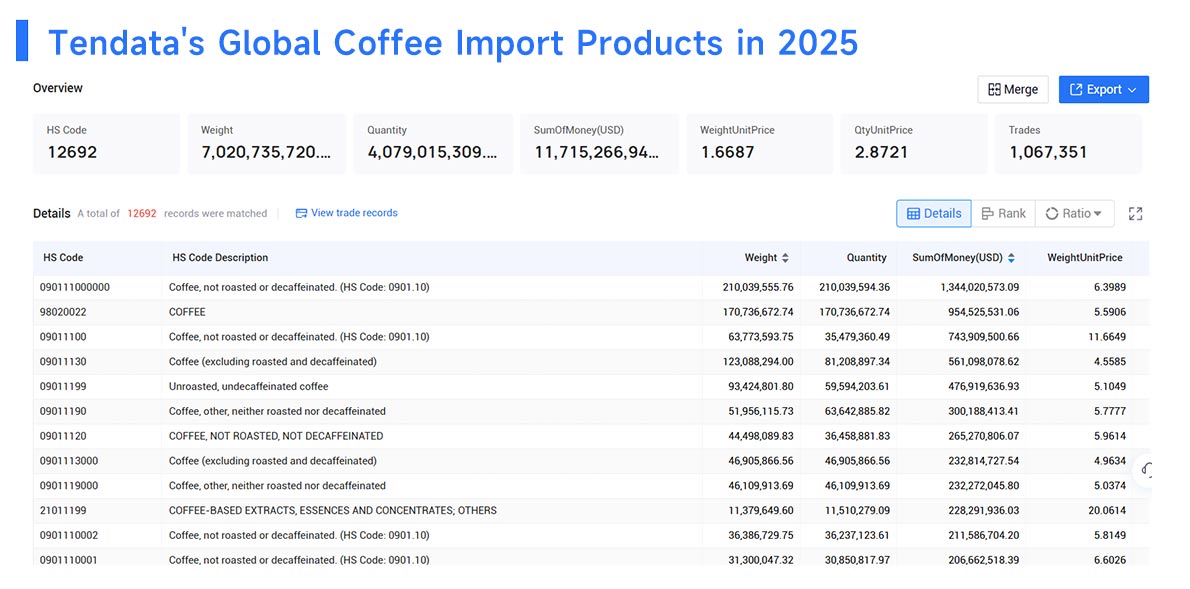
According to Tendata global trade data, the structure of coffee imports by country in 2025 is highly concentrated around a few core HS codes, primarily dominated by unroasted and non-decaffeinated coffee products. HS Code 9011100000 alone accounts for 11.47% ($1344.02 Million) of total import value, making it the most significant category in global coffee trade. This is followed by general coffee classifications such as 98020022 (8.15%, $954.53 Million) and multiple subcategories under unroasted coffee, including 9011100 and 9011130, which further reinforce the dominance of raw coffee beans in international supply chains.
In addition, mid-tier HS codes like 9011199, 9011190, and 9011120 highlight the diversity within unroasted coffee imports, covering variations in processing and classification across different markets. Meanwhile, value-added segments such as 21011199 (coffee-based extracts, essences, and concentrates), contributing 1.95% ($228.29 Million), indicate a growing demand for processed coffee products, especially in developed consumer markets.
Top Coffee Importing by Country
According to Tendata global trade data, below is the list of major coffee importing countries in 2025:
1.Mexico (18.10%, $2119.91 Million)
2.Vietnam (9.35%, $1095.30 Million)
3.Colombia (7.60%, $890.72 Million)
4.Turkey (7.41%, $868.26 Million)
5.India (6.32%, $740.42 Million)
6.Belgium (5.78%, $676.98 Million)
7.Russia (5.52%, $646.65 Million)
8.Philippines (5.44%, $636.85 Million)
9.Ukraine (5.24%, $613.47 Million)
10.Malaysia (5.20%, $608.85 Million)
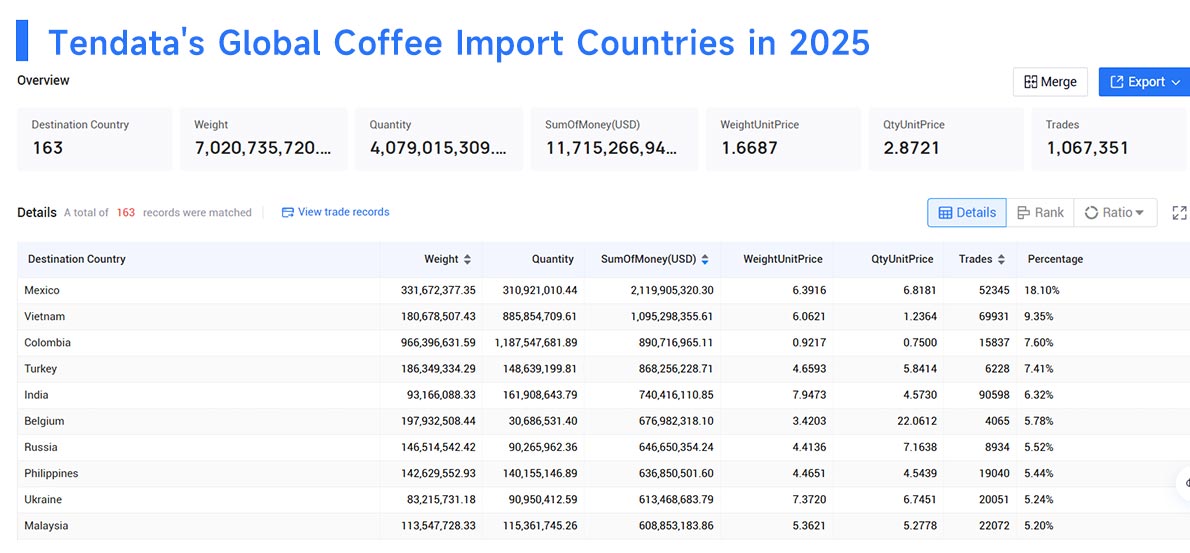
According to Tendata global trade data, the landscape of coffee imports by country in 2025 highlights a diverse mix of emerging and established markets driving global demand. Mexico ranks as the leading importer, accounting for 18.10% ($2,119.91 Million) of total imports, reflecting its strong domestic consumption and processing demand. It is followed by Vietnam (9.35%, $1,095.30 Million) and Colombia (7.60%, $890.72 Million), both of which are also major coffee producers, indicating active intra-industry trade and re-export dynamics.
Other key players in coffee importing by country include Turkey (7.41%), India (6.32%), and Belgium (5.78%), each serving as important regional distribution and consumption hubs. Meanwhile, countries such as Russia, the Philippines, Ukraine, and Malaysia contribute steadily to global import volumes, showing rising consumption trends in Eastern Europe and Southeast Asia.
Top Global Coffee Importers in 2025
According to Tendata global trade data, here is the list of top coffee importers worldwide in 2025:
1.NESTLE (5.37%, $629.29 Million)
2.TOP OF THE CROP NV (4.37%, $512.34 Million)
3.EXPORTADORA CAFE CALIFORNIA (2.44%, $285.52 Million)
4.NESTLE BRASIL LTDA (2.02%, $236.61 Million)
5.DESCAFEINADORES MEXICANOS (1.39%, $163.40 Million)
6.CAFIVER (1.34%, $157.50 Million)
7.COMERCIALIZADORA MEXICO AMERICANA (1.34%, $156.48 Million)
8.PURE AFRICA GREEN COFFEE BV NE (1.24%, $145.38 Million)
9.NESTLE PHILIPPINES (1.21%, $141.33 Million)
10.CCL PRODUCTS INDIA LIMITED (1.17%, $136.84 Million)
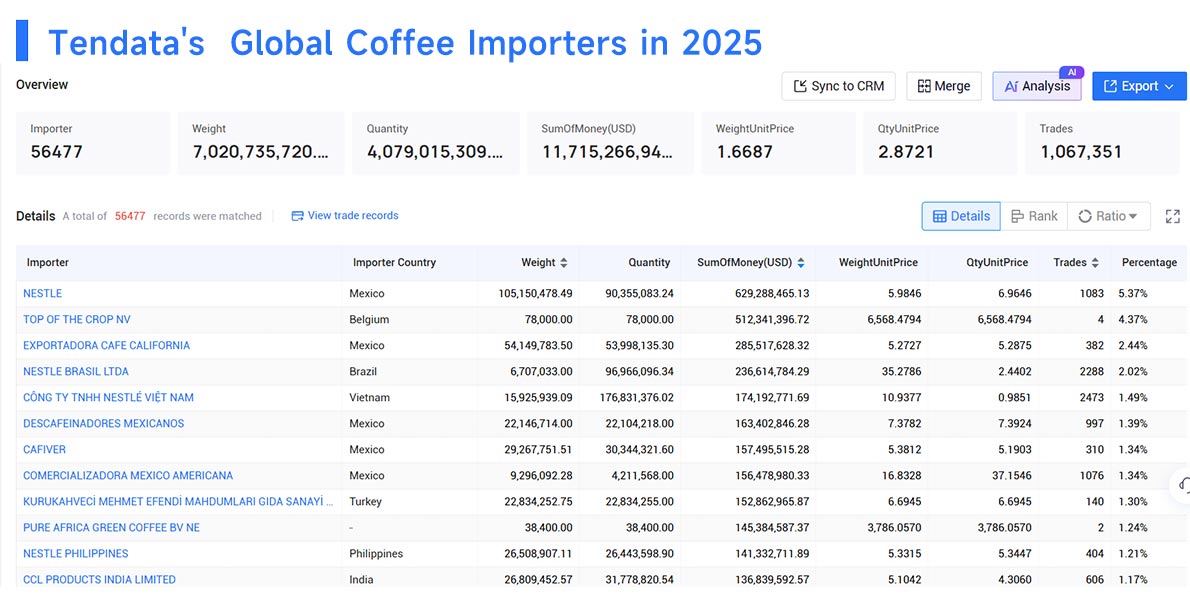
How to Find Coffee Import Data with Tendata?
Understanding how to access accurate and actionable trade intelligence is critical for businesses navigating the global coffee market. As coffee remains one of the most widely traded agricultural commodities worldwide, with steadily growing demand across major consuming regions and emerging markets , analyzing coffee imports by country has become essential for identifying real buyers, tracking demand shifts, and optimizing export strategies.
With Tendata, companies can efficiently obtain comprehensive coffee import data through an integrated big data platform. By simply selecting relevant HS codes (such as 0901 and 2101), users can access detailed insights including importer names, transaction values, trade frequency, and supply chain relationships across 200+ countries and regions. This enables exporters to move beyond surface-level statistics and directly identify active buyers who have maintained consistent purchasing behavior over the past 12 months.
More importantly, Tendata allows businesses to analyze coffee imports by country at a granular level—revealing which markets are expanding, which buyers are increasing procurement, and how pricing trends evolve over time. At the same time, its AI-powered tools help interpret coffee importing by country patterns, uncovering hidden opportunities such as re-export hubs, emerging consumption markets in Asia, and shifts caused by supply disruptions or price volatility.
By taking Tendata’s data-driven insights, companies can reduce blind prospecting, improve customer targeting accuracy, and build more effective market entry strategies—turning global coffee trade data into a practical growth engine for international business expansion.
Final Words
In conclusion, the global coffee trade continues to evolve as demand expands across both traditional and emerging markets, making the analysis of coffee imported by country increasingly important for exporters and market strategists. As one of the most widely traded agricultural commodities, coffee remains a core component of international trade, supported by growing global consumption and rising demand in Asia and developing regions .
From the data above, it is clear that coffee imports are not only concentrated in major consuming economies but are also spreading across diverse markets, with strong participation from both producing and non-producing countries. This dynamic structure highlights the need for precise, real-time insights to identify high-potential buyers, understand sourcing patterns, and track price fluctuations across regions.
Tendata plays a critical role in this process by transforming complex trade flows into actionable intelligence. Through its comprehensive database, businesses can analyze coffee imports by country at both macro and micro levels—identifying top importing markets, monitoring active buyers, and uncovering supply chain relationships. At the same time, Tendata enables deeper analysis of coffee imported by country, helping companies detect emerging demand trends, evaluate buyer reliability, and refine market entry strategies.
Ultimately, in an increasingly competitive and data-driven global market, leveraging tools like Tendata allows exporters to move beyond guesswork, improve targeting efficiency, and convert trade data into measurable business growth.
FAQ
1.How can I find reliable coffee import data and identify real buyers?
Accessing accurate and actionable data on coffee imports by country and coffee importing by country is essential for businesses looking to expand in the global coffee market. Coffee is one of the most widely traded agricultural commodities worldwide, with strong and growing demand driven by consumption in non-producing countries and emerging markets . However, publicly available data is often fragmented, delayed, or limited to high-level statistics, making it difficult to identify real buyers and market opportunities.
Tendata solves this problem by providing a comprehensive global trade database that integrates customs data, shipment records, and company-level insights. With Tendata, users can easily analyze coffee imports by country, including detailed metrics such as importer names, transaction values, purchase frequency, and supplier relationships. This allows businesses to go beyond basic market research and directly identify active buyers who are consistently importing coffee.
In addition, Tendata enables deeper analysis of coffee importing by country, helping companies track demand trends, monitor competitor activity, and uncover high-potential markets. By filtering data based on HS codes like 0901 (coffee beans) and 2101 (coffee extracts), exporters can pinpoint exactly who is buying, how much they are purchasing, and when they are likely to reorder.
In short, instead of relying on outdated or generalized reports, Tendata empowers businesses with real-time, data-driven insights—turning global coffee import data into a practical tool for precise customer acquisition and market expansion.
Category
Leave Message for Demo Request or Questions