
 Tendata AI
  Exhibition
 B2B Platforms
 Standalone Website
 Social Media
 Emails
 Import News
 2026-04-07
Keypoints
· The global beef trade continues to expand, with strong demand driven by population growth and protein consumption, supporting steady growth in beef imports by country across both developed and emerging markets
· Major importing regions are becoming more diversified, with countries in Latin America and Southeast Asia playing an increasingly important role in beef importing by country, reflecting shifting consumption patterns and supply gaps
· Fresh and frozen boneless beef (HS Codes 0201 & 0202) dominate global trade, indicating strong demand for both premium cuts and bulk supply products in international markets
Data Overview 2025: Global Beef Imports by Country
Based on Tendata trade data, the global beef import market in 2025 remains highly active, with 17,569 importers across 129 destination countries, generating a total import value of $11.48 billion and 586,478 trade transactions. Strong global demand—especially in major consuming markets like China—continues to support import growth, even amid supply constraints and price volatility . At the same time, rising imports in regions such as North America and Europe reflect tightening domestic production and increasing reliance on international suppliers .
The global beef trade plays a vital role in supporting food supply chains, foodservice industries, and retail markets across the world. From fresh and chilled cuts to frozen and processed beef products, international trade in beef is essential to meeting rising global protein demand and balancing supply gaps between producing and consuming countries. Understanding beef imports by country provides valuable insight into consumption trends, market dependencies, and evolving trade dynamics.
This blog explores key beef importing countries based on global trade data, highlighting major demand markets, import patterns, beef HS Codes, and other critical trends shaping the global beef industry.
List of Major Beef Importing HS Codes
According to Tendata global trade data, here is the list of top beef HS Codes in 2025:
1.HS Code:2013001(12.09%, $1388.07 Million):Boneless bovine meat, fresh or chilled: boneless
2.HS Code:2023001(7.77%, $892.00 Million):Frozens; beef, boneless bovine meat, frozen: boneless
3.HS Code:2023000(7.41%, $851.02 Million):Frozen, boneless meat of bovine animals. (0209)
4.HS Code:202300000(4.64%, $532.06 Million):Frozen, boneless meat of bovine animals. (0209)
5.HS Code:2032999(3.43%, $394.23 Million):Other pork meat, frozen: other. (excl. sausages and similar products, of swine)
6.HS Code:3021400(3.25%, $372.54 Million):Fresh or chilled Atlantic salmon (Salmo salar) and Danube salmon (Hucho hucho)
7.HS Code:2031999(2.47%, $283.75 Million):Pork meat, other (fresh or chilled)
8.HS Code:2012020(2.46%, $282.79 Million):Fresh or chilled beef, n.e.s. (incl. prime cuts and offal)
9.HS Code:2301209000(2.38%, $272.82 Million):Flours, meals and pellets of fish, crustaceans or aquatic invertebrates; inedible, n.e
10.HS Code:2071400000(1.81%, $207.56 Million):Frozen cuts and edible offal of fowls of the species Gallus domesticus
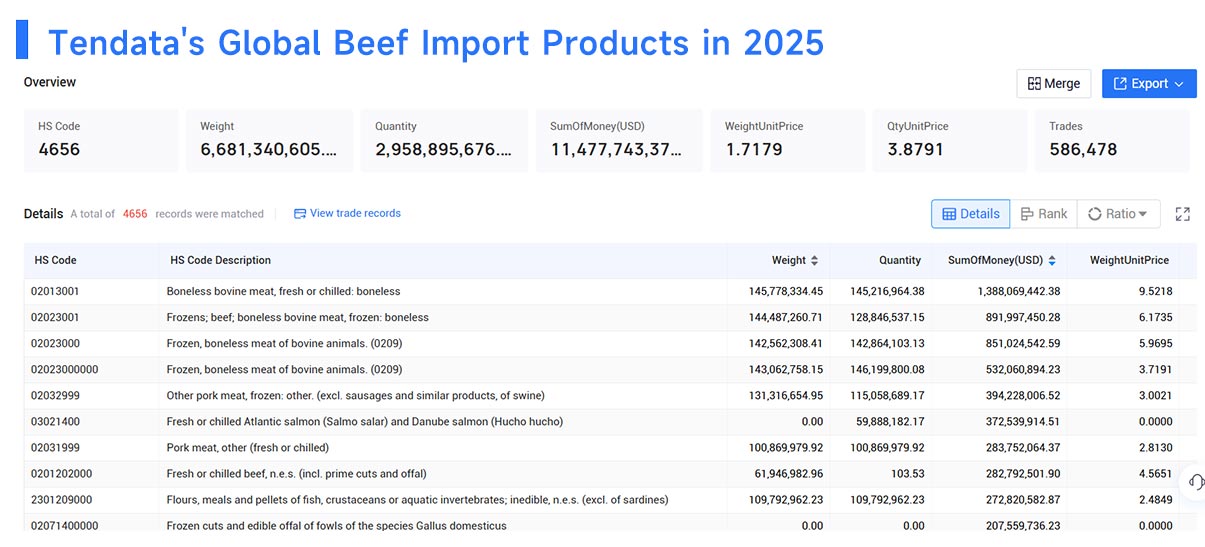
According to Tendata global trade data, the structure of global beef trade can be clearly understood through key HS Codes, which provide a granular view of product segmentation and demand distribution. In the context of beef imports by country, HS Code analysis reveals that boneless bovine meat—both fresh and frozen—dominates international trade flows, reflecting strong demand for standardized, high-value cuts across major importing markets.
In 2025, HS Code 2013001 (12.09%, $1388.07 Million) leads the market, covering fresh or chilled boneless beef, followed by 2023001 (7.77%, $892.00 Million) and 2023000 (7.41%, $851.02 Million), both representing frozen boneless beef products. These categories highlight the dual demand for fresh premium cuts and frozen bulk supply, which supports large-scale food processing and retail distribution globally. Additionally, HS Code 2012020 (2.46%, $282.79 Million) further reflects diversified demand for fresh or chilled beef products, including prime cuts and offal.
Beyond core beef categories, related protein products such as pork, poultry, and seafood also appear in trade data, indicating substitution effects and broader protein sourcing strategies across different regions. This diversified HS Code landscape helps explain shifting procurement patterns in beef imports by country, where buyers balance price, supply stability, and consumer preferences.
Overall, analyzing these HS Codes enables businesses to identify high-demand product types, track competitive supply chains, and refine market entry strategies. With Tendata’s trade intelligence, companies can go deeper—mapping real importers, monitoring purchasing cycles, and uncovering actionable opportunities in the global beef market.
Top Beef Imports by Country
According to Tendata global trade data, below is the list of major beef importing countries in 2025:
1.Mexico(34.71%, $3983.75 Million)
2.Brazil(12.32%, $1413.50 Million)
3.Uruguay(7.37%, $845.97 Million)
4.Indonesia(6.51%, $746.84 Million)
5.Philippines(5.92%, $679.23 Million)
6.Colombia(5.04%, $578.01 Million)
7.Vietnam(5.00%, $574.45 Million)
8.Uzbekistan(4.35%, $498.85 Million)
9.Angola(3.70%, $424.80 Million)
10.Chile(3.68%, $422.22 Million)
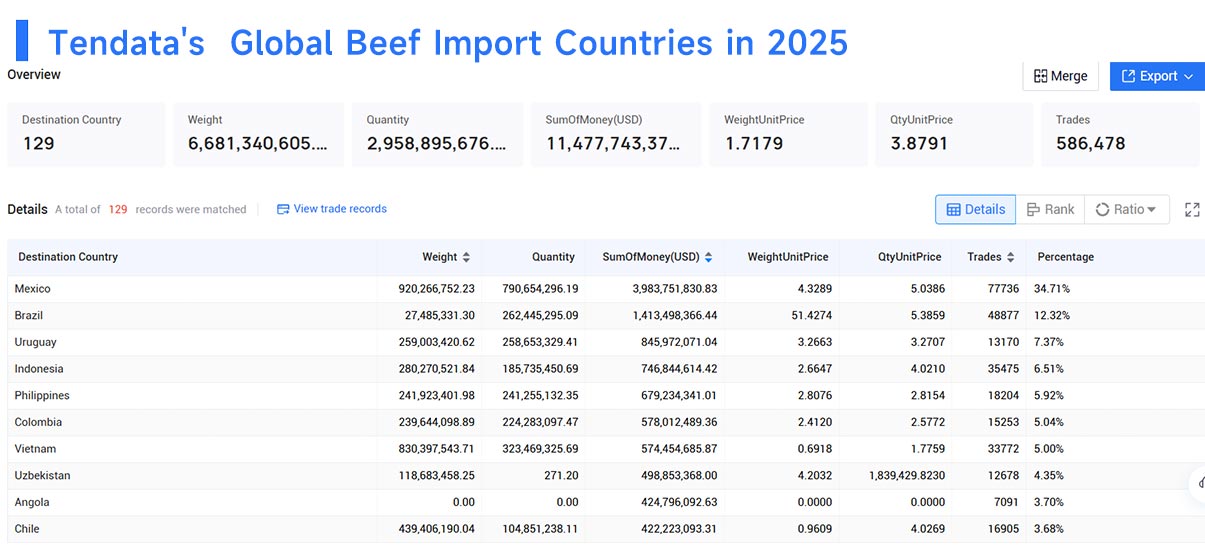
The global beef trade landscape in 2025 highlights a clear concentration of demand across emerging and established consumption markets. Analyzing beef imports by country shows that Latin America and Southeast Asia play a dominant role in driving global import volumes, supported by rising consumption, urbanization, and supply gaps in domestic production.
According to Tendata global trade data, Mexico leads beef importing by country, accounting for 34.71% ($3983.75 Million) of total imports, making it the most significant demand hub. This is followed by Brazil (12.32%, $1413.50 Million) and Uruguay (7.37%, $845.97 Million), reflecting strong intra-regional trade dynamics within the Americas. Meanwhile, Southeast Asian markets such as Indonesia (6.51%, $746.84 Million), Philippines (5.92%, $679.23 Million), and Vietnam (5.00%, $574.45 Million) continue to expand their import demand due to population growth and increasing protein consumption.
In addition, countries like Colombia (5.04%, $578.01 Million), Uzbekistan (4.35%, $498.85 Million), Angola (3.70%, $424.80 Million), and Chile (3.68%, $422.22 Million) are emerging as stable growth markets, diversifying global demand patterns. These shifts highlight how beef importing by country is no longer concentrated solely in traditional markets but is increasingly driven by developing economies.
Overall, understanding beef imports by country enables exporters to identify high-potential markets, optimize regional strategies, and align supply chains with evolving global consumption trends.
Top Global Beef Importers in 2025
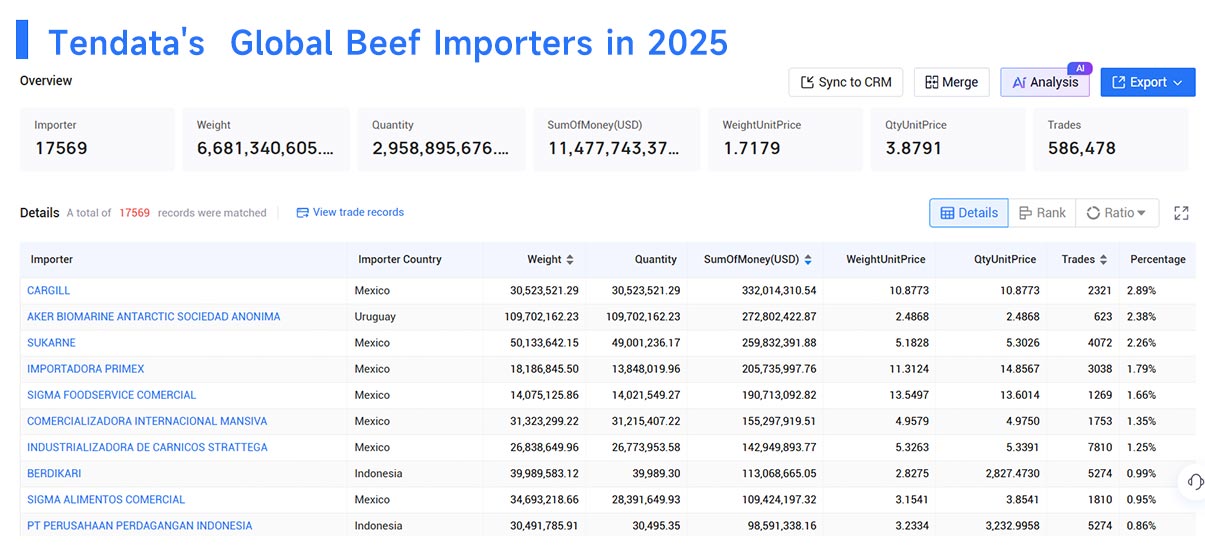
According to Tendata global trade data, here is the list of top beef importers worldwide in 2025:
1.CARGILL(2.89%, $332.01 Million)
2.AKER BIOMARINE ANTARCTIC SOCIEDAD ANONIMA(2.38%, $272.80 Million)
3.SUKARNE(2.26%, $259.83 Million)
4.IMPORTADORA PRIMEX(1.79%, $205.74 Million)
5.SIGMA FOODSERVICE COMERCIAL(1.66%, $190.71 Million)
6.COMERCIALIZADORA INTERNACIONAL MANSIVA(1.35%, $155.30 Million)
7.INDUSTRIALIZADORA DE CARNICOS STRATTEGA(1.25%, $142.95 Million)
8.BERDIKARI(0.99%, $113.07 Million)
9.SIGMA ALIMENTOS COMERCIAL(0.95%, $109.42 Million)
10.PT PERUSAHAAN PERDAGANGAN INDONESIA(0.86%, $98.59 Million)
How to Find Beef Import Data with Tendata?
With Tendata’s global trade intelligence platform, users can easily explore beef importing by country through multi-dimensional data analysis. By entering relevant HS Codes (such as 0201 for fresh beef and 0202 for frozen beef), companies can track import volumes, values, and country-wise distribution in real time. This is critical, as HS codes form the backbone of global trade data classification and enable precise tracking of commodities across markets .
Through Tendata, businesses can:
· Identify key markets driving beef imports by country, including emerging regions with rising consumption
· Analyze importer activity, including purchase frequency, transaction size, and supplier relationships
· Monitor price trends and demand shifts across different countries and time periods
· Discover verified buyers with continuous purchasing records, improving lead quality and conversion rates
This level of visibility is increasingly important as global beef trade continues to expand, driven by growing demand and supply imbalances across regions . Instead of relying on fragmented or outdated information, Tendata integrates multi-source data—including customs records, logistics data, and market intelligence—to provide a complete and actionable view of the global beef market.
In short, if you want to understand beef importing by country, uncover real buyers, and build a scalable export strategy, Tendata offers the data depth and analytical tools needed to turn trade insights into measurable business growth.
Final Words
In conclusion, the global beef trade continues to evolve as demand shifts across regions and supply dynamics become more complex. Analyzing beef imports by country reveals not only where demand is concentrated, but also how purchasing patterns are influenced by factors such as population growth, protein consumption trends, and supply shortages. For instance, global beef imports are heavily driven by Asian markets, which account for over 46% of total import value, followed by Europe and North America, highlighting a clear regional demand structure.
In this increasingly competitive landscape, having access to reliable and granular trade data is essential. Tendata empowers businesses to go beyond surface-level statistics by providing deep insights into beef imported by country, including HS code-level analysis (0201 for fresh beef and 0202 for frozen beef), real importer identification, and transaction-level tracking. This allows exporters to pinpoint high-demand markets, evaluate buyer credibility, and monitor procurement cycles with precision.
Ultimately, understanding beef imports by country through data-driven tools like Tendata enables companies to reduce market uncertainty, improve targeting efficiency, and build sustainable growth strategies in the global beef trade.
FAQ
1. How can businesses analyze beef importing by country effectively?
To analyze beef importing by country, companies need access to detailed, multi-source trade data, including shipment records, importer names, and pricing trends. Platforms like Tendata integrate customs data from multiple countries, allowing users to track real transactions, identify active buyers, and monitor demand fluctuations. For instance, global beef trade data shows that frozen beef accounts for over 50% of total import value, highlighting strong demand for bulk supply products .
2.How does Tendata help in finding beef import data?
Tendata provides a comprehensive solution for exploring beef imports by country through HS code-based analysis, real-time dashboards, and verified importer databases. Users can:
· Filter markets by country, region, or product category
· Identify top importers and their purchasing cycles
· Track price trends and supplier relationships
· Access shipment-level data for accurate decision-making
This enables businesses to move beyond basic statistics and gain actionable insights into beef importing by country, improving lead generation and conversion rates.
3.Why is Tendata valuable for beef exporters?
In a competitive global market, relying on outdated or fragmented data can lead to missed opportunities. Tendata consolidates trade intelligence from multiple sources, providing a clear and reliable view of global demand. By leveraging insights on beef imports by country, exporters can pinpoint the most profitable markets, reduce risk, and build data-driven growth strategies.
Category
Leave Message for Demo Request or Questions