
 Tendata AI
  Exhibition
 B2B Platforms
 Standalone Website
 Social Media
 Emails
 Import News
 2026-04-07
Keypoints
· The structure of Peruvian food imports in 2025 reveals a diversified mix of agricultural inputs, processed foods, and consumer-ready products, reflecting both domestic demand and supply chain supplementation needs.
·The structure of Peruvian food imports in 2025 shows a highly concentrated regional sourcing pattern, with Latin ·American countries dominating the supply chain.
·Peru recorded 712 importers, sourcing food products from 34 destination countries, with a total import value of $510.91 million across 11,764 trades, highlighting an active and moderately concentrated import network.
The Peruvian food import market plays a vital role in supporting the country’s food supply, agricultural processing, and consumer demand across diverse sectors. From essential staples such as grains and edible oils to value-added products like processed foods and beverages, Peruvian food imports contribute significantly to maintaining food security and stabilizing domestic consumption. As global trade continues to evolve, understanding Peruvian food imports provides valuable insight into sourcing patterns, supplier competitiveness, and shifting demand trends.
This analysis explores the structure of Peruvian food imports based on global trade data, highlighting major supplying countries, key HS code categories, leading importers, and overall trade dynamics. By examining these factors, businesses can better understand market opportunities, optimize export strategies, and identify high-potential buyers within the growing Peruvian food import landscape.
Global Peruvian Food ImportS Data: 2025 Overview
The global market for peruvian food imports reflects a growing and increasingly diversified trade structure driven by domestic demand, food security needs, and expanding retail consumption. According to available trade insights, Peru recorded 712 importers, sourcing food products from 34 destination countries, with a total import value of $510.91 million across 11,764 trades, highlighting an active and moderately concentrated import network. This aligns with broader national trends, where food imports account for around 11.9% of total merchandise imports, indicating their strategic importance in the country’s supply chain.
List of Major Peruvian Food Importing HS Codes
According to Tendata global trade data, here is the list of top Peruvian food HS Codes in 2025:
1.HS Code:2309909018(23.15%, $118.26 Million):Other preparations of animal feeding
2.HS Code:2309909013(17.40%, $88.89 Million):Other preparations of animal feeding
3.HS Code:901119000(5.93%, $30.30 Million):Coffee, other, neither roasted nor decaffeinated
4.HS Code:20057000(5.73%, $29.25 Million):Pruned/prs served olives, not by vinegar/frozen
5.HS Code:1511100000(4.15%, $21.19 Million):Crude palm oil
6.HS Code:2106907900(4.07%, $20.79 Million):Food preparations, not elsewhere specified
7.HS Code:2104101000(3.49%, $17.84 Million):Soups and broths and preparations therefor
8.HS Code:80610000(2.85%, $14.57 Million):Fresh grapes (Vitis vinifera)
9.HS Code:18031000(2.35%, $12.01 Million):Cocoa paste, not defatted
10.HS Code:2835250000(1.53%, $7.80 Million):Calcium hydrogen orthophosphate
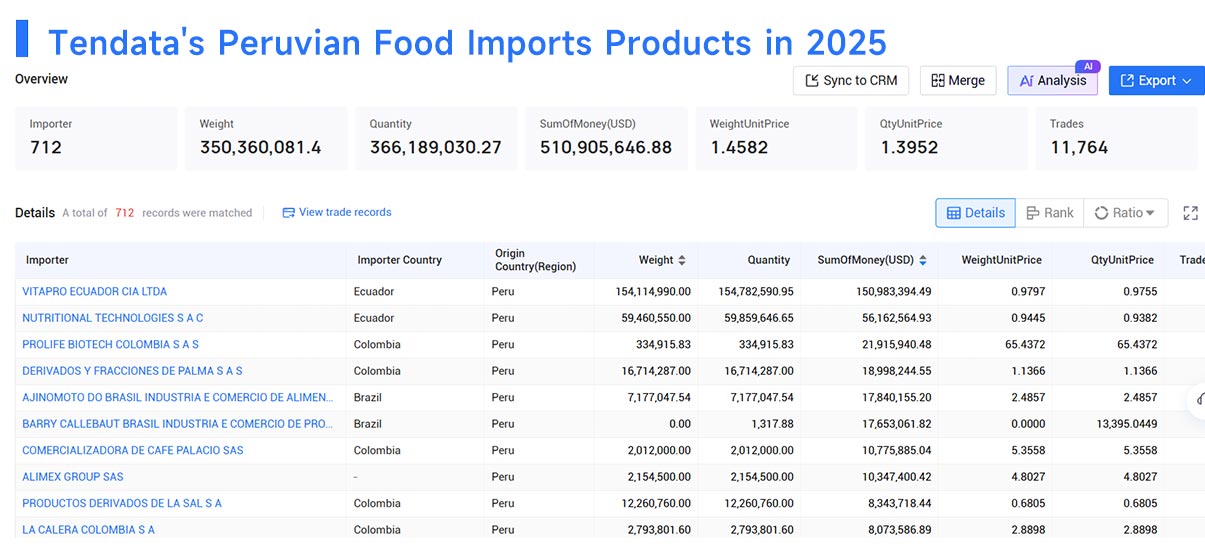
According to Tendata global trade data, the structure of Peruvian food imports in 2025 reveals a diversified mix of agricultural inputs, processed foods, and consumer-ready products, reflecting both domestic demand and supply chain supplementation needs. The largest share of Peruvian food imported products is concentrated in animal feeding preparations under HS Codes 2309909018 (23.15%, $118.26 Million) and 2309909013 (17.40%, $88.89 Million), indicating strong demand from Peru’s livestock and agriculture sectors.
In addition, staple and value-added food categories such as coffee (HS Code 901119000, 5.93%, $30.30 Million), olives (HS Code 20057000, 5.73%, $29.25 Million), and crude palm oil (HS Code 1511100000, 4.15%, $21.19 Million) play a critical role in supporting both food processing industries and retail consumption. Meanwhile, processed food items like food preparations (HS Code 2106907900, 4.07%) and soups and broths (HS Code 2104101000, 3.49%) highlight a growing trend toward convenience foods in the Peruvian market.
Fresh and semi-processed agricultural imports, including grapes (HS Code 80610000, 2.85%) and cocoa paste (HS Code 18031000, 2.35%), further demonstrate Peru’s integration into global agri-food supply chains. Overall, the composition of Peruvian food imports reflects a balanced combination of raw materials for industrial use and finished products for consumer markets, offering clear opportunities for exporters targeting Peru’s evolving food demand landscape.
Top Peruvian Food Importing Countries
Food from Peru for example.
According to Tendata global trade data, below is the list of major Peruvian food importing countries in 2025:
1.Ecuador(42.94%, $219.38 Million)
2.Colombia(31.72%, $162.07 Million)
3.Brazil(15.50%, $79.18 Million)
4.Russia(4.97%, $25.42 Million)
5.Vietnam(1.83%, $9.35 Million)
6.Panama(1.24%, $6.34 Million)
7.Chile(0.42%, $2.16 Million)
8.Liberia(0.41%, $2.10 Million)
9.Uruguay(0.27%, $1.40 Million)
10.Dominican Republic(0.15%, $0.76 Million)
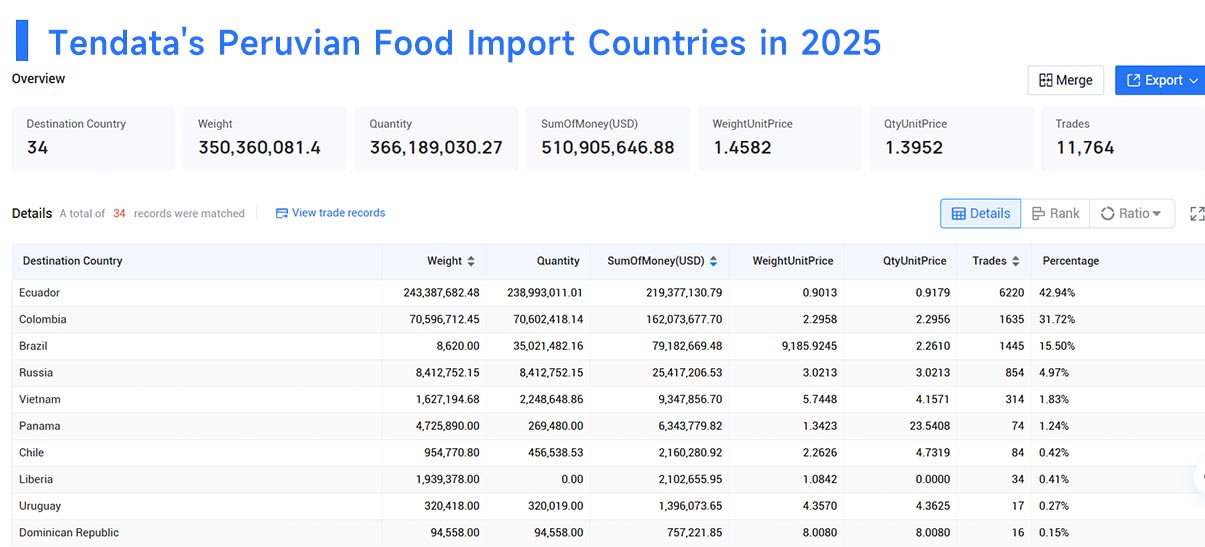
According to Tendata global trade data, the structure of Peruvian food imports in 2025 shows a highly concentrated regional sourcing pattern, with Latin American countries dominating the supply chain. Ecuador leads Peruvian food importing with a significant 42.94% share ($219.38 Million), followed by Colombia at 31.72% ($162.07 Million) and Brazil at 15.50% ($79.18 Million). Together, these three countries account for over 90% of total Peruvian food imports, highlighting Peru’s strong dependence on neighboring markets for food supply and agricultural inputs.
Beyond the top suppliers, countries such as Russia (4.97%, $25.42 Million) and Vietnam (1.83%, $9.35 Million) play a supplementary role, indicating Peru’s efforts to diversify sourcing for specific food categories. Smaller contributors including Panama, Chile, Liberia, Uruguay, and the Dominican Republic collectively represent niche trade flows that support specialized or seasonal demand.
Top Global Peruvian food Importers in 2025
Food from Peru for example.
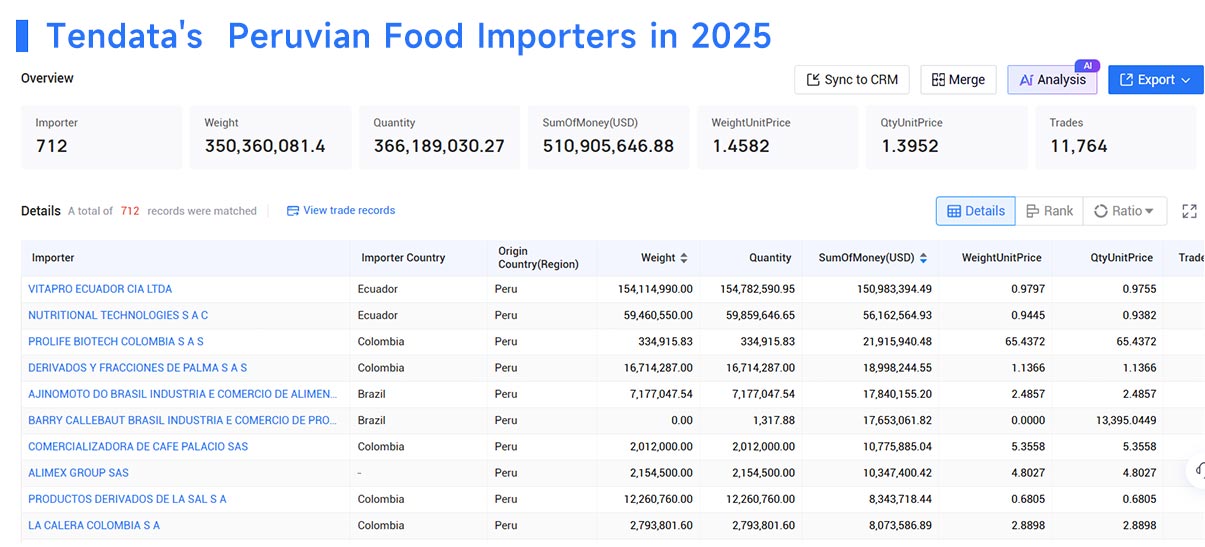
According to Tendata global trade data, here is the list of top Peruvian food importers worldwide in 2025:
1.VITAPRO ECUADOR CIA LTDA(29.55%, $150.98 Million)
2.NUTRITIONAL TECHNOLOGIES S A C(10.99%, $56.16 Million)
3.PROLIFE BIOTECH COLOMBIA S A S(4.29%, $21.92 Million)
4.DERIVADOS Y FRACCIONES DE PALMAS A S(3.72%, $18.998 Million)
5.AJINOMOTO DO BRASIL INDUSTRIA E COMERCIO DE ALIMENTOS LTDA(3.49%, $17.84 Million)
6.BARRY CALLEBAUT BRASIL INDUSTRIA E COMERCIO DE PRODUTOS(3.46%, $17.65 Million)
7.COMERCIALIZADORA DE CAFE PALACIO SAS(2.11%, $10.78 Million)
8.ALIMEX GROUP SAS(2.03%, $10.35 Million)
9.PRODUCTOS DERIVADOS DE LA SAL S A(1.63%, $8.34 Million)
10.LA CALERA COLOMBIA S A(1.58%, $8.07 Million)
How to Find Peruvian food Imports Data with Tendata?
To effectively analyze Peruvian food imports and identify real business opportunities, using a professional trade data platform like Tendata is essential. Tendata provides access to global import-export data from 228+ countries, including detailed shipment records such as product descriptions, HS codes, trade values, supplier and buyer information, and origin-destination flows.
For businesses focusing on Peruvian food imported products, the process typically starts by searching specific keywords or HS codes related to food categories within the Tendata platform. Users can then filter by Peru as the destination market to uncover critical insights such as major supplying countries, active importers, transaction frequency, and pricing trends. This enables precise market sizing and demand validation.
More importantly, Tendata allows companies to move beyond macro-level statistics and directly identify real buyers. By analyzing historical transaction records, businesses can pinpoint importers with continuous purchasing activity, evaluate their supplier networks, and even access verified contact details such as emails and social media accounts for direct outreach.
In addition, built-in analytics tools—including data visualization, trend tracking, and customizable reports—help transform raw trade data into actionable insights, supporting strategic decisions in market entry, customer development, and competitive benchmarking.
Overall, using Tendata to analyze Peruvian food imports not only improves market transparency but also enables exporters to efficiently identify high-potential buyers, optimize targeting strategies, and accelerate growth in the Peruvian food imported market.
Final Words
In conclusion, the evolving structure of Peruvian food imports highlights Peru’s position as a net food-importing market, where demand for staple commodities such as cereals, oils, and processed foods continues to grow alongside changing consumer preferences. As Peru relies on imports to supplement domestic production—particularly for grains, dairy, and meat products—this creates sustained opportunities for global exporters targeting the Peruvian food importing landscape .
For businesses looking to capitalize on this market, Tendata provides a decisive advantage by transforming complex trade flows into actionable insights. Through its comprehensive database, companies can track Peruvian food imported products at the shipment level, identify high-frequency buyers, analyze supplier networks, and monitor pricing trends across different HS codes and origin countries. This enables exporters to move beyond generic market research and directly engage with verified importers who demonstrate consistent purchasing behavior.
Ultimately, combining real-time data analytics with strategic targeting allows businesses to reduce uncertainty, improve conversion efficiency, and accelerate market entry. With the support of Tendata, companies can effectively navigate the Peruvian food imports ecosystem, uncover high-value opportunities, and build sustainable growth in an increasingly competitive global food trade environment.
FAQ: Insight into Food from Peru
1.How can I analyze Peruvian food imports using Tendata?
Understanding Peruvian food imports requires more than just surface-level statistics—it demands access to detailed, shipment-level trade intelligence. Peru is classified as a net food-importing country, relying heavily on imports of staples such as wheat, maize, and other essential food products to meet domestic demand .
With Tendata, businesses can efficiently analyze Peruvian food imports by leveraging multi-country customs data, enabling users to track Peruvian food imported products across key dimensions such as HS codes, supplier countries, importer profiles, transaction frequency, and pricing trends. By simply entering product keywords or HS codes and selecting Peru as the origin market, users can identify top importing countries, active buyers, and high-demand product categories.
More importantly, Tendata goes beyond macro trade analysis by helping companies pinpoint real and active importers with continuous purchasing records. This allows exporters to directly target high-quality leads, evaluate competitor supply chains, and develop data-driven market entry strategies.
In practice, using Tendata to explore Peruvian food imports enables businesses to reduce market uncertainty, improve customer acquisition efficiency, and uncover sustainable growth opportunities in the evolving Peruvian food imported market.
Category
Leave Message for Demo Request or Questions