
 Tendata AI
  Exhibition
 B2B Platforms
 Standalone Website
 Social Media
 Emails
 Import News
 2026-04-14
Keypoints
·The United States remains a US biggest importer in goat-related trade, supported by 583 active importers across 34 countries, generating $28.47 million and 6,919 transactions, reflecting a fragmented yet stable demand structure.
·The US biggest importing structure is highly diversified, extending beyond goat meat into high-value sectors such as biotechnology, dairy products, and laboratory reagents, indicating strong cross-industry demand linked to livestock and food supply chains.
·Globally, goat import demand is concentrated in markets like Colombia (52.20%) and Mexico (28.85%), but the U.S., as a US biggest importer, stands out for its high-value, stable, and diversified import profile rather than sheer volume dominance.

The US goat import market plays an increasingly important role in supporting food supply chains, specialty agriculture, and niche consumption segments across the United States. From traditional goat meat products to high-value biological materials and dairy derivatives, imports continue to drive supply stability and market diversity. As a US biggest importer, the country relies on a wide network of global suppliers to meet growing demand from ethnic food markets, food service industries, and biotechnology applications.
Understanding the structure of the US biggest importer landscape provides valuable insight into evolving trade dynamics, including sourcing patterns, HS code distribution, and the integration of goat-related products into multiple industries such as pharmaceuticals and food processing. This analysis explores key trends in US goat import data, highlighting major importing categories, leading trade partners, and the broader role of the United States within global goat trade networks.
Overview of the US Leading Goat Import Market
According to Tendata-based trade insights, the US goat import market shows active participation, with 583 importers sourcing from 34 countries, generating a total trade value of $28.47 million across 6,919 transactions. This structure highlights a highly fragmented yet stable procurement network, where multiple small-to-mid-sized buyers contribute to consistent import flows. Globally, while the U.S. is not the largest volume buyer compared to Middle Eastern markets, it remains a strategically important destination due to its high-value consumption and diversified sourcing channels.
List of US Biggest Importing HS Codes
Goat for example. According to Tendata trade data, here is the list of leading goat HS Codes in 2026 Q1:
1.HS Code:3822190000(45.98%, $12.36 million):Diagnostic or laboratory reagents, n.e.s. (excl. those for veterinary use)
2.HS Code:84294002(15.60%, $4.19 million):Self-propelled tamping machines and roadrollers
3.HS Code:04061001(12.96%, $3.49 million):Mozzarella cheese in balls or slices, unripened
4.HS Code:0406100000(7.84%, $2.11 million):Fresh cheese, incl. whey cheese, curds
5.HS Code:38221990(5.24%, $1.41 million):Diagnostic or laboratory reagents on a backing, prepared diagnostic or laboratory reagents
6.HS Code:30021290(2.56%, $0.69 million):Antisera and other blood fractions
7.HS Code:38229090(1.60%, $0.43 million):Other certified reference materials
8.HS Code:2309902000(1.54%, $0.42 million):Preparations used in animal feeding (excluding dog or cat food)
9.HS Code:3822190001(1.31%, $0.35 million):Diagnostic or laboratory reagents, n.e.s. (excl. those for veterinary use)
10.HS Code:040690900090(1.19%, $0.32 million):Cheese, n.e.s. (excl. processed cheese, incl. mixtures of cheese)
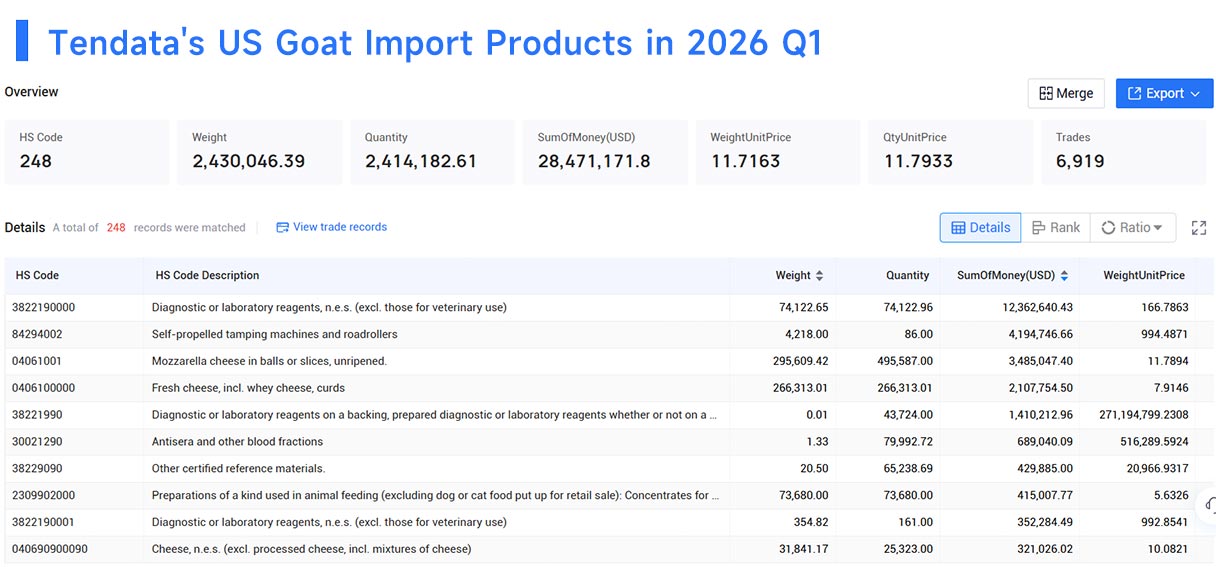
According to Tendata trade data, the structure of US biggest importing categories related to goat-associated and adjacent products in 2026 Q1 reveals a highly diversified import portfolio. While goat meat and by-products remain niche segments, the broader trade flow shows that the United States, as a US biggest importer, is heavily reliant on high-value biological, dairy, and specialty agricultural inputs that are often linked to livestock processing, food supply chains, and laboratory usage.
Leading the list is HS Code 3822190000, accounting for 45.98% ($12.36 million), covering diagnostic or laboratory reagents. This reflects strong demand from the U.S. biotechnology and food safety sectors, where animal-derived materials—including goat-based reagents—play a critical role. Following this, HS Code 84294002 (15.60%, $4.19 million) highlights imports of specialized machinery, indicating infrastructure support for agricultural and processing industries.
In the dairy-related segment, HS Code 04061001 (12.96%, $3.49 million) and 0406100000 (7.84%, $2.11 million) show notable imports of fresh and mozzarella cheese, reflecting downstream consumption trends tied to goat milk alternatives and specialty dairy markets. Additional categories such as antisera and blood fractions (HS Code 30021290, 2.56%) and certified reference materials (HS Code 38229090, 1.60%) further demonstrate the integration of goat-derived biological materials into pharmaceutical and research applications.
Overall, this HS code breakdown underscores how the U.S., as both a US biggest importer and a key player in US biggest importing networks, extends its goat-related import demand beyond traditional meat trade into high-value sectors such as biotechnology, dairy innovation, and advanced agricultural inputs.
US Biggest Importing Countries
US for source country. According to Tendata trade data, below is the list of major goat importing countries in 2026 Q1:
1.Colombia(52.20%, $14.75 million)
2.Mexico(28.85%, $8.16 million)
3.India(8.26%, $2.33 million)
4.Brazil(4.05%, $1.14 million)
5.Pakistan(1.45%, $0.41 million)
6.Kazakhstan(1.32%, $0.37 million)
7.Ukraine(1.29%, $0.36 million)
8.Panama(1.18%, $0.33 million)
9.Vietnam(0.35%, $0.10 million)
10.Indonesia(0.30%, $0.08 million)
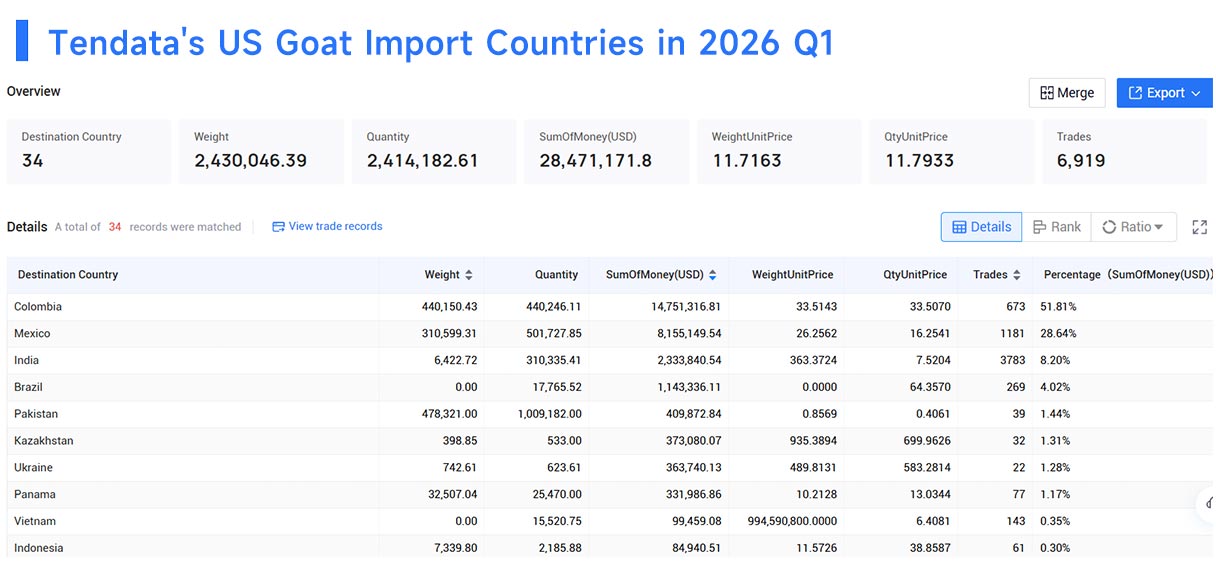
According to Tendata trade data, the global goat import landscape in 2026 Q1 is highly concentrated, with a few key markets dominating total trade value. Colombia leads with 52.20% ($14.75 million), followed by Mexico at 28.85% ($8.16 million) and India at 8.26% ($2.33 million). Other countries such as Brazil, Pakistan, and Kazakhstan contribute smaller yet stable shares, indicating a geographically diverse but top-heavy demand structure.
Within this global context, the United States maintains its strategic position as a US biggest importer in high-value and niche livestock-related segments. Although the U.S. is not the largest volume buyer compared to Latin American markets in this dataset, its US biggest import profile is defined by premium consumption, diversified sourcing, and strong downstream demand from food service, ethnic markets, and processing industries.
This contrast highlights a key trade dynamic: emerging and developing markets drive bulk import volumes, while the United States, as a US biggest importer, plays a critical role in value-driven imports with higher standards, stable purchasing cycles, and broader application across meat consumption, dairy alternatives, and related supply chains.
US Biggest Importers of Goat in 2025
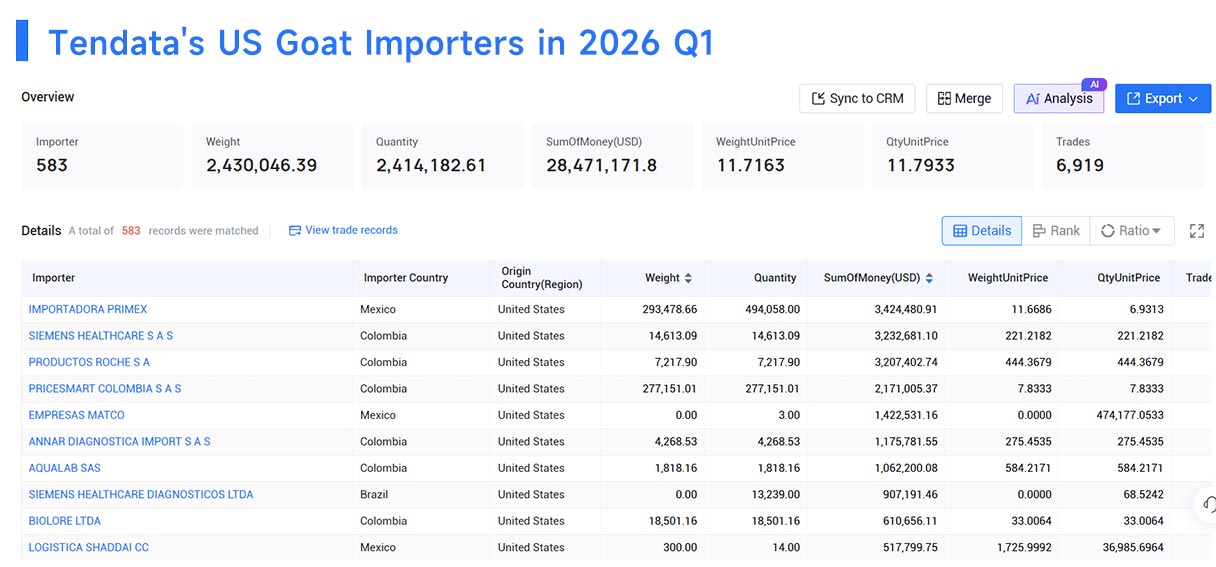
According to Tendata trade data, here is the list of top gaot importers worldwide in 2026 Q1:
1.IMPORTADORA PRIMEX(18.77%, $3.42 million)
2.SIEMENS HEALTHCARE S A S(17.72%, $3.23 million)
3.PRODUCTOS ROCHE S A(17.58%, $3.21 million)
4.PRICESMART COLOMBIA S A S(11.90%, $2.17 million)
5.EMPRESAS MATCO(7.80%, $1.42 million)
6.ANNAR DIAGNOSTICA IMPORT S A S(6.45%, $1.18 million)
7.AQUALAB SAS(5.82%, $1.06 million)
8.SIEMENS HEALTHCARE DIAGNOSTICOS LTDA(4.97%, $0.91 million)
9.BIOLORE(3.35%, $0.61 million)
10.LOGISTICA SHADDAI CC(2.84%, $0.52 million)
How to find US Goat Products Import Data?
Understanding the structure of US biggest importing markets—especially niche segments like goat products—requires access to accurate, shipment-level trade data rather than relying on fragmented public statistics. Official sources such as government datasets (e.g., USDA trade databases) provide macro-level import and export figures for goats and related livestock, but they typically lack detailed insights such as importer names, transaction prices, and supplier relationships .
To overcome these limitations, platforms like Tendata integrate multi-source customs data, bill of lading records, and commercial trade intelligence into a unified system. This allows users to directly access US goat import data at a granular level, including importers, exporters, shipment frequency, pricing, and product specifications. For example, real shipment records show that the United States continuously imports goat meat (HS Code 02045000) from countries like Australia, China, and Uruguay, reflecting stable sourcing patterns and consistent demand.
With Tendata, businesses can go beyond basic statistics and identify real buyers who are actively importing, track procurement cycles, and analyze supplier networks. This is especially valuable for companies targeting the U.S. market as a US biggest importer, where demand is fragmented across multiple importers but driven by high-value consumption and stable purchasing behavior.
In practice, users can simply filter by HS Code, product keyword (e.g., goat meat), or destination country within Tendata’s platform to generate actionable insights. This enables exporters to precisely target the US biggest importing companies, validate market demand, and develop data-driven market entry strategies instead of relying on guesswork.
Final Words
The US goat import market reflects a clear long-term trend: strong demand combined with structural reliance on global supply. As domestic production remains limited, the United States continues to depend heavily on imports, with nearly half of its goat meat consumption sourced internationally . This reinforces the country’s position as a US biggest importer, where consistent demand is driven by ethnic consumption, food service expansion, and rising preference for lean protein alternatives.
From a global perspective, the US biggest import structure is not defined solely by volume leadership, but by value, stability, and diversified sourcing. Data shows that the U.S. imports tens of millions of dollars in goat products annually, with major suppliers such as Australia dominating the supply chain due to scale and reliability . At the same time, emerging markets contribute to a more fragmented but resilient global trade network.
Looking ahead, the U.S. goat import market is expected to maintain steady growth, supported by increasing multicultural demand and expanding consumption patterns. For exporters and suppliers, this means that targeting the United States as a US biggest importer requires not only competitive pricing, but also consistent supply capacity, compliance with strict standards, and the ability to meet specialized market needs. In this context, data-driven insights—such as those provided by Tendata—become essential tools for identifying real buyers, optimizing market entry strategies, and capturing opportunities within the evolving US biggest import landscape.
FAQ
1.What are the key import categories in US goat-related trade?
Tendata data shows that US biggest importing categories extend beyond traditional goat meat into high-value segments such as diagnostic reagents, dairy products, and biological materials. For example, HS Code 3822190000 alone accounts for 45.98% ($12.36 million), indicating strong demand from biotechnology and laboratory sectors. This demonstrates that goat-related imports in the U.S. are deeply integrated into food, pharmaceutical, and research supply chains.
2.How can Tendata help identify US goat import opportunities?
Tendata provides access to multi-source customs data, enabling users to identify real US importers, shipment frequency, pricing trends, and supplier networks. By filtering by HS codes (such as goat meat or related categories), businesses can directly target active buyers and understand procurement cycles. This is especially useful when entering the U.S. market as a US biggest importer, where precision targeting is critical for success.
Unlike public datasets that only offer aggregated statistics, Tendata delivers shipment-level data with actionable insights, including importer names and transaction details. This allows exporters to move beyond general market analysis and focus on high-potential clients within the US biggest importing ecosystem, improving conversion rates and reducing market entry risks.
Category
Leave Message for Demo Request or Questions