
 Tendata AI
  Exhibition
 B2B Platforms
 Standalone Website
 Social Media
 Emails
 Import News
 2026-04-15
Keypoints
· The importer US market is highly fragmented yet active, with 3,568 importers sourcing from 69 countries and generating over $873 million across 43,535 trades, highlighting strong demand and a globally integrated supply chain.
· In terms of product classification, the import US structure is centered on HS Code 2009 (fruit and vegetable juices), while also extending to related beverage categories such as HS Code 22029999, reflecting the growing overlap between juice, functional drinks, and ready-to-drink products.
· The HS code distribution shows that although bulk commodities dominate total trade value, juice-specific categories like HS Code 20091202 and 20098101 still represent stable and growing segments driven by health-conscious consumption trends.

The US juice import market plays a vital role in supporting the food and beverage industry, retail distribution, and the growing demand for healthy, ready-to-drink products across the country. From basic fruit juices to premium blends and functional beverages, juice imports contribute significantly to consumption diversity and supply stability in the United States. The active participation of importer US companies ensures continuous sourcing from global markets, driving trade flows and strengthening international supply chains.
Overview of the US Juice Import Market
The importer US landscape is highly fragmented yet active, with 3,568 importers sourcing from 69 countries, generating a total import value of $873,061,685.78 across 43,535 trades. Major supplying countries such as Brazil, Mexico, and Turkey dominate the competitive landscape, highlighting a diversified and globally integrated supply chain . This combination of broad sourcing networks and high transaction frequency indicates that the U.S. remains one of the most dynamic and opportunity-rich markets for juice exporters worldwide, with consistent demand growth and strong importer participation shaping future trade expansion.
List of Major juice Importing HS Codes
According to Tendata global trade data, here is the list of top juice HS Codes in 2025
1.HS Code:2709(77.61%, $554.70 million):Petroleum oils and oils obtained from bituminous minerals
2.HS Code:2713(5.06%, $36.17 million):Petroleum bitumen
3.HS Code:27111300(3.06%, $21.84 million):Butanes, liquefied (excluding of a purity ≥95%)
4.HS Code:20091202(2.86%, $20.41 million):Juice, without freezing, with Brix value ≤20
5.HS Code:22029999(2.48%, $17.71 million):Beverages, non-alcoholic, containing ≥2% by weight
6.HS Code:2710(1.86%, $13.28 million):Jet fuel
7.HS Code:20098101(1.60%, $11.43 million):Cranberries
8.HS Code:2711(1.42%, $10.13 million):Butanes, liquefied (other forms)
9.HS Code:2713(1.24%, $8.88 million):Petroleum coke, non-calcined
10.HS Code:2711(1.22%, $8.74 million):Propane, liquefied; in containers
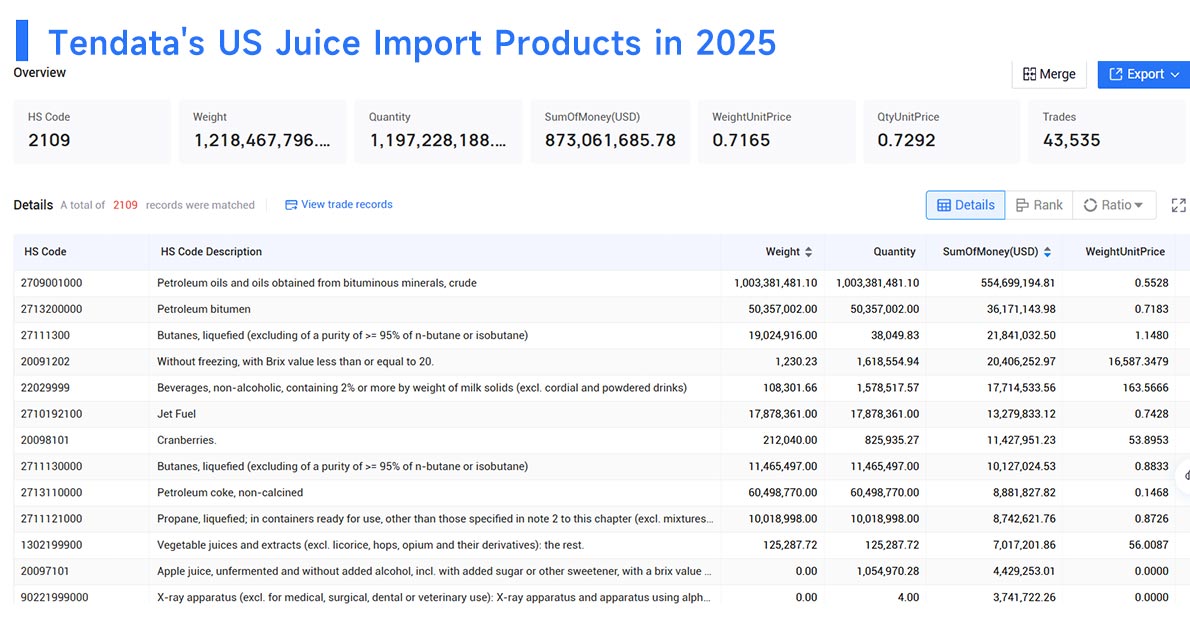
According to Tendata global trade data, the US juice import market is structured around a combination of beverage-related HS codes, with core classifications primarily concentrated under HS Code 2009, which covers fruit and vegetable juices that are unfermented and without added alcohol . In the current import US structure, although energy-related HS codes dominate total trade value, juice-specific categories still play a critical role in the food and beverage segment. For example, HS Code 20091202 (juice, ≤20 Brix) accounts for $20.41 million (2.86%), while HS Code 20098101 (cranberry juice) contributes $11.43 million (1.60%), reflecting stable demand from health-conscious consumers and retail channels.
From a broader classification perspective, juice products imported by importer US are not limited to pure juice categories but also extend to adjacent beverage codes such as HS Code 22029999 (non-alcoholic beverages), indicating the growing overlap between juice, functional drinks, and ready-to-drink products. Within the HS framework, subcategories such as apple juice (200971), mixed juices (200990), and other fruit-based juices are further segmented based on factors like Brix level and composition, enabling more precise trade tracking and tariff application .
Overall, the HS code distribution highlights that while the absolute share of juice-specific imports remains smaller compared to bulk commodities, the import US juice segment is highly diversified, with multiple subcategories supporting niche demand. This layered HS structure provides valuable insight for exporters targeting the U.S. market, helping them identify precise product positioning, optimize compliance, and better align with the evolving procurement strategies of importer US.
Top Juice Importing Countries
According to Tendata global trade data, below is the list of major juice importing countries in 2025:
1.Uruguay(76.20%, $648.89 Million)
2.Mexico(8.93%, $76.00 Million)
3.India(6.43%, $54.79 Million)
4.Colombia(1.83%, $15.59 Million)
5.Philippines(1.27%, $10.83 Million)
6.Paraguay(1.13%, $9.60 Million)
7.Ukraine(1.00%, $8.48 Million)
8.Brazil(0.91%, $7.74 Million)
9.Panama(0.86%, $7.33 Million)
10.Guatemala(0.85%, $7.20 Million)
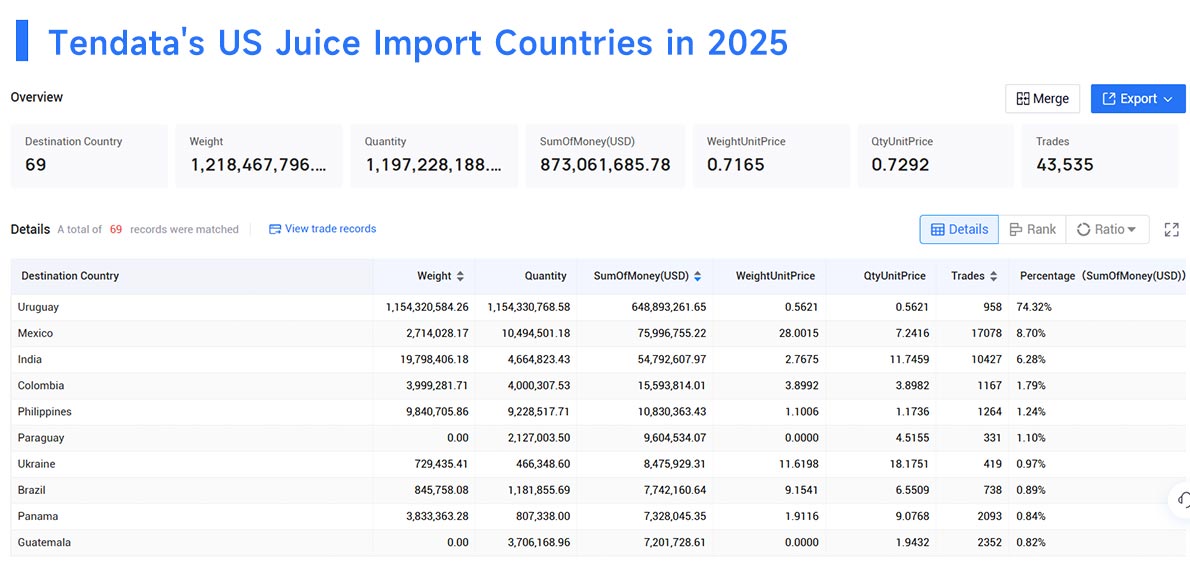
According to Tendata global trade data, the US juice import market in 2025 shows a highly concentrated sourcing pattern, similar to the structure seen in major global commodity trade flows. Uruguay dominates the supply side with a commanding 76.20% share ($648.89 million), making it the core partner in the importing US supply chain. This is followed by Mexico (8.93%) and India (6.43%), which together reinforce a diversified but still top-heavy supplier base. Other countries such as Colombia, the Philippines, Paraguay, and Ukraine contribute smaller yet stable shares, indicating niche product flows and regional specialization within the global juice trade.
From a market structure perspective, this concentration highlights how importer US relies heavily on a few key exporting countries for consistent supply, while maintaining a long tail of secondary partners to ensure flexibility and product diversity. The presence of Latin American countries like Uruguay, Mexico, Brazil, and Guatemala further reflects geographic advantages in fruit production and trade logistics, which are critical for fresh and processed juice categories.
Overall, the current importing US landscape demonstrates both dependency and diversification: a dominant supplier ensures volume stability, while multiple smaller exporters provide resilience against supply chain disruptions. For global exporters, understanding this country-level distribution is essential to identify competitive positioning, optimize market entry strategies, and better align with procurement patterns of importer US in the evolving juice trade market.
Top US Juice Importers in 2025
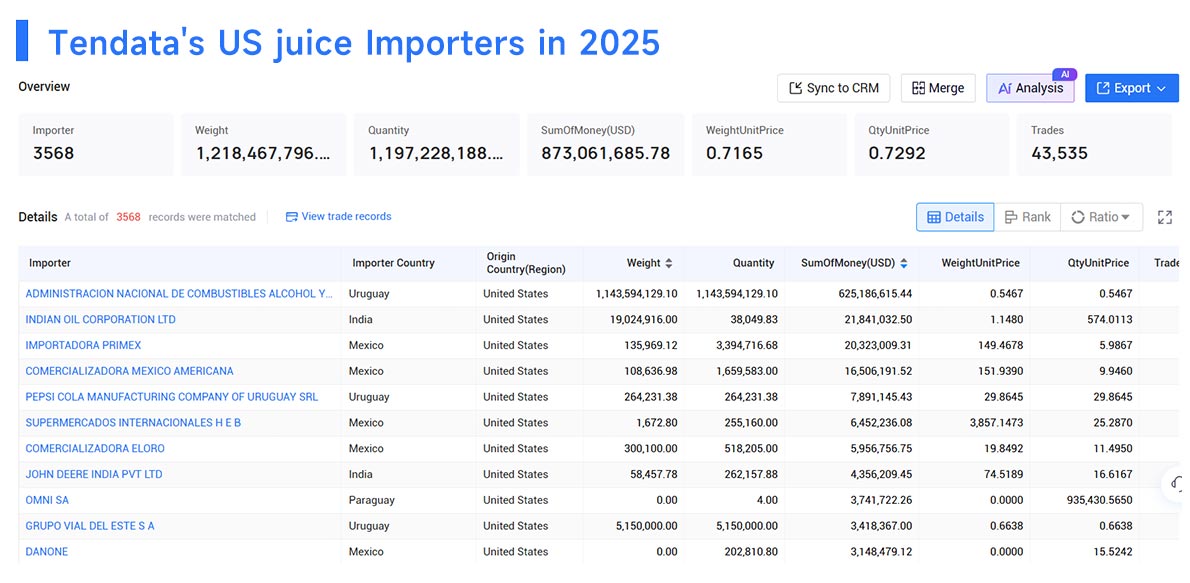
According to Tendata global trade data, here is the list of top juice importers worldwide in 2025:
1.ADMINISTRACION NACIONAL DE COMBUSTIBLES ALCOHOL Y PORTLAND(71.61%, $625.19 Million)
2.INDIAN OIL CORPORATION LTD(2.50%, $21.84 Million)
3.IMPORTADORA PRIMEX(2.33%, $20.32 Million)
4.COMERCIALIZADORA MEXICO AMERICANA(1.89%, $16.51 Million)
5.PEPSI COLA MANUFACTURING COMPANY OF URUGUAY SRL(0.90%, $7.89 Million)
6.SUPERMERCADOS INTERNACIONALES H E B(0.74%, $6.45 Million)
7.COMERCIALIZADORA EL ORO(0.68%, $5.96 Million)
8.JOHN DEERE INDIA PVT LTD(0.50%, $4.36 Million)
9.OMNI SA(0.43%, $3.74 Million)
10.GRUPO VIAL DEL ESTE S A(0.39%, $3.42 Million)
How to find Juice Products Import Data?
To effectively analyze US juice import data, businesses need access to structured and reliable trade intelligence platforms that provide shipment-level visibility and HS code classification. According to industry practices highlighted in platforms like Seair, users can identify key trends by searching import US data through HS codes (such as 2009 for fruit juices), filtering by country, supplier, and transaction value, and analyzing historical shipment records to uncover real buyer behavior .
With Tendata, this process becomes more efficient and data-driven. Users can directly explore the importer US landscape by tracking actual import records, identifying active buyers with continuous purchasing activity over the past 12 months, and analyzing supplier networks across multiple countries. The platform integrates customs data, shipping records, and commercial intelligence, enabling users to drill down into specific juice categories, monitor price trends, and evaluate procurement cycles.
More importantly, Tendata allows exporters to move beyond basic statistics and access actionable insights—such as verified importer profiles, transaction frequency, and supply chain relationships—helping them accurately target high-potential clients in the import US market. This approach not only improves market entry efficiency but also reduces the risk of relying on low-quality or inactive buyers, making trade data a critical tool for scaling in the competitive global juice industry.
Final Words
In conclusion, the US juice import market reflects a dynamic and evolving trade landscape shaped by strong consumer demand, concentrated supplier networks, and increasing reliance on global sourcing. With the U.S. juice market valued at nearly $25 billion in 2025 and expected to maintain steady growth, the role of imports remains essential in meeting domestic consumption needs and product diversification .
From the data perspective, the dominance of key supplier countries—led by Uruguay—combined with a wide base of active buyers highlights a dual structure where volume concentration and market fragmentation coexist. This means that while large-scale suppliers ensure stability, a broad range of participants in the importer US ecosystem continues to drive competition and niche demand.
Looking ahead, the importing US trend is expected to remain upward, supported by health-conscious consumption, innovation in juice categories, and supply-side constraints in domestic production. For exporters, success in this market will depend on leveraging accurate trade data, identifying active and reliable importer US partners, and aligning with shifting demand patterns. Ultimately, those who combine data-driven targeting with flexible supply strategies will be best positioned to capture long-term opportunities in the expanding US juice import sector.
FAQ
1.Which countries dominate juice supply to the US?
According to Tendata, Uruguay leads with a 76.20% share, followed by Mexico (8.93%) and India (6.43%). This concentration shows that importer US depends heavily on a few key exporters while maintaining additional sourcing channels from countries like Colombia, Brazil, and Guatemala to ensure supply chain flexibility.
2.How can Tendata help identify reliable US juice importers?
Tendata enables users to analyze real shipment records, identify active importer US buyers with consistent purchasing behavior, and evaluate supplier networks. By tracking transaction frequency, import value, and historical trade relationships, businesses can pinpoint high-quality buyers instead of relying on unverified directories.
3.How can businesses use import US data to grow in the juice market?
By using Tendata, exporters can access detailed import US data, including buyer profiles, sourcing countries, and pricing trends. This allows companies to target the right importer US partners, optimize market entry strategies, and align with evolving demand patterns. Data-driven decision-making significantly improves conversion rates and reduces risks in the competitive US juice import sector.
Category
Leave Message for Demo Request or Questions