
 Tendata AI
  Exhibition
 B2B Platforms
 Standalone Website
 Social Media
 Emails
 Import News
 2026-06-02
Global demand for imported wheat remained substantial in 2025, with total international purchases reaching approximately US$51.1 billion.
Despite strong worldwide demand for this essential grain, the overall value of wheat imports declined compared with previous years. Since 2021, when global wheat imports were valued at US$63.8 billion, total spending has decreased by 20%. On a year-over-year basis, worldwide wheat import expenditures fell 13.5%, down from US$59.1 billion in 2024.

Leading Wheat Importing Countries
The global wheat market is driven by a relatively small group of major buyers. In 2025, the top five wheat-importing countries were Egypt, Indonesia, Italy, the Philippines, and Morocco.
Together, these nations accounted for 26.5% of total global wheat imports, highlighting their significant role in international grain trade.
Wheat Imports by Region
Asia remained the largest wheat-importing region in 2025, purchasing wheat worth approximately US$19.7 billion, equivalent to 38.7% of worldwide imports.
Africa ranked second, representing 25.4% of global wheat purchases, while European countries accounted for 21.5% of total import value.
Other regions contributed smaller shares:
· Latin America and the Caribbean (excluding Mexico): 10.1%
· North America: 3.8%
· Oceania: 0.6%, led by New Zealand, Papua New Guinea, and Fiji
For customs classification purposes, wheat and meslin are categorized under HS Code 1001.
Top 15 Wheat Importers in 2025
The following countries recorded the highest wheat import values during 2025:
1.Egypt — US$3.7 billion (7.3%)
2.Indonesia — US$3.3 billion (6.4%)
3.Italy — US$2.9 billion (5.6%)
4.Philippines — US$1.9 billion (3.7%)
5.Morocco — US$1.8 billion (3.5%)
6.Spain — US$1.69 billion (3.3%)
7.Japan — US$1.61 billion (3.1%)
8.Brazil — US$1.6 billion (3.1%)
9.Algeria — US$1.4 billion (2.8%)
10.South Korea — US$1.31 billion (2.6%)
11.Nigeria — US$1.29 billion (2.5%)
12.Mexico — US$1.18 billion (2.3%)
13.Vietnam — US$1.18 billion (2.3%)
14.Türkiye — US$1.16 billion (2.3%)
15.mainland China — US$1.14 billion (2.2%)
Collectively, these fifteen countries represented 53.1% of global wheat import value in 2025.
Fastest-Growing and Declining Wheat Markets
Among the major wheat importers, only a few countries increased their purchases compared with 2024.
The strongest growth was recorded by:
· Nigeria (+19.7%)
· Italy (+8.7%)
· Morocco (+0.2%)
Meanwhile, several major wheat markets significantly reduced their imports. The largest declines were seen in:
· mainland China (-67.2%)
· Algeria (-52.2%)
· Vietnam (-24.8%)
· Egypt (-16.3%)
These shifts reflect changing domestic production levels, inventory management strategies, and evolving global grain market conditions.
Global Wheat Importing Companies in 2025
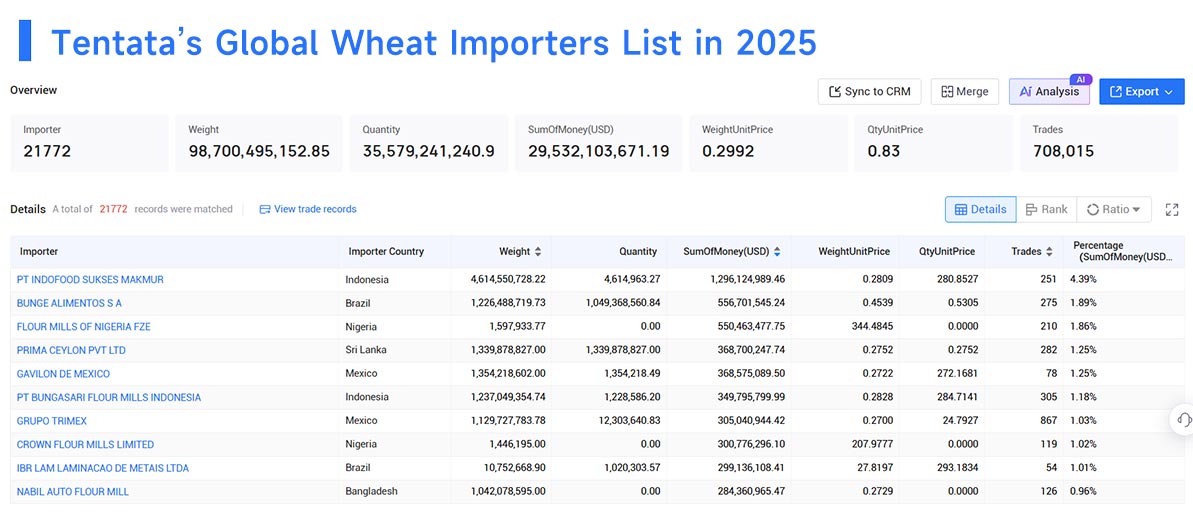
According to Tendata import data, the following companies ranked among the world's leading wheat importers in 2025: >>Find More Wheat Importers through Tendata
1.PT INDOFOOD SUKSES MAKMUR — 4.39% (US$1,296.12 million)
2.BUNGE ALIMENTOS S.A. — 1.89% (US$556.70 million)
3.FLOUR MILLS OF NIGERIA FZE — 1.86% (US$550.46 million)
4.PRIMA CEYLON PVT LTD — 1.25% (US$368.70 million)
5.GAVILON DE MEXICO — 1.25% (US$368.58 million)
6.PT BUNGASARI FLOUR MILLS INDONESIA — 1.18% (US$349.80 million)
7.GRUPO TRIMEX — 1.03% (US$305.04 million)
8.CROWN FLOUR MILLS LIMITED — 1.02% (US$300.78 million)
9.IBR LAM LAMINACAO DE METAIS LTDA — 1.01% (US$299.14 million)
10.NABIL AUTO FLOUR MILL — 0.96% (US$284.36 million)
Access to reliable wheat trade data is crucial for exporters, grain suppliers, commodity traders, and market analysts. By leveraging verified customs records and shipment intelligence, businesses can identify active wheat buyers, evaluate purchasing volumes, and uncover new market opportunities.
Tendata's global trade platform provides comprehensive information on wheat importers, including transaction histories, supplier-buyer relationships, product details, and company contact information. These insights help businesses find qualified buyers, monitor market trends, and develop more effective international trade strategies.
Whether you are looking to expand into new markets or identify high-volume wheat purchasers, accurate import data can significantly improve sourcing and business development efforts in the global grain industry.
Category
Leave Message for Demo Request or Questions