 Tendata AI
  Import News
 2026-06-30
Global cement imports were valued at approximately US$15.7 billion in 2025, reflecting steady international demand from the construction and infrastructure sectors. As a key ingredient in concrete production, cement remains an essential building material used in residential, commercial, and large-scale infrastructure projects worldwide.
Compared with 2021, when worldwide cement imports totaled US$16.6 billion, the overall value of international purchases declined by 5.4% over the five-year period. Despite the longer-term decrease, the market showed signs of recovery in 2025, with import spending increasing by 1.6% from US$15.5 billion in 2024.
The global cement import market is led by a relatively small group of major economies. The five largest importers—the United States, the United Kingdom, France, Italy, and the Netherlands—accounted for approximately 28.6% of worldwide cement import value in 2025.
From a regional perspective, Europe remained the largest cement-importing region, purchasing approximately US$5.1 billion, equivalent to 32.4% of global imports. Asia ranked second with 24.3%, followed by Africa, which accounted for 17.9% of worldwide cement imports. North America represented 16% of total purchases.
The remaining demand came from Latin America and the Caribbean (7.7%) and Oceania (1.7%), led primarily by Australia, Papua New Guinea, and Fiji.
For customs classification, cement products are categorized under HS Code 2523.

Top Cement Importing Countries in 2025
The United States remained the world's largest cement importer in 2025, purchasing approximately US$2.3 billion worth of cement, accounting for 14.9% of global imports.
The United Kingdom ranked second with US$569.3 million (3.6%), followed closely by France at US$535.5 million (3.4%), Italy at US$531.7 million (3.4%), and the Netherlands at US$517.2 million (3.3%).
Other major cement-importing countries included:
1. Philippines (2.8%, $446.9 Million)
2. Israel (2.6%, $408.5 Million)
3. Bangladesh (2.5%, $397 Million)
4. Ivory Coast (2.0%, $316.6 Million)
5. Poland (1.6%, $257.8 Million)
6. Singapore (1.5%, $237.6 Million)
7. Hungary (1.5%, $228 Million)
8. Mali (1.4%, $219.4 Million)
9. Taiwan (1.4%, $215 Million)
10. Australia (1.3%, $206.7 Million)
Together, these 15 countries accounted for approximately 47.3% of global cement imports in 2025, reflecting a geographically diversified demand across developed and emerging economies.
Fastest-Growing and Declining Cement Import Markets
Several major importers recorded notable growth between 2024 and 2025.
Ivory Coast led the growth rankings with a 32.1% increase in cement imports. Poland followed with 28.2% growth, while Italy expanded by 27.4% and Israel recorded an 18.4% increase.
Several countries experienced declining import values during the same period. Bangladesh posted the largest decrease, with imports falling 26.4%, followed by Mali (-25.7%), Hungary (-21.4%), and the Philippines (-13.9%).
Leading Cement Importing Companies in 2025
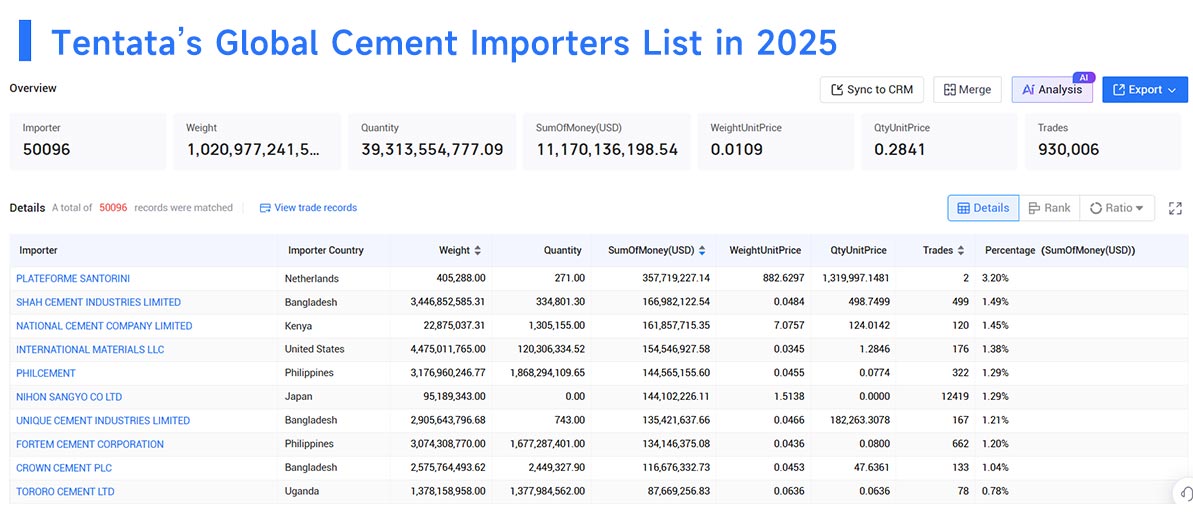
According to Tendata trade intelligence data, the leading cement importers in 2025 included:
1. PLATEFORME SANTORINI (3.20%, $357.72 Million)
2. SHAH CEMENT INDUSTRIES LIMITED (1.49%, $166.98 Million)
3. NATIONAL CEMENT COMPANY LIMITED (1.45%, $161.86 Million)
4. INTERNATIONAL MATERIALS LLC (1.38%, $154.55 Million)
5. PHILCEMENT (1.29%, $144.57 Million)
6. NIHON SANGYO CO LTD (1.29%, $144.10 Million)
7. UNIQUE CEMENT INDUSTRIES LIMITED (1.21%, $135.42 Million)
8. FORTEM CEMENT CORPORATION (1.20%, $134.15 Million)
9. CROWN CEMENT PLC (1.04%, $116.68 Million)
10. TORORO CEMENT LTD (0.78%, $87.67 Million)
>>Find More Cement Importers via Tendata<<
The global cement import market remained relatively stable in 2025, supported by ongoing investments in housing, commercial development, and public infrastructure. Although long-term import values have declined compared with 2021, steady year-over-year growth indicates resilient demand across many regions. As urbanization and infrastructure projects continue worldwide, international cement trade is expected to remain an important component of the global construction materials market.
Category
Leave Message for Demo Request or Questions