
 Tendata AI
  Exhibition
 B2B Platforms
 Standalone Website
 Social Media
 Emails
 Export News
 2026-02-18
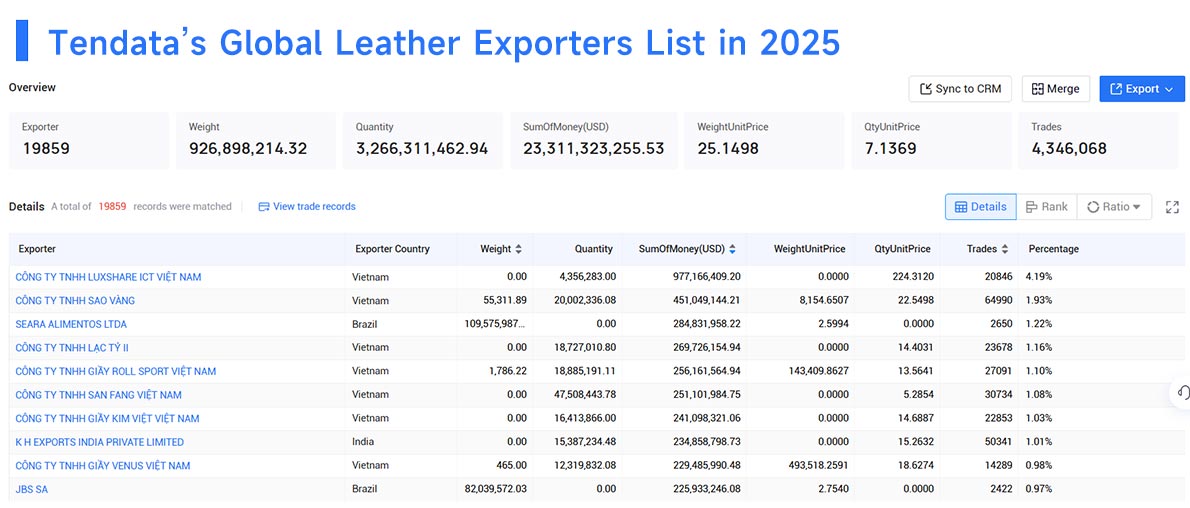
The global leather exports market continued to demonstrate strong industrial importance and international trade activity in 2025. According to Tendata global trade data, leather exports reached a total value of US$23.31 billion, involving 19,859 exporters and more than 4.34 million trade transactions worldwide. These figures highlight the scale and complexity of the leather industry, which supports global footwear, fashion, automotive interiors, furniture manufacturing, and industrial materials.
As supply chains become more specialized and sustainability expectations rise, leather exports remain a critical component of international manufacturing and consumer goods production.

Market Overview of Leather Exports in 2025
· Total Export Value: US$23,311,323,255
· Number of Exporters: 19,859
· Total Trades: 4,346,068 transactions
The high number of transactions shows that leather exports operate within a high-frequency and diversified trade environment, ranging from raw hides and semi-processed leather to finished leather goods and footwear components.
Main Leather Exports Companies in 2025
According to Tendata, the following companies ranked among the main leather exports leaders worldwide in 2025:
1. Luxshare ICT Vietnam Co., Ltd. – 4.19% | US$977.17 million
2. Sao Vang Co., Ltd. – 1.93% | US$451.05 million
3. Seara Alimentos Ltda – 1.22% | US$284.83 million
4. Lac Ty II Co., Ltd. – 1.16% | US$269.73 million
5. Roll Sport Vietnam Footwear Co., Ltd. – 1.10% | US$256.16 million
6. San Fang Vietnam Co., Ltd. – 1.08% | US$251.10 million
7. Kim Viet Vietnam Footwear Co., Ltd. – 1.03% | US$241.10 million
8. K H Exports India Private Limited – 1.01% | US$234.86 million
9. Venus Vietnam Footwear Co., Ltd. – 0.98% | US$229.49 million
10. JBS S.A. – 0.97% | US$225.93 million
While these companies represent significant volumes, the leather exports market remains highly fragmented, with thousands of manufacturers, tanneries, and contract producers participating in global supply chains.
Structural Characteristics of the Leather Exports Market
1. Integrated manufacturing ecosystems
Leather exports are closely linked to footwear production, fashion accessories, automotive interiors, and upholstery industries.
2. Strong presence of contract manufacturing
Many exporters operate as OEM/ODM partners for global brands, producing leather components and finished goods.
3. Regional production clusters
Vietnam, India, Brazil, and Southeast Asia continue to dominate leather exports due to strong manufacturing infrastructure and skilled labor.
4. Sustainability and traceability requirements
Environmental standards, ethical sourcing, and traceability systems are becoming essential for global leather exports compliance.
Opportunities for Leather Exporters and Global Buyers
The 2025 leather exports data highlights several strategic opportunities:
· Diversified sourcing strategies → Brands increasingly source from multiple countries
· Value-added processing → Finished leather goods provide higher margins than raw materials
· Sustainable leather innovation → Eco-tanning, recycled leather, and alternative materials are growing trends
· Automotive and furniture demand → Expanding markets for leather beyond fashion
Data-driven exporter targeting → Trade platforms like Tendata help identify reliable leather exports partners and evaluate supplier capabilities
Exporters who combine quality manufacturing with sustainability compliance and digital supply chain management are positioned for long-term growth.
Conclusion
The global leather exports market in 2025 stands as a high-value, high-frequency, and globally integrated industrial sector. With over US$23.3 billion in export value and more than 4.3 million trade transactions, leather remains a foundational material across multiple manufacturing industries.
As global brands seek resilient and responsible supply chains, leather exports will increasingly depend on innovation, sustainability, and data-driven market intelligence. For exporters, manufacturers, and buyers alike, leveraging global trade data is becoming essential to identify opportunities, reduce risks, and build long-term competitive advantage in the evolving leather industry. 👜
Category
Leave Message for Demo Request or Questions