
 Tendata AI
  Exhibition
 B2B Platforms
 Standalone Website
 Social Media
 Emails
 Export News
 2026-02-24
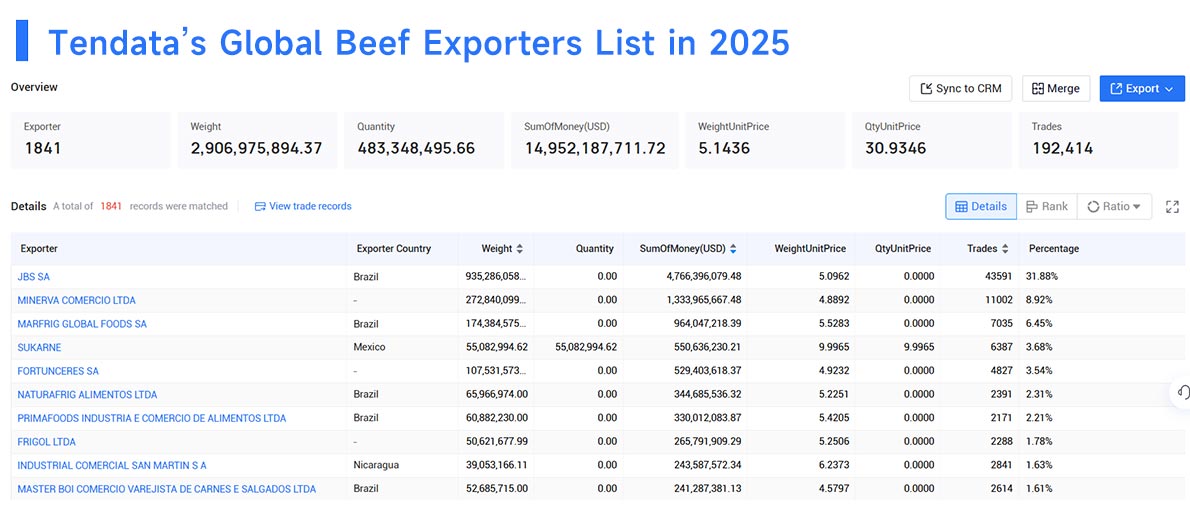
The global beef trade continued to expand in 2025, supported by strong international demand for protein, expanding food processing industries, and the growth of global retail and food service sectors. According to international trade data, the beef exporters market involved 1,841 exporters, with a total export value of US$14.95 billion, covering nearly 2.91 billion kilograms of beef across 192,414 trade transactions worldwide.
These figures highlight beef as one of the most valuable agricultural commodities in global trade, driven by consistent consumer demand and large-scale production networks.

Market Overview of Beef Exporters in 2025
· Total Export Value: US$14,952,187,711
· Total Export Weight: 2,906,975,894 kg
· Total Quantity: 483,348,495 units
· Average Weight Unit Price: US$5.14 per kg
· Average Quantity Unit Price: US$30.93
· Number of Exporters: 1,841
· Total Trades: 192,414 transactions
The relatively small number of exporters compared to other commodity sectors indicates a more concentrated and industrialized market, where large meat processors and multinational food companies dominate production and export activities.
Main Beef Exporters in 2025
According to Tendata global trade data, the following companies ranked among the main beef exporters worldwide in 2025:
1. JBS S.A. – 31.88% | US$4.77 billion
2. Minerva Comercio Ltda – 8.92% | US$1.33 billion
3. Marfrig Global Foods S.A. – 6.45% | US$964.05 million
4. Sukarne – 3.68% | US$550.64 million
5. Fortunceres S.A. – 3.54% | US$529.40 million
6. Naturafrig Alimentos Ltda – 2.31% | US$344.69 million
7. Primafoods Industria e Comercio de Alimentos Ltda – 2.21% | US$330.01 million
8. Frigol Ltda – 1.78% | US$265.79 million
9. Industrial Comercial San Martin S.A. – 1.63% | US$243.59 million
10. Master Boi Comercio Varejista de Carnes e Salgados Ltda – 1.61% | US$241.29 million
The strong market share held by top companies shows that the beef exporters industry is highly consolidated, with large multinational meat processors leading global supply chains.
Structural Characteristics of the Beef Exporters Market
1. Industrial-scale production
Beef exports rely on large slaughterhouses, advanced cold-chain logistics, and vertically integrated meat processing companies.
2. High regulatory standards
Food safety regulations, animal health certifications, and traceability requirements play a critical role in international beef trade.
3. Stable global demand
Beef consumption remains strong in retail markets, restaurants, processed food manufacturing, and institutional food supply sectors.
4. Price sensitivity and supply dynamics
Beef prices are influenced by feed costs, climate conditions, livestock supply, and global economic factors.
Opportunities for Beef Exporters and Global Buyers
The 2025 beef trade data reveals several strategic opportunities:
· Emerging market demand growth → Increasing imports in Asia, the Middle East, and Africa
· Value-added products → Processed and packaged beef products offer higher margins
· Supply chain digitalization → Improved traceability and quality assurance systems
· Sustainability initiatives → Carbon reduction and responsible farming practices are gaining importance
· Data-driven exporter analysis → Trade data platforms enable buyer targeting, risk assessment, and supply chain optimization for beef exporters
Companies that combine efficient production with strong compliance and sustainable sourcing practices are best positioned for long-term growth.
Conclusion
The global beef exporters market in 2025 represents a high-value, industrially concentrated, and strategically important agricultural sector. With nearly US$15 billion in export value and billions of kilograms traded worldwide, beef remains a critical component of the global food supply chain.
As international demand continues to evolve, successful beef exporters will depend on quality assurance, regulatory compliance, advanced logistics, and data-driven market intelligence. In an increasingly competitive environment, leveraging global trade data is becoming essential for identifying opportunities, strengthening supply chains, and building long-term global partnerships in the meat export industry. 🥩
Category
Leave Message for Demo Request or Questions