
 Tendata AI
  Exhibition
 B2B Platforms
 Standalone Website
 Social Media
 Emails
 Export News
 2026-03-27
Keypoints
·Strong Market Scale with High Liquidity
The global gold export market reached over USD 120+ billion in 2025, supported by tens of thousands of exporters and more than one million traders, indicating a highly liquid and globally integrated trading system.
·Demand-Driven Growth Supported by Price Surge
Record-breaking gold prices and rising investment demand significantly boosted export value, with global demand exceeding 5,000 tonnes for the first time, highlighting strong momentum across financial and commodity markets.
·Export Structure Dominated by Value-Added Products
Gold exports are not limited to raw materials. Jewellery-related HS codes account for a major share, showing that value-added products drive a large portion of global trade and profit margins.
·Emerging Economies Lead Export Supply
Countries such as Ivory Coast, India, and Ghana dominate gold exports, reflecting a shift toward production-driven exporters with strong mining capacity and growing integration into global supply chains.
Global Golden Export Data: 2025 Overview
The global gold export market in 2025 demonstrates strong scale, high participation, and sustained strategic importance within international trade. Based on Tendata data, gold exports reached a total value of USD 129.32 billion, supported by 28,016 exporters across 135 countries and involving over 1.26 million traders, reflecting a highly liquid and globally distributed trading network. This positions gold as a key commodity not only in traditional jewelry and industrial applications, but also as a critical financial asset and store of value in times of economic uncertainty.
Understanding the top gold exporting countries, major supply sources, and key HS codes provides valuable insight into global supply chains, production capabilities, and shifting trade dynamics. This article explores the gold export market based on global trade data, highlighting leading exporting countries, major producers, export values, product classifications, and key trends, helping businesses and investors better navigate opportunities in the global gold trade.
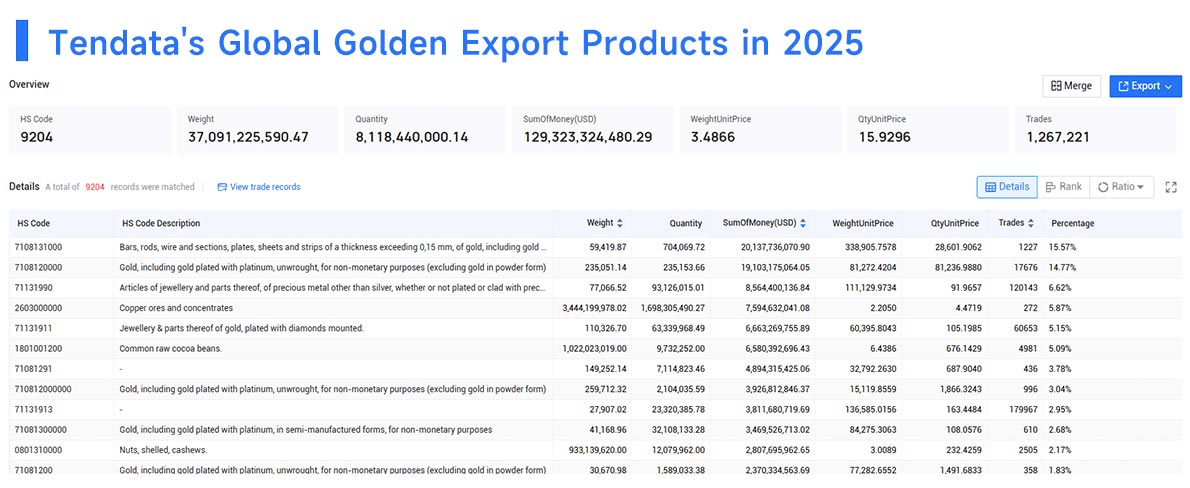
List of Major Golden Exporting HS Codes
According to Tendata global trade data, here is the list of top golden HS Codes in 2025:
Top 5 global golden export HS Code List in 2025:
1.HS Code:711319909(6.62%,$8,564.40million):Articles of jewellery and parts thereof, of precious metal other than silver, whether or not plated or clad with precious metal
2.HS Code:711319119(5.15%,$6,663.27 million):Jewellery & parts thereof of gold, plated with diamonds mounted.
3.HS Code:71081200(1.83%,$2,370.33 million):Gold, including gold plated with platinum, unwrought, for non-monetary purposes (excluding gold in powder form)
4.HS Code:71081290(1.29%,$1,663.53 million):Gold, incl. gold plated with platinum, unwrought, for non-monetary purposes (excl. gold in powder form)
5.HS Code:71131919(0.98%,$1,271.32 million):Jewellery & parts thereof of gold, n.e.s.
The global gold export market covers both raw materials and high-value finished products, with trade activity distributed across multiple HS code categories. Based on Tendata data for 2025, the top HS codes highlight the strong dominance of gold jewellery exports, alongside steady flows of unwrought gold used for investment and industrial purposes.
Overall, this HS code structure shows a clear pattern: gold exports are not limited to raw commodities but are heavily driven by value-added products such as jewellery. This dual structure—combining upstream raw gold supply with downstream manufacturing—enhances the resilience and profitability of the global gold trade, while also reflecting shifting demand toward high-margin, consumer-driven segments.
Top 10 Golden Exporting Countries
According to Tendata global trade data, below is the list of major golden exporting countries in 2025:
1.Ivory Coast(17.52%, $22,658.44 million)
2.India(12.83%,$16,598.25 million)
3.Ghana(12.00%,$15,523.18 million)
4.Peru(9.85% ,$12,739.41 million)
5.Indonesia(9.08%,$11,737.62 million)
6.Kazakhstan(5.91%,$7,643.19 million)
7.Mexico(5.87%,$7,586.62 million)
8.Colombia(3.86%,$4,989.11 million)
9.Tanzania(3.14%,$4,065.63 million)
10.Malaysia(2.94%,$3,808.51 million)
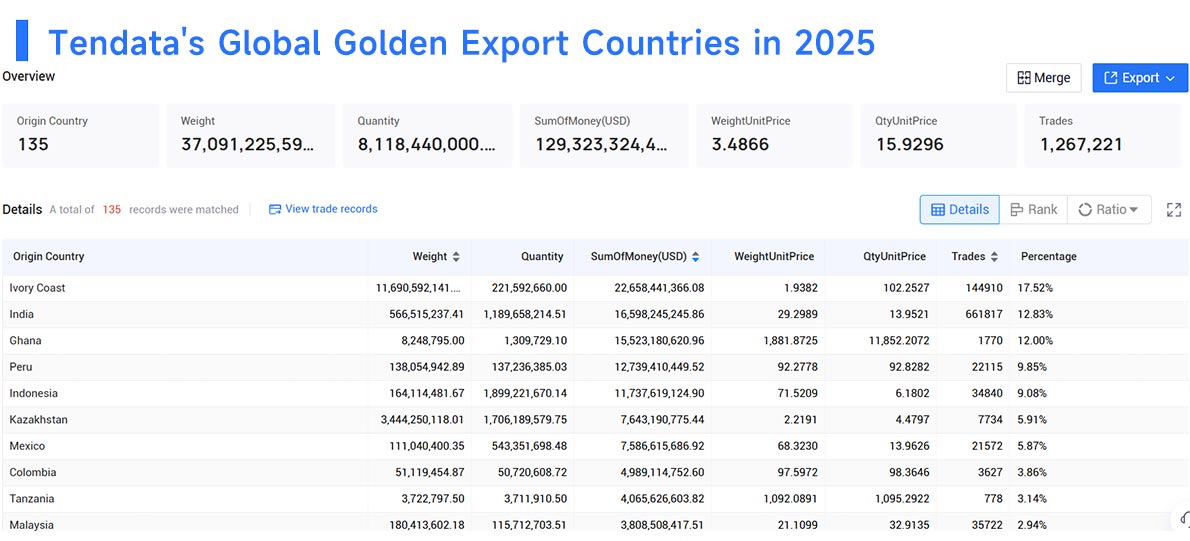
The global gold export market in 2025–2026 shows a clear concentration among emerging mining economies, with supply increasingly driven by resource-rich countries rather than traditional financial hubs. Based on Tendata data, Ivory Coast leads global gold exports with a 17.52% share (USD 22.66 billion), followed by India (12.83%) and Ghana (12.00%), forming the top tier of exporters. Countries such as Peru, Indonesia, and Kazakhstan also play key roles, each contributing between 5%–10% of global exports, while Mexico, Colombia, Tanzania, and Malaysia complete the top 10 list.
Overall, the top 10 gold exporting countries account for a substantial share of global trade, indicating a highly competitive yet resource-concentrated market. The dominance of these countries reflects not only their mining capacity, but also their ability to integrate into global supply chains, making them critical players in shaping international gold trade flows.
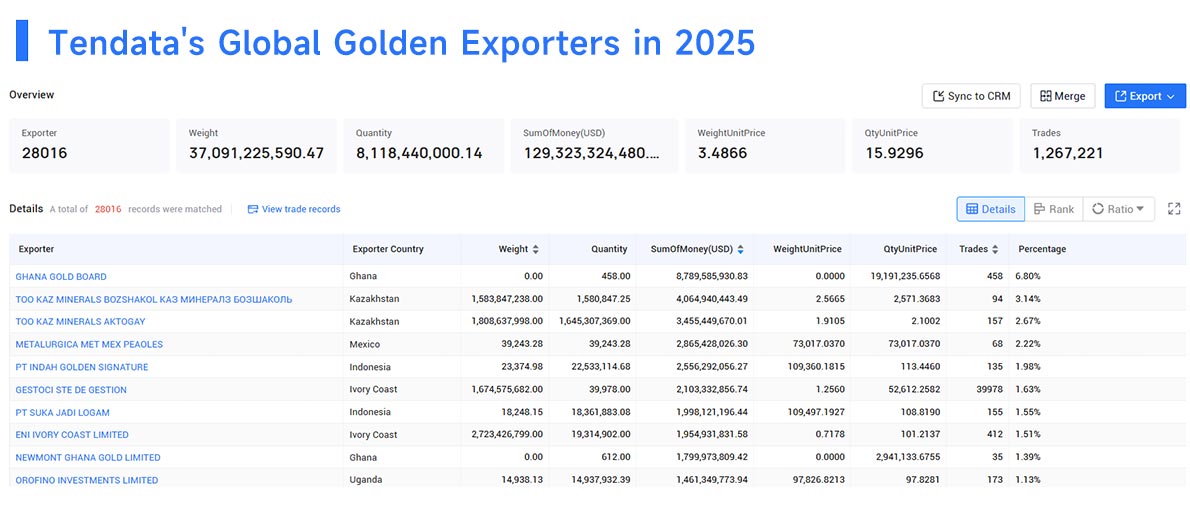
Top Global Golden Exporters in 2025
According to Tendata global trade data, here is the list of top golden exporters worldwide in 2025:
1.GHANA GOLD BOARD(6.80% ,$8,789.59 million)
2.ТОО KAZ MINERALS BOZSHAKOL КАЗ МИНЕРАЛЗ БОЗШАКОЛЬ(3.14%,$4,064.94 million)
3.ТОО KAZ MINERALS AKTOGAY(2.67% ,$3,455.45 million)
4.METALURGICA MET MEX PEAOLES(2.22%,$2,865.43 million)
5.PT INDAH GOLDEN SIGNATURE(1.98%,$2,556.29 million)
6.GESTOCI STE DE GESTION(1.63%,$2,103.33 million)
7.PT SUKA JADI LOGAM(1.55% ,$1,998.12 million)
8.ENI IVORY COAST LIMITED(1.51% ,$1,954.93 million)
9.NEWMONT GHANA GOLD LIMITED(1.39% ,$1,799.97 million)
10.OROFINO INVESTMENTS LIMITED(1.13% ,$1,461.35 million)
How to Find Golden Export Data with Tendata
Accessing accurate gold export data is essential for understanding market trends, identifying buyers, and evaluating competition. Platforms like Tendata provide a structured and efficient way to retrieve this information through real customs records and advanced analytics tools.
First, users can simply input product keywords such as “gold export” or relevant HS codes (e.g., 7108 or 7113) into the Tendata system. The platform then returns detailed shipment-level data, including exporter and importer names, transaction values, quantities, and destination markets. This allows businesses to quickly understand which countries are exporting the most gold, where the demand is concentrated, and how trade flows are evolving.
Second, Tendata enables users to filter and segment data by country, time period, and buyer activity, helping identify the most active gold importers and high-potential markets. With access to millions of transaction records and company profiles, users can analyze buyer purchasing frequency, supplier relationships, and price trends, which are critical for targeting the right customers.
Finally, beyond raw data, Tendata integrates market analysis, competitor tracking, and customer development tools, allowing exporters to move from data insights to actionable strategy. Instead of manually collecting fragmented information, businesses can use a single platform to identify opportunities, validate buyers, and optimize their gold export strategy with precision.
Final Words
The global gold export market in 2025–2026 stands out as one of the most strategic, high-value, and globally interconnected trade sectors, driven by strong demand fundamentals and expanding participation. With export values exceeding USD 120 billion, and supported by over a million traders worldwide, gold continues to play a dual role as both a commodity and a financial asset in the global economy.
Looking ahead, success in the gold export business will depend less on access to supply alone, and more on the ability to interpret trade flows, identify reliable buyers, and respond to market shifts quickly. In this context, data-driven tools like Tendata are becoming essential, enabling exporters to move beyond fragmented information and make precise, informed decisions.
FAQ
1. What is gold export data and why is it important?
Gold export data includes shipment records, exporter and importer details, trade value, volume, and destination markets. It helps businesses understand global demand, pricing trends, and buyer activity, which is critical for identifying opportunities and reducing market risk. Gold exports exceeded USD 120+ billion globally, highlighting its importance as both a commodity and financial asset.
2. How can I find reliable gold buyers using Tendata?
With Tendata, you can search by HS codes (e.g., 7108, 7113) or product keywords to access real customs data. The platform reveals active importers, purchase frequency, supplier relationships, and transaction history, helping you identify buyers who are consistently sourcing gold rather than one-time purchasers.
3. Can Tendata help analyze gold export trends and markets?
Yes. Tendata aggregates billions of trade records and provides tools to analyze export volumes, price movements, and country-level demand distribution. This allows exporters to track which markets are growing, which countries dominate supply, and where new opportunities are emerging.
4. What kind of company information can I get from Tendata?
Beyond trade data, Tendata offers access to company profiles, decision-maker contacts, and supply chain relationships. Users can identify key stakeholders such as buyers, procurement managers, and distributors, making it easier to reach out and convert leads into actual orders.
5. How does Tendata improve gold export business decisions?
Instead of relying on fragmented or outdated information, Tendata provides real-time, data-driven insights. Exporters can use it to validate buyers, monitor competitors, optimize pricing strategies, and identify high-potential markets, ultimately improving efficiency and increasing deal success rates.
Category
Leave Message for Demo Request or Questions