
 Tendata AI
  Exhibition
 B2B Platforms
 Standalone Website
 Social Media
 Emails
 Export News
 2026-04-02
Keypoints
·The export structure is highly concentrated, with a dominant destination market (such as the Philippines) accounting for a significant share, while secondary markets across Asia, the Middle East, and developed economies provide diversification opportunities.
·Bangladesh’s dairy exports are primarily focused on processed products such as milk, cream, and value-added food items, rather than raw milk, indicating gradual upgrading along the value chain.
·The presence of 1,700+ exporters and 45 destination countries suggests a broad but fragmented export base, where many small and medium exporters participate with relatively low transaction frequency.

The dairy sector plays an increasingly important role in supporting food supply, nutrition, and agro-based industries across global markets. From basic milk and cream products to processed dairy and value-added food items, the exports of Bangladesh contribute to regional trade flows and emerging market demand. Understanding Bangladesh milk export trends provides valuable insight into production capabilities, export structures, and evolving trade dynamics within the global dairy industry. This analysis explores Bangladesh’s dairy export landscape based on global trade data, highlighting key export destinations, major HS Codes, exporter activity, and other critical trends shaping the future of exports of Bangladesh in the milk sector.
Milk Exports of Bangladesh: Data Overview 2025
According to Tendata Bangladesh trade data, the overall structure of exports of Bangladesh in the milk sector reflects a relatively small but active export network with clear growth potential. In 2025, the market includes 1,709 exporters serving 45 destination countries, generating a total export value of approximately $8.77 million across 405 trade transactions. This indicates that Bangladesh’s dairy export sector is characterized by a moderate exporter base but relatively low transaction frequency, suggesting that exports are still in a developing stage with room for expansion.
From an industry perspective, Bangladesh’s dairy sector operates under a dual dynamic—while domestic demand remains high and often requires imports to fill supply gaps, export activity continues to rise, particularly in processed dairy products such as milk and cream . This creates a unique trade pattern where exports of Bangladesh are driven more by niche opportunities and regional demand rather than large-scale global competitiveness.
List of Major Milk Exporting of Bangladesh HS Codes
According to Tendata Bangladesh trade data, here is the list of top milk HS Codes in 2025:
1.HS Code:4012010(58.63%, $5.14 Million):Milk and cream of a fat content by weight of > 1% but <= 6%, not concentrated nor containing added sugar or other sweetening matter (excl. butter)
2.HS Code:19053100(13.50%, $1.18 Million):Biscuits, sweet (excl. wafers)
3.HS Code:17049090(11.69%, $1.03 Million):Other sugar confectionery, not containing cocoa
4.HS Code:22029900(4.76%, $0.42 Million):Other non-alcoholic beverages
5.HS Code:62044400(1.31%, $0.12 Million):Woven fabrics of synthetic staple fibres
6.HS Code:20098900(1.19%, $0.10 Million):Juices of single fruit or vegetable, unflavoured, not containing spirits, with added sugar or other sweetening substances
7.HS Code:21069090(1.01%, $0.09 Million):Other food preparations not elsewhere specified
8.HS Code:4032000(1.00%, $0.09 Million):Dairy products; birds' eggs; natural honey; edible products of animal origin, n.e.s.
9.HS Code:4029900(0.98%, $0.09 Million):Milk and cream, not in solid form, concentrated, sweetened
10.HS Code:4012090(0.43%, $0.04 Million):Milk and cream of a fat content by weight of > 1% but <= 6%, other
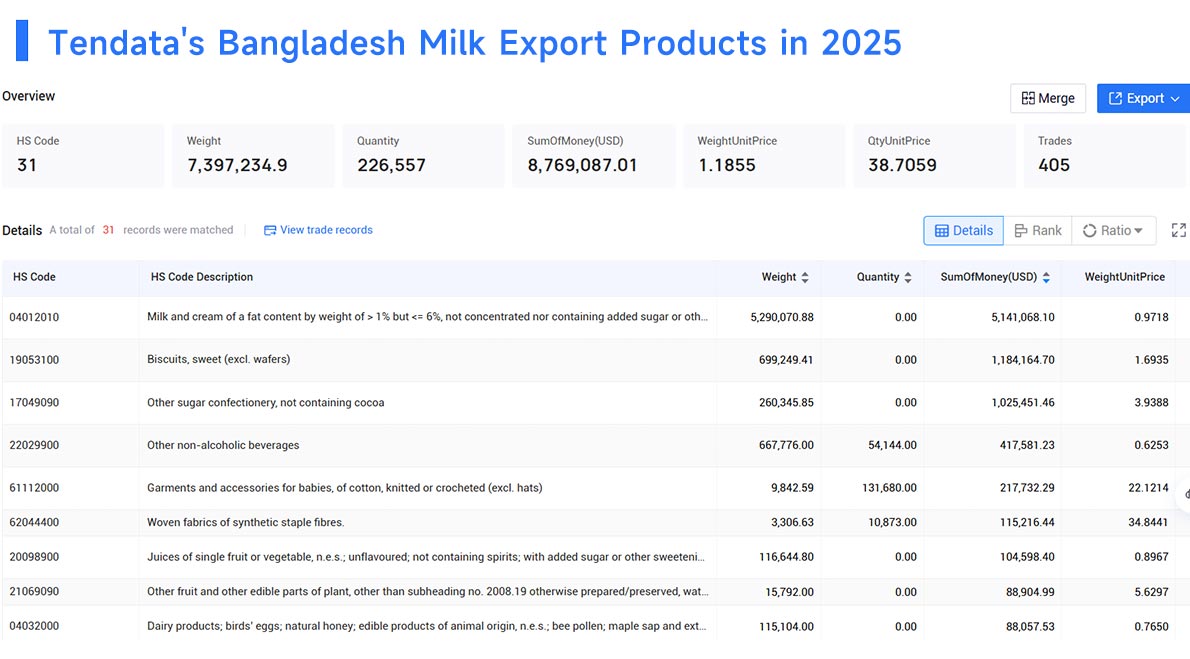
According to Tendata Bangladesh trade data, the structure of exports of Bangladesh in the milk and dairy-related segment reflects a diversified product mix, extending beyond raw dairy to include processed and value-added food categories. Among all product lines, HS Code 4012010 dominates the market, accounting for 58.63% of total export value (approximately $5.14 million), indicating that non-concentrated milk and cream remains the core component of Bangladesh’s dairy exports.
In addition to primary dairy products, Bangladesh shows notable export activity in downstream and related food categories. For instance, HS Code 19053100 (sweet biscuits) represents 13.50% of exports, while HS Code 17049090 (sugar confectionery) contributes 11.69%, highlighting the country’s growing capability in processed food manufacturing linked to dairy supply chains. Other supporting categories include non-alcoholic beverages (22029900) and fruit/vegetable juices (20098900), which together indicate diversification into fast-moving consumer goods.
Smaller shares are distributed across niche segments such as food preparations (21069090), animal-origin edible products (4032000), and concentrated milk products (4029900), each contributing around 1% of total export value. These categories, although limited in scale, suggest emerging opportunities for product upgrading and value-added exports.
Top Milk Exporting of Bangladesh by Destination Country
According to Tendata Bangladesh trade data, below is the list of major milk exporting countries in 2025:
1.Philippines (69.44%, $6.09 Million)
2.Vietnam (7.90%, $0.69 Million)
3.India (3.96%, $0.35 Million)
4.Cambodia (2.81%, $0.25 Million)
5.United Kingdom (2.58%, $0.23 Million)
6.United States (1.53%, $0.13 Million)
7.Saudi Arabia (1.17%, $0.10 Million)
8.United Arab Emirates (1.05%, $0.09 Million)
9.Sri Lanka (1.02%, $0.09 Million)
10.Laos (0.83%, $0.07 Million)
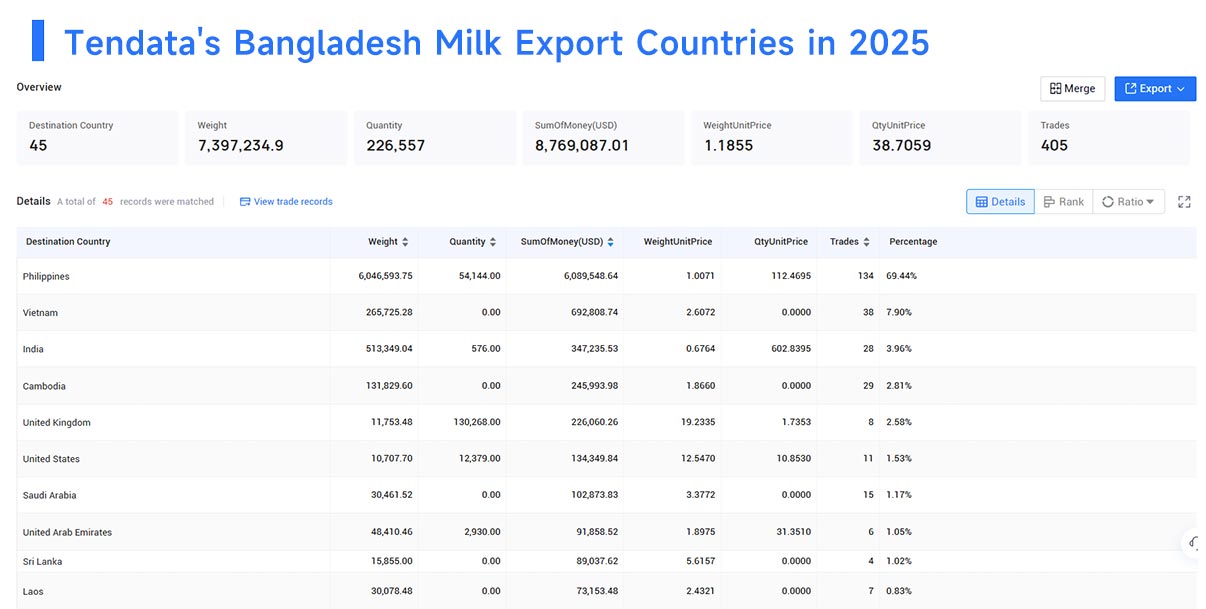
According to Tendata Bangladesh trade data, the geographic distribution of exports of Bangladesh in the milk sector reveals a highly concentrated yet regionally strategic market structure. In 2025, the Philippines stands out as the dominant destination, accounting for a significant 69.44% of total export value (approximately $6.09 million). This strong concentration indicates a stable and possibly long-term trade relationship, making the Philippines a core market for Bangladesh’s dairy exports.
Beyond this primary market, Bangladesh maintains a diversified export footprint across Asia and selected global markets. Vietnam (7.90%) and India (3.96%) represent key regional buyers, reflecting growing demand within neighboring and Southeast Asian economies. Emerging markets such as Cambodia (2.81%) and Sri Lanka (1.02%) further highlight Bangladesh’s expanding presence in developing consumption markets.
Meanwhile, exports to developed economies—including the United Kingdom (2.58%) and the United States (1.53%)—though smaller in share, indicate Bangladesh’s ability to meet higher regulatory and quality standards. Additionally, Middle Eastern markets such as Saudi Arabia (1.17%) and the United Arab Emirates (1.05%) provide supplementary demand, driven by strong import reliance in the region.
Exporting Of Bangladesh: Top Bangladesh Milk Exporters in 2025
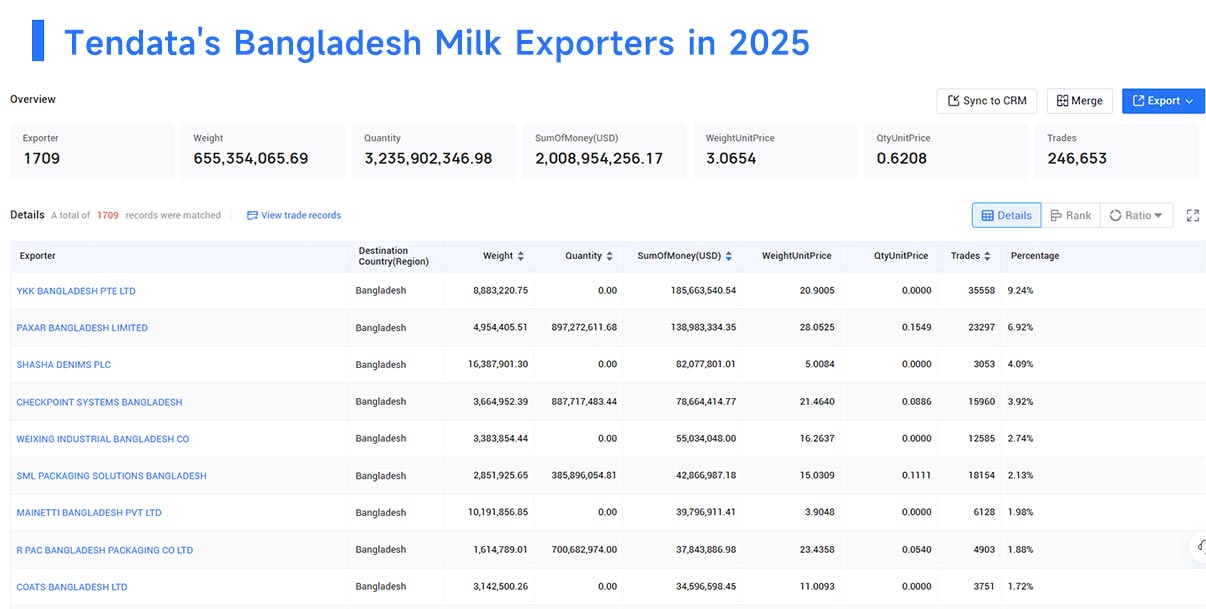
According to Tendata Bangladesh trade data, here is the list of top milk exporters in 2025:
1.YKK BANGLADESH PTE LTD (9.24%, $185.66 Million)
2.PAXAR BANGLADESH LIMITED (6.92%, $138.98 Million)
3.SHASHA DENIMS PLC (4.09%, $82.08 Million)
4.CHECKPOINT SYSTEMS BANGLADESH (3.92%, $78.66 Million)
6.WEIXING INDUSTRIAL BANGLADESH CO (2.74%, $55.03 Million)
7.SML PACKAGING SOLUTIONS BANGLADESH (2.13%, $42.87 Million)
8.MAINETTI BANGLADESH PVT LTD (1.98%, $39.80 Million)
9.R PAC BANGLADESH PACKAGING CO LTD (1.88%, $37.84 Million)
10.COATS BANGLADESH LTD (1.72%, $34.60 Million)
Exporting Of Bangladesh: How to Find Milk Export Data of Bangladesh with Tendata
To effectively analyze exports of Bangladesh in the milk sector, businesses need to rely on structured global trade data platforms and official statistical sources. As highlighted in industry practices, import-export data can be accessed through databases such as customs records, international trade platforms, and government statistical systems, which provide detailed insights into shipment-level transactions, HS codes, values, and trading partners .
For Bangladesh milk exports, the process typically begins with identifying the relevant HS Codes (such as milk and dairy-related classifications), then filtering trade data by country, time period, and product category. Using platforms like Tendata or similar global trade intelligence tools, users can track key indicators including export value, shipment frequency, and major destination markets. These systems aggregate data from customs authorities, ports, and logistics records, ensuring a high level of accuracy and real-time relevance .
In addition, advanced trade databases allow users to go beyond basic statistics by analyzing buyer-supplier relationships, pricing trends, and demand patterns. This enables exporters to identify high-potential markets, monitor competitors, and optimize their export strategies. For example, by examining shipment data and partner countries, businesses can pinpoint stable buyers and uncover new opportunities within the exports of Bangladesh dairy sector.
Final Words
In conclusion, the current landscape of exports of Bangladesh in the milk sector reflects a niche yet steadily evolving segment within the country’s broader agri-food trade. While Bangladesh remains a net importer of dairy products due to strong domestic demand and supply gaps , its export activity—particularly in processed milk and cream—continues to grow and reach multiple international markets . This dual dynamic highlights both the challenges and the untapped potential of Bangladesh’s dairy industry in global trade.
FAQ
1. Which countries are the main destinations for exports of Bangladesh milk?
Based on Tendata trade data, the exports of Bangladesh milk are highly concentrated, with the Philippines dominating as the primary destination, followed by Vietnam, India, and several smaller markets across Asia, the Middle East, and developed economies. This structure highlights a strong reliance on a core buyer while maintaining a diversified secondary market presence.
2.How can businesses find reliable data on exporting of Bangladesh dairy products?
Businesses can access exporting of Bangladesh milk data through global trade intelligence platforms like Tendata, which aggregate customs records, bill of lading data, and international shipment information. These platforms provide detailed insights such as exporter names, HS codes, shipment values, pricing trends, and buyer contacts—enabling more precise market analysis and customer targeting.
3.How does Tendata help analyze exports of Bangladesh more effectively?
Tendata enhances the analysis of exports of Bangladesh by transforming raw trade data into actionable insights. Users can identify top buyers, track demand trends across countries, and evaluate competitor activity. With advanced filters and AI-driven analytics, businesses can uncover high-potential markets, optimize export strategies, and reduce risks in global dairy trade.
Category
Leave Message for Demo Request or Questions