
 Tendata AI
  Exhibition
 B2B Platforms
 Standalone Website
 Social Media
 Emails
 Export News
 2026-04-02
Keypoints
·The global export of copper reflects a highly structured value chain, covering upstream ores (HS 2603), refined copper cathodes (HS 7403), and downstream semi-finished products, indicating strong vertical integration across international trade.
·Recycling and secondary copper (scrap) exports are becoming a key growth segment, with countries like the United States, Germany, and Japan playing important roles in supplying recycled copper to global markets, enhancing sustainability and cost efficiency .
·Trade dynamics among exporters of copper are shifting due to geopolitical factors, pricing arbitrage, and evolving supply chains, with countries like China increasingly influencing global copper flows through expanding refining capacity and re-export activities

The global copper export industry plays a vital role in supporting key sectors such as construction, electronics, renewable energy, and transportation worldwide. From raw copper ores to refined cathodes and value-added copper products, the export of copper drives international trade and underpins modern industrial development. Understanding the major exporters of copper provides valuable insights into global supply chains, resource distribution, and processing capabilities across different regions.
This blog explores the copper export market based on global trade data, highlighting leading exporters of copper, key exporting countries, copper HS codes, and emerging trade trends. By analyzing these factors, businesses can better understand market dynamics, identify growth opportunities, and make more informed decisions in the evolving global copper trade landscape.
Exporters of Copper: 2025 Overview of Global Copper Export Data
The global copper export market in 2025 demonstrates a highly active and widely distributed trade network, reflecting the critical role of copper in industrial and technological supply chains. According to Tendata global trade data, there are 21,491 exporters of copper supplying to 208 destination countries, generating a total trade value of $68.38 billion across 1,150,022 transactions. This extensive participation highlights the strong global demand for copper across sectors such as construction, electronics, energy, and automotive manufacturing.
The large number of exporters indicates a competitive and diversified supplier base, while the broad destination coverage underscores copper’s universal importance as a strategic raw material. At the same time, the high transaction volume suggests stable and frequent procurement cycles, particularly for refined copper and semi-finished products. Overall, the global landscape of exporters of copper reflects a mature and interconnected market, where both resource-rich countries and processing-driven economies play key roles in sustaining the continuous flow of copper in international trade.
Exporters of Copper: List of Major Copper Exporting HS Codes
According to Tendata global trade data, here is the list of top copper HS Codes in 2025:
1.HS Code:26030001(16.52%, $11.30 Billion):Copper ores and concentrates (excl. roasted iron pyrites)
2.HS Code:2603000000(14.53%, $9.93 Billion):Copper ores and concentrates
3.HS Code:7403110000(14.46%, $9.89 Billion):Copper, refined, in the form of cathodes and sections of cathodes.
4.HS Code:7403190000(4.98%, $3.40 Billion):Refined copper products, unwrought, n.e.s.
5.HS Code:2603000000(3.50%, $2.39 Billion):Copper ores and concentrates
6.HS Code:74031100(3.37%, $2.30 Billion):Copper, refined, in the form of cathodes and sections of cathodes.
7.HS Code:74031900(2.85%, $1.95 Billion):Refined copper products, unwrought, n.e.s.
8.HS Code:26030000(2.79%, $1.91 Billion):Copper ores and concentrates
9.HS Code:74040003(2.52%, $1.72 Billion):Waste and waste, copper.
10.HS Code:74111000(2.21%, $1.51 Billion):Copper tubes and pipes, refined.
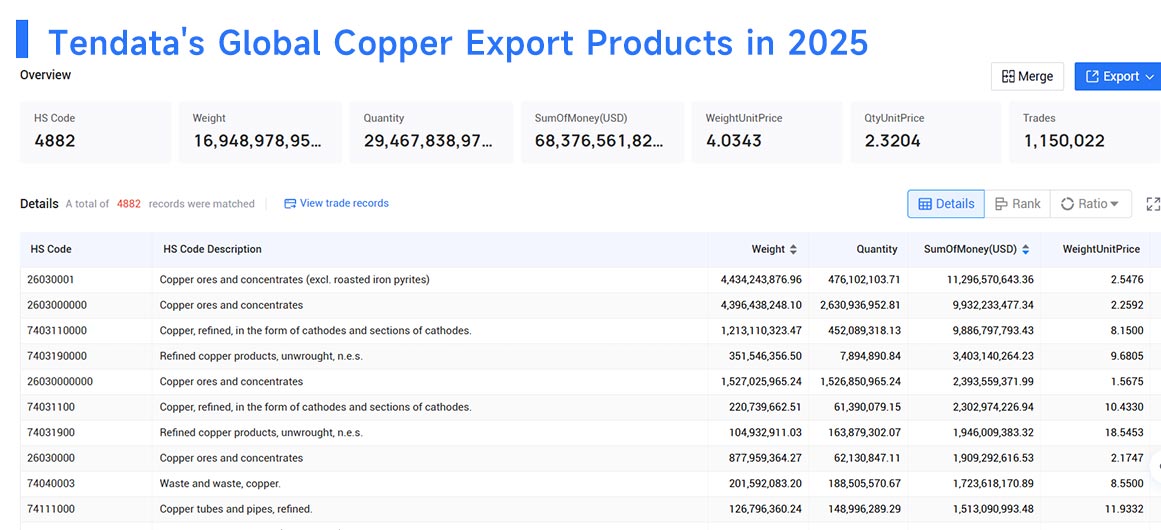
According to Tendata global trade data, the export of copper in 2025 is strongly concentrated across a range of key HS codes, reflecting both upstream raw materials and downstream processed products within the global supply chain. Among these, HS Code 26030001 (copper ores and concentrates) leads with a 16.52% share valued at $11.30 billion, followed by 2603000000 and 7403110000, which represent significant volumes of copper ores and refined copper cathodes respectively. This indicates that the exporters of copper are not only dominated by resource-rich countries supplying raw ores, but also by industrialized economies specializing in refined copper products.
In addition, refined copper categories such as HS Code 7403190000 and 74031100 highlight the importance of semi-processed and unwrought copper in international trade, while secondary segments like copper waste (HS Code 74040003) and copper tubes and pipes (HS Code 74111000) demonstrate the growing role of recycling and value-added manufacturing. Overall, the structure of the export of copper shows a vertically integrated trade pattern—from raw ore extraction to refined and fabricated copper products—providing exporters with multiple entry points into global markets and reinforcing the strategic importance of copper across industries such as construction, electronics, and energy.
Exporters of Copper: Top Copper Exporting Countries
According to Tendata global trade data, below is the list of major copper exporting countries in 2025:
1.China(43.72%, $29.89 Billion)
2.Turkey(7.95%, $5.44 Billion)
3.United States(4.67%, $3.19 Billion)
4.Japan(4.47%, $3.06 Billion)
5.South Korea(3.31%, $2.26 Billion)
6.Vietnam(3.14%, $2.15 Billion)
7.India(2.91%, $1.99 Billion)
8.Switzerland(2.33%, $1.60 Billion)
9.Germany(2.14%, $1.47 Billion)
10.Saudi Arabia(2.11%, $1.44 Billion)
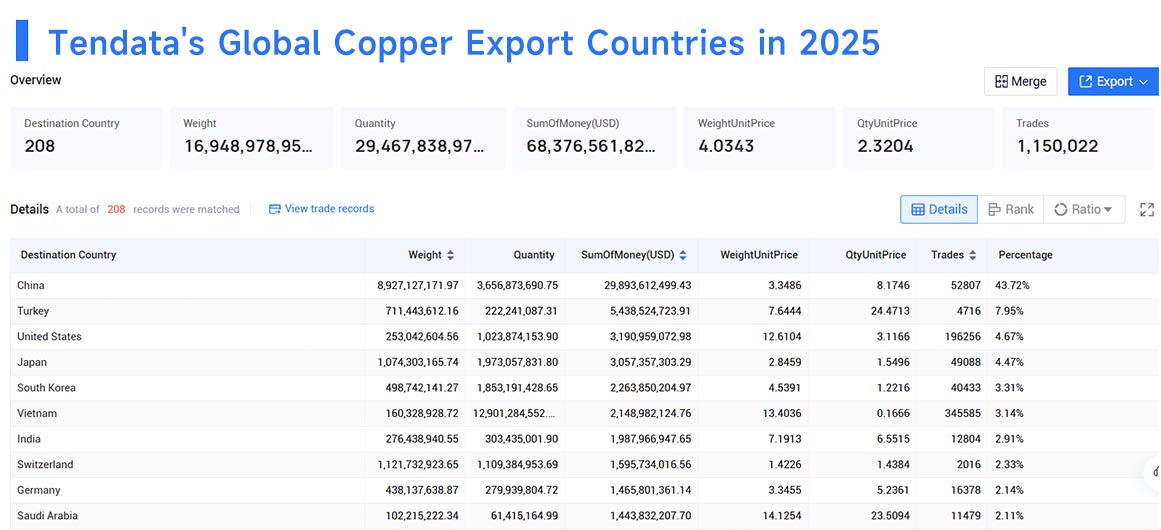
According to Tendata global trade data, the exporting of copper in 2025 is characterized by a highly concentrated yet diversified global landscape, where both manufacturing powerhouses and processing hubs play critical roles. China dominates the market with a commanding 43.72% share, reaching $29.89 billion, making it the leading force among the exporters of copper. This reflects not only its large-scale refining capacity but also its strong position in downstream copper product manufacturing.
Following China, countries such as Turkey (7.95%, $5.44 billion) and the United States (4.67%, $3.19 billion) emerge as key contributors, supported by their strategic roles in regional trade and industrial supply chains. Advanced economies including Japan (4.47%) and South Korea (3.31%) further strengthen the global exporting of copper through high-value refined copper and precision components, particularly for electronics and automotive industries.
Meanwhile, emerging exporters like Vietnam (3.14%) and India (2.91%) are gaining traction, benefiting from expanding manufacturing bases and increasing integration into global value chains. European players such as Switzerland (2.33%) and Germany (2.14%), along with Middle Eastern exporter Saudi Arabia (2.11%), highlight the importance of specialized processing, re-export activities, and strategic trade positioning.
Top Global Exporters of Copper in 2025
According to Tendata global trade data, here is the list of top copper exporters worldwide in 2025:
1.ТОВАРИЩЕСТВО С ОГРАНИЧЕННОЙ ОТВЕТСТВЕННОСТЬЮ KAZAKHMYS SMELTING KAZAKHMYS(9.06%, $6.20 Billion)
2.OPERADORA DE MINAS E INSTALACIONES MINERAS(6.35%, $4.34 Billion)
3.TOO KAZ MINERALS BOZSHAKOL КАЗ МИНЕРАЛЗ БОЗШАКОЛЬ(5.94%, $4.06 Billion)
4.TOO KAZ MINERALS AKTOGAY(5.33%, $3.65 Billion)
5.TOO КАЗЦИНК(4.85%, $3.32 Billion)
6.MULTIMODAL ACEROS DE SONORA(2.94%, $2.01 Billion)
7.TRAFIGURA(2.63%, $1.80 Billion)
8.SOUTHERN PERU COPPER CORPORATION SUCURS(2.03%, $1.39 Billion)
9.SALOBO METAIS SA(1.79%, $1.23 Billion)
10.CÔNG TY TNHH GIA CÔNG ĐỒNG HẢI LƯỢNG VIỆT NAM(1.56%, $1.07 Billion)
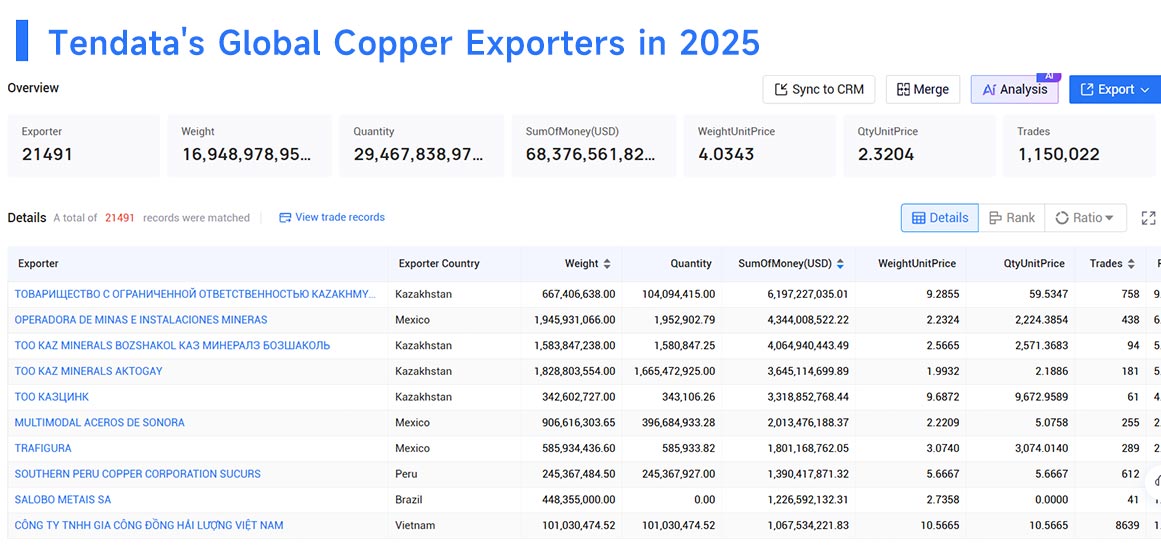
How to Find Copper Export Data with Tendata?
To effectively analyze the export of copper and identify reliable exporters of copper, businesses need to leverage structured global trade databases and HS code–based data platforms. The first step is to search using relevant HS codes which allows users to access detailed export records by product category, country, and shipment level. Platforms like customs databases and international trade intelligence tools provide comprehensive datasets that include exporter names, shipment values, quantities, destination markets, and pricing trends.
By filtering copper export data through these tools like AI-enhanced Tendata, companies can identify active exporters of copper, track their shipment frequency, and evaluate their market coverage across different regions. In addition, advanced analytics features—such as competitor tracking, buyer identification, and price benchmarking—enable exporters to uncover high-demand markets and optimize their global trade strategies. These datasets are typically updated regularly and sourced from official customs records, ensuring reliability and timeliness for decision-making.
Overall, finding accurate copper trade data is not just about accessing statistics—it involves transforming shipment-level insights into actionable intelligence. With the right tools such as Tendata, businesses can move beyond basic analysis to pinpoint high-value customers, monitor global demand shifts, and strengthen their position within the competitive landscape of exporters of copper.
Final Words
In conclusion, the global copper export market is evolving into a highly strategic and data-driven ecosystem, shaped by strong industrial demand, supply concentration, and increasing price volatility. As copper remains a critical material for energy transition, electronics, and infrastructure, global demand continues to rise while supply faces structural constraints, with reserves heavily concentrated in a few countries and prices reaching record highs in recent years . This creates both opportunities and competitive pressure for exporters of copper worldwide.
Against this backdrop, using accurate and timely trade data has become essential. Tendata enables businesses to move beyond surface-level statistics by providing shipment-level insights into global copper flows, including exporter profiles, destination markets, and transaction trends. With access to over 21,000+ exporters of copper across 200+ countries, companies can identify high-value partners, track active buyers, and optimize their market entry strategies with precision.
Ultimately, success in the copper trade is no longer determined solely by supply capacity, but by the ability to interpret data and act on it. By combining comprehensive global trade data with AI-powered analysis, Tendata empowers businesses to stay competitive, reduce risk, and capture new growth opportunities in the increasingly complex landscape of copper exports.
FAQ
1.What insights can Tendata provide for analyzing the exporting of copper?
Tendata offers comprehensive analytics for the exporting of copper, including market trends, top exporting countries, key buyers, and pricing dynamics. By analyzing shipment data, businesses can identify high-demand markets, track changes in global copper trade flows, and understand the full supply chain—from ores to refined products. This aligns with how global trade data is structured using HS codes to segment products and analyze international trade patterns effectively.
2. How does copper export data help in finding new buyers and markets?
Copper export data provides actionable insights such as buyer identities, import volumes, and purchasing frequency. With Tendata, users can filter and segment this data to discover active buyers, emerging markets, and stable procurement patterns. This helps exporters move beyond basic statistics and directly connect with high-potential customers, improving conversion rates and reducing market entry risks.
3.Why is Tendata a valuable tool for exporters of copper?
Tendata transforms raw trade data into strategic intelligence by combining global shipment records with AI-driven analysis. For companies involved in the exporting of copper, it enables precise customer targeting, competitor monitoring, and market expansion planning. By leveraging these insights, businesses can strengthen their position among global exporters of copper and make faster, data-driven decisions in a highly competitive international market.
Category
Leave Message for Demo Request or Questions