
 Tendata AI
  Exhibition
 B2B Platforms
 Standalone Website
 Social Media
 Emails
 Export News
 2026-04-03
Keypoints
·Coffee exports are primarily structured under HS Code 0901 (green/roasted coffee) and HS Code 2101 (coffee extracts and instant coffee), with unroasted coffee accounting for the largest share of global trade.
·The landscape of top coffee exporters shows a dual structure: traditional producing countries like Brazil and Vietnam dominate raw coffee supply, while developed economies such as Germany, Switzerland, and the United States lead in processing and re-export.
·Export markets are highly concentrated in developed regions, where strong logistics, roasting capacity, and branding capabilities allow countries to capture higher value in the coffee supply chain.

The global coffee industry plays a vital role in supporting agriculture, food processing, retail, and consumer markets worldwide. From raw green coffee beans to roasted and instant coffee products, coffee exports are a key driver of international trade and economic activity. Understanding the top coffee exporters provides valuable insight into global supply chains, production capabilities, and shifting trade patterns. This analysis explores the leading players in coffee export based on global trade data, highlighting top coffee exporters, major producing countries, coffee export data, relevant HS Codes, and the key trends shaping the global coffee market.
Global Top Coffee Exporters Data: 2025 Overview
The global coffee export market continues to expand as one of the most dynamic segments in agricultural trade, supported by strong demand and a highly integrated global supply chain. According to Tendata data, coffee exports reached $45.21 billion, involving 19,086 exporters, covering 220 destination countries, and generating over 462,610 trade transactions, reflecting a highly fragmented yet globally connected market. This scale is consistent with broader industry estimates showing global coffee trade exceeding $50 billion annually, driven by sustained consumption growth and diversified product forms.
List of Top Coffee Exporting HS Codes
According to Tendata global trade data, here is the list of top coffee HS Codes in 2025:
1.HS Code:9011110(20.10%, $9.08 Billion):COFFEE, ARABICA, RAW OR GREEN, NOT ROASTED, NOT DECAFFEINATED, IN-QUOTA
2.HS Code:9011130(18.13%, $8.19 Billion):Coffee (excluding roasted and decaffeinated)
3.HS Code:901119000(15.70%, $7.10 Billion):Coffee, other, neither roasted nor decaffeinated
4.HS Code:9011100(12.93%, $5.85 Billion):Coffee, not roasted or decaffeinated. (HS Code: 0901.10)
5.HS Code:901110000(3.94%, $1.78 Billion):Coffee, not roasted or decaffeinated. (HS Code: 0901.10)
6.HS Code:9011120(3.15%, $1.42 Billion):COFFEE, NOT ROASTED, NOT DECAFFEINATED
7.HS Code:21011111(2.27%, $1.02 Billion):Extracts, essences and concentrates, of coffee
8.HS Code:9011199(2.24%, $1.01 Billion):Unroasted, undecaffeinated coffee
9.HS Code:21011110(2.20%, $0.99 Billion):Instant coffee flavourings
10.HS Code:9011130900(1.91%, $0.87 Billion):Coffee (excluding roasted and decaffeinated)
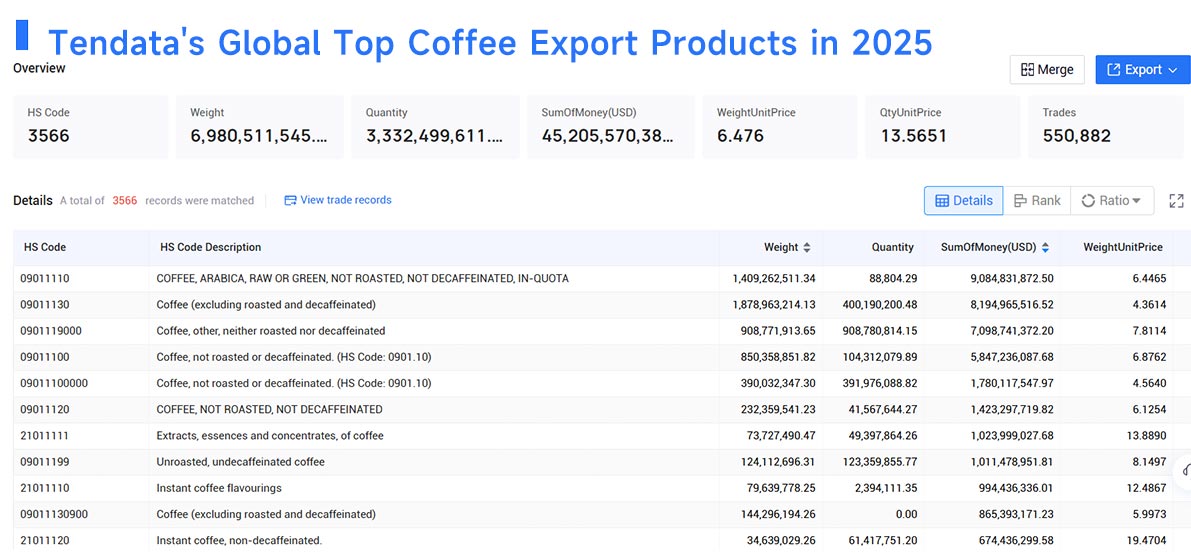
According to global trade statistics and HS classification systems, coffee is primarily traded under HS Codes 0901 (green and roasted coffee) and 2101 (coffee extracts and instant coffee), forming a critical segment of agricultural commodities in international trade. Recent coffee export data shows that global trade value exceeded $42 billion, highlighting strong and resilient demand across major consuming regions such as North America and Europe . Within this framework, the structure of top coffee export categories is dominated by unroasted and non-decaffeinated coffee (HS 0901), which accounts for the largest share of global shipments, followed by processed products like instant coffee and extracts.
Top Coffee Exporting Countries
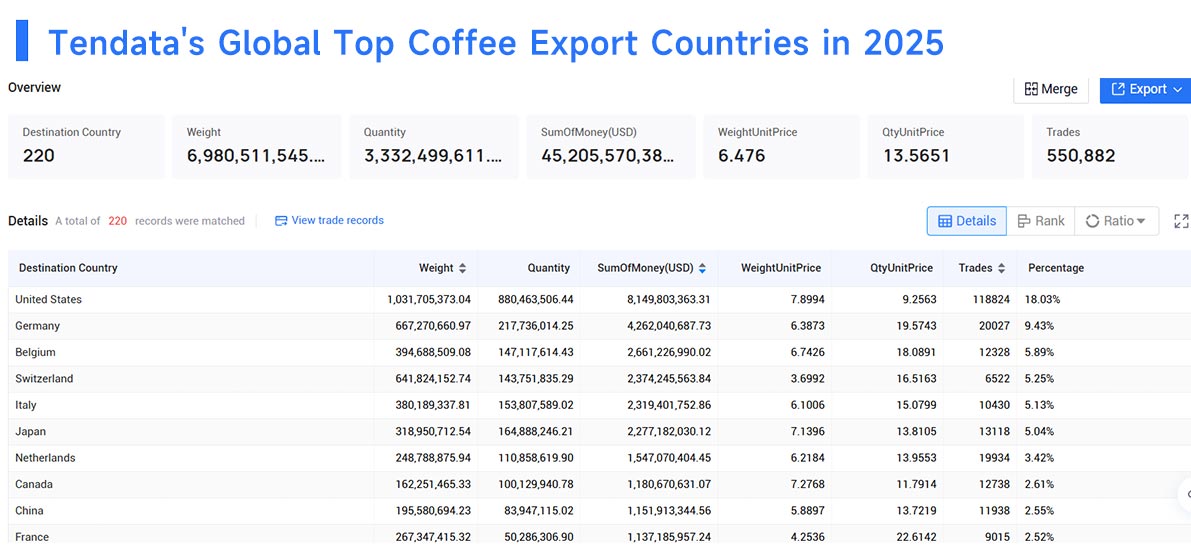
According to Tendata global trade data, below is the list of major coffee exporting countries in 2025:
1.United States(18.03%, $8.15 Billion)
2.Germany(9.43%, $4.26 Billion)
3.Belgium(5.89%, $2.66 Billion)
4.Switzerland(5.25%, $2.37 Billion)
5.Italy(5.13%, $2.32 Billion)
6.Japan(5.04%, $2.28 Billion)
7.Netherlands(3.42%, $1.55 Billion)
8.Canada(2.61%, $1.18 Billion)
9.China(2.55%, $1.15 Billion)
10.France(2.52%, $1.14 Billion)
Top Coffee Exporters in 2025
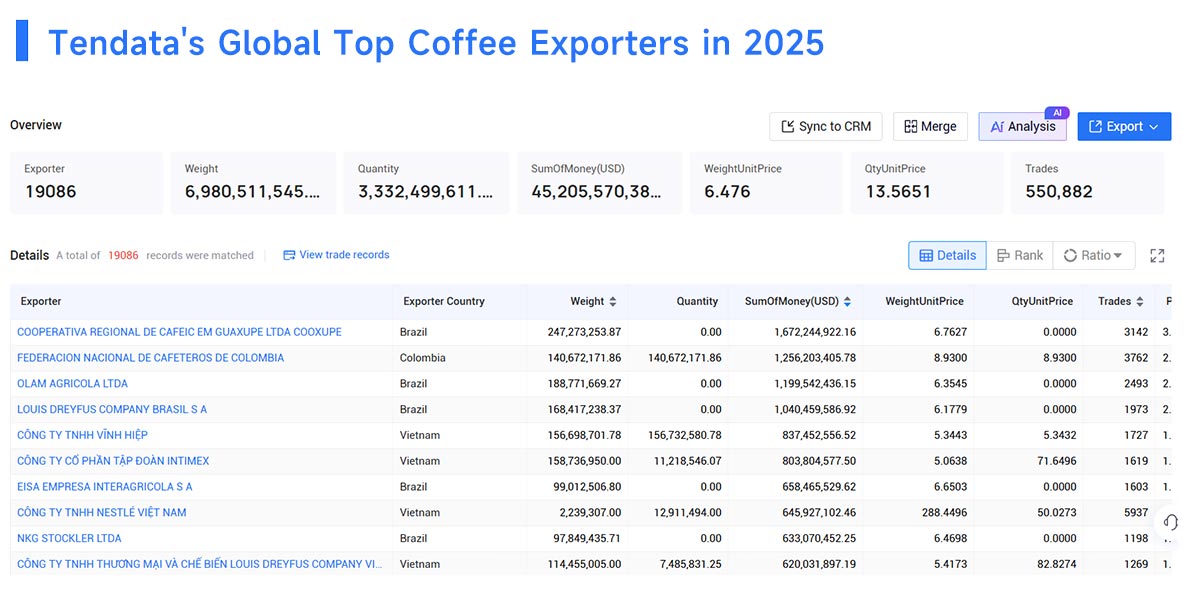
According to Tendata global trade data, here is the list of top coffee exporters worldwide in 2025:
1.COOPERATIVA REGIONAL DE CAFEIC EM GUAXUPE LTDA COOXUPE(3.70%, $1.67 Billion)
2.FEDERACION NACIONAL DE CAFETEROS DE COLOMBIA(2.78%, $1.26 Billion)
3.OLAM AGRICOLA LTDA(2.65%, $1.20 Billion)
4.LOUIS DREYFUS COMPANY BRASIL S A(2.30%, $1.04 Billion)
5.CÔNG TY TNHH VĨNH HIỆP(1.85%, $0.84 Billion)
6.CÔNG TY CỔ PHẦN TẬP ĐOÀN INTIMEX(1.78%, $0.80 Billion)
7.EISA EMPRESA INTERAGRICOLAS A(1.46%, $0.66 Billion)
8.CÔNG TY TNHH NESTLÉ VIỆT NAM(1.43%, $0.65 Billion)
9.NKG STOCKLER LTDA(1.40%, $0.63 Billion)
10.CÔNG TY TNHH THƯƠNG MẠI VÀ CHẾ BIẾN LOUIS DREYFUS COMPANY VIỆT NAM(1.37%, $0.62 Billion)
How to Find Coffee Export Data with Tendata?
To effectively analyze and identify top coffee exporters and understand the landscape of top coffee exporting markets, businesses must rely on structured trade data based on HS classification systems and verified shipment records. Coffee products are primarily categorized under HS Code 0901 (raw and roasted coffee) and HS Code 2101 (coffee extracts and instant coffee), which serve as the foundation for tracking global trade flows, export volumes, and market demand .
Companies can also find reliable coffee export data through customs records, bill of lading data, and global trade databases that aggregate shipment-level information from multiple countries. These datasets provide critical insights such as exporter names, transaction values, destination markets, and product specifications. By analying such data, businesses can accurately identify top coffee exporters, monitor competitor activity, and uncover high-potential buyers across different regions.
In addition, HS code–based trade data enables a deeper breakdown of top coffee exporting segments, distinguishing between raw coffee beans (green coffee), roasted products, and value-added derivatives like instant coffee. This level of granularity allows exporters to evaluate which product categories are driving growth and where pricing or demand advantages exist.
Overall, finding actionable coffee export data requires combining standardized HS classification with real-time shipment intelligence. Platforms like Tendata integrate multi-country customs data and continuously updated trade records, enabling users to efficiently locate top coffee exporters, analyze global supply chains, and build precise market entry or expansion strategies in the highly competitive coffee trade industry.
Final Words
In conclusion, the global coffee export market continues to demonstrate strong resilience and structural complexity, driven by both producing countries and advanced re-export hubs. Coffee remains one of the most traded agricultural commodities worldwide, with global export value exceeding $40–50 billion annually, supported by standardized HS classifications such as 0901 and 2101 . While traditional producing countries like Brazil, Vietnam, and Colombia dominate raw bean supply, the landscape of top coffee exporters increasingly includes developed economies that specialize in processing, branding, and redistribution, forming a dual-layer global value chain.
FAQ
1.How does Tendata help find top coffee exporters?
Tendata aggregates multi-country customs data and bill of lading records, enabling users to directly identify active top coffee exporters and verify real transaction histories. Instead of relying on aggregated statistics alone, users can drill down into specific companies, track their export frequency, and analyze their key destination markets—making it easier to target high-potential partners in the top coffee export ecosystem.
2.Why is HS code-based analysis important in coffee export?
HS codes ensure consistency and accuracy in global trade analysis. Since coffee trade is primarily categorized under HS Code 0901, businesses can use this unified classification to compare markets, monitor pricing trends, and identify growth segments across regions. This standardized approach is essential for benchmarking top coffee exporters and building data-driven export strategies.
3.How can businesses use Tendata to improve coffee export strategies?
By Tendata, companies can move from broad market research to precise customer development. The platform helps users identify buyers with consistent purchasing patterns, analyze supplier competition, and uncover emerging markets. This allows exporters to optimize their positioning within the top coffee export value chain and connect directly with verified global buyers.
Category
Leave Message for Demo Request or Questions