
 Tendata AI
  Exhibition
 B2B Platforms
 Standalone Website
 Social Media
 Emails
 Export News
 2026-04-03
Key Takeaways
Supplier discovery is not a one-tool problem. Here's what to remember:
· B2B marketplaces are best for passive global supplier discovery at low cost, but require heavy manual filtering.
· Risk & compliance tools add critical due diligence layers but don't help you identify which suppliers actually make what you need.
· Trade data platforms bridge both gaps — they show you who is actively exporting the right products, with verified volume data.

Supplier discovery is no longer a simple Google search or a trip to a trade show. Today's procurement teams rely on specialized platforms to surface qualified suppliers, assess risk, and validate capabilities — often across multiple countries simultaneously. Below, we break down the top tools across three core categories.
1.B2B General Supplier Marketplaces
These platforms are the traditional starting point for international supplier discovery. You post your requirements, and suppliers come to you — making them a passive but wide-reaching discovery method.
(1)Alibaba / Global Sources
The world's largest B2B marketplace, primarily strong in Asian manufacturing. Ideal for high-volume sourcing of consumer goods, electronics, and industrial products.
· Strength
Passive inbound model — upload your needs and let qualified suppliers reach out to you. Massive supplier base, low barrier to entry.
· Limitation
Requires significant manual filtering. No built-in trust verification — additional vetting is essential to avoid mismatched or low-quality suppliers.
(2)ThomasNet
North America's leading industrial supplier directory, covering manufacturing, custom fabrication, and specialized components.
·Strength
Excellent for North American sourcing with verified industrial suppliers. Great for finding niche manufacturers.
·Limitation
Geographic scope is limited. Manual screening still required; no deep background check or trade history data.
(3)Kompass
A global B2B directory with detailed company profiles across industries, spanning over 70 countries.
·Strength
Broad global reach with structured company profiles. Good for initial supplier discovery across diverse categories.
·Limitation
Profile quality varies. Like other marketplaces, it relies on self-reported data without independent verification of product-specific capabilities.
2.Risk & Compliance-Focused Tools
When supplier discovery needs to go beyond product matching and into corporate due diligence, these platforms deliver financial, ethical, and operational risk intelligence.
(1)Dun & Bradstreet (D&B)
D&B is the global standard for business credit and financial risk data, providing detailed supplier background checks and financial health scores.
·Strength
In-depth corporate background data — financial stability, credit scores, ownership structure. Ideal for enterprise-level supplier due diligence.
·Limitation
Does not provide product-level supplier data. You cannot match suppliers to specific procurement needs or product categories directly.
(2)EcoVadis
A sustainability and ESG rating platform that scores suppliers on environmental, social, and governance criteria.
·Strength
Essential for organizations with sustainability commitments or regulatory ESG requirements. Internationally recognized scoring methodology.
·Limitation
Focused on ESG ratings only. Not suited for initial supplier discovery or product-category matching.
(3)Resilinc
A supply chain risk intelligence platform that maps supplier exposure to geopolitical, natural disaster, and operational disruptions.
·Strength
Best-in-class for multi-tier supply chain risk mapping. Especially useful for risk-sensitive industries like aerospace, pharma, or automotive.
·Limitation
Not a discovery tool — it works best when you already have a supplier list you want to audit for risk.
3.Trade Data & Intelligence Platforms
Trade data tools go further than directories or risk databases — they analyze real customs and shipment records to show you exactly who is exporting what, to whom, and in what volume. This is arguably the most actionable form of supplier discovery data.
(1)Panjiva (S&P Global)
Panjiva analyzes global trade shipment records, making it powerful for competitive intelligence and verifying supplier trade activity.
(2)ImportGenius
Similar to Panjiva, ImportGenius provides US import/export records and is popular for tracking competitor sourcing patterns.
(3)Tendata
Tendata stands out among trade data providers as an all-in-one supplier discovery and due diligence platform, combining trade intelligence with built-in background screening.
Unlike Panjiva and ImportGenius, Tendata bundles supplier due diligence directly into its platform — covering company basics, news sentiment, and intellectual property records — without gating contact information behind additional fees. If you need to source from markets in Southeast Asia, Latin America, Africa, or beyond North America and Europe, Tendata's 228+ country coverage makes it the strongest choice.
Strengths:
·Built-in supplier background checks (company info, news, IP records) — no extra fees
·228+ countries covered — the broadest global reach among trade data tools
·Supplier contact details included in the base plan
·Ideal for discovering suppliers outside the US and beyond typical market coverage
To illustrate Tendata's depth, here are the top spice suppliers with verified 2025 export records — including trade volume share and estimated revenue — surfaced directly from the platform:
1.MARINASOL S A(4.87%, $64.2 Million)
2.CÔNG TY TNHH HARRIS FREEMAN VIỆT NAM(4.73%, $62.32 Million)
3.GRANJAS CARROLL DE MEXICO(4.72%, $62.27 Million)
4.CÔNG TY CỔ PHẦN ĐẦU TƯ XUẤT NHẬP KHẨU PHÚC THỊNH(4.16%, $54.84 Million)
5.COMERCIALIZADORA PEPSICO MEXICO(3.24%, $42.68 Million)
6.CÔNG TY CỔ PHẦN PROSI THĂNG LONG(2.92%, $38.51 Million)
7.CÔNG TY TNHH THỰC PHẨM NHẤT NGUYÊN(2.71%, $35.71 Million)
8.NESTLE COTE D IVOIRE(2.71%, $35.67 Million)
9.CÔNG TY TNHH SẢN XUẤT VÀ XUẤT KHẨU RỪNG XANH T AND K(1.95%, $25.71 Million)
10.CÔNG TY CỔ PHẦN SENSPICES VIỆT NAM(1.43%, $18.85 Million)
Source: Tendata platform — 2025 export records, spice category. Revenue figures are estimated from trade volume data.
>>Request A Free Demo with Tendata<<
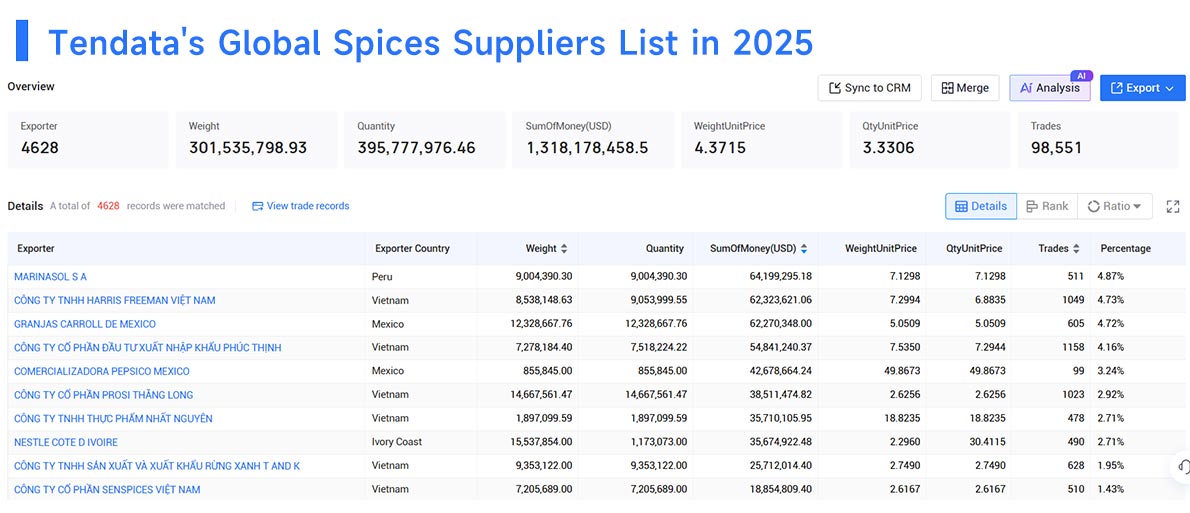
This level of granularity — including supplier share, verified export history, and geographic diversity across Vietnam, Mexico, and Côte d'Ivoire — is exactly what makes trade data tools superior for targeted supplier discovery compared to passive marketplaces.
For most procurement teams, the ideal workflow combines a trade data platform like Tendata for initial supplier discovery, followed by D&B or EcoVadis for targeted due diligence on shortlisted candidates. This layered approach to supplier discovery maximizes efficiency while minimizing supply chain risk.
FAQ
1.Which supplier discovery tool is best for small businesses?
For SMBs, Alibaba, ThomasNet, and Kompass are the most accessible entry points — they're relatively affordable and allow passive inbound discovery. However, small businesses looking for verifiable trade data should consider Tendata, which offers comprehensive background data without requiring multiple paid add-ons.
2.What makes Tendata better than Panjiva or ImportGenius?
Three main advantages: first, Tendata covers 228+ countries versus the more limited geographic scope of Panjiva and ImportGenius. Second, Tendata includes built-in supplier background checks (financials, news, IP records) at no extra cost. Third, supplier contact details are included in the base plan, whereas Panjiva and ImportGenius charge additional fees to unlock contact information.
3.Can I use multiple supplier discovery tools together?
Yes — and for enterprise procurement, this is best practice. A common workflow is to use a trade data platform like Tendata for initial supplier discovery, then layer in D&B for financial due diligence and EcoVadis for ESG scoring on your shortlisted candidates. Each tool adds a distinct dimension to the evaluation.
4. How do I verify if a supplier is legitimate?
The most reliable verification combines multiple signals: actual trade records (from platforms like Tendata) proving the supplier has active export history, financial health data from D&B, ESG ratings from EcoVadis if sustainability is a concern, and direct communication with the supplier including factory audits where possible. Trade data alone is often the fastest first filter, as it is based on customs records rather than self-reported claims.
Category
Leave Message for Demo Request or Questions