
 Tendata AI
  Exhibition
 B2B Platforms
 Standalone Website
 Social Media
 Emails
 Export News
 2026-04-03
Keypoints
·Asia continues to dominate the global jewelry exporting landscape, accounting for over 50% of total exports, followed by Europe and North America, reflecting strong manufacturing capacity and established luxury markets . Leading jewelry exporter countries such as Italy, India, China, and the United States play a central role in shaping global supply chains, combining craftsmanship, branding, and large-scale production capabilities.
·Jewelry export market is highly diversified, covering precious metal jewelry, gemstones, diamonds, and imitation accessories, with HS Code 7113 categories dominating trade flows. At the same time, emerging trends such as sustainable jewelry, lab-grown diamonds, and cross-border e-commerce are reshaping how jewelry is produced and jewelry exported globally.
The global jewelry industry plays a vital role in luxury consumption, fashion, and international trade, connecting manufacturers, designers, and retailers across global markets. From high-value gold and diamond pieces to silver and imitation accessories, jewelry exported products contribute significantly to global economic activity and cross-border commerce.
Global Jewelry Exporter Data: 2025 Overview
The global jewelry exporter landscape continues to demonstrate strong scale and diversification, supported by rising global demand and expanding trade networks. According to Tendata trade data, the jewelry export sector in 2025 includes 4,089 active exporters supplying products to 189 destination countries, generating a total trade value of $2.13 billion across 153,103 transactions. This reflects a highly fragmented yet dynamic market structure, where both established and emerging jewelry exporters participate in global supply chains.
For each jewelry exporter, this data highlights two key strategic implications: first, the wide geographic coverage (189 countries) indicates strong opportunities for market diversification; second, the high transaction volume suggests stable and repeat purchasing behavior among global buyers. Using detailed trade data enables jewelry exporters to identify high-frequency importers, track product demand trends by HS code, and optimize export strategies in an increasingly competitive global marketplace.
List of Major Jewelry Exporting HS Codes
According to Tendata global trade data, here is the list of top jewelry HS Codes in 2025:
1.HS Code:71131990(28.88%, $614.27 million):Articles of jewellery and parts thereof, of precious metal other than silver, whether or not plated or clad with precious metal
2.HS Code:71131999(8.29%, $176.36 million):Jewellery of other precious metals, whether or not clad or plated with precious metals (excl. gold and silver)
3.HS Code:71131910(5.37%, $114.29 million):Articles of jewellery and parts thereof, of precious metal other than silver, whether or not plated or clad with precious metal (excluding articles > 100 years old): Jewellery of gold, (un)set
4.HS Code:71131190(2.62%, $55.79 million):Jewellery & parts thereof, of silver, n.e.s.
5.HS Code:71129102(1.95%, $41.54 million):Gold or gold placket (plaque), except the barreduras containing another precious metal
6.HS Code:71131999(1.14%, $24.20 million):Silver jewellery, whether or not coated or plated with other precious metals: other
7.HS Code:71131919(1.07%, $22.80 million):Jewellery & parts thereof of gold, n.e.s.
8.HS Code:71171920(0.80%, $17.11 million):Imitation jewellery, of base metal, whether or not plated with precious metal (excluding cuff links and studs)
9.HS Code:71131911(0.76%, $16.13 million):Jewellery & parts thereof of gold, plated with diamonds mounted.
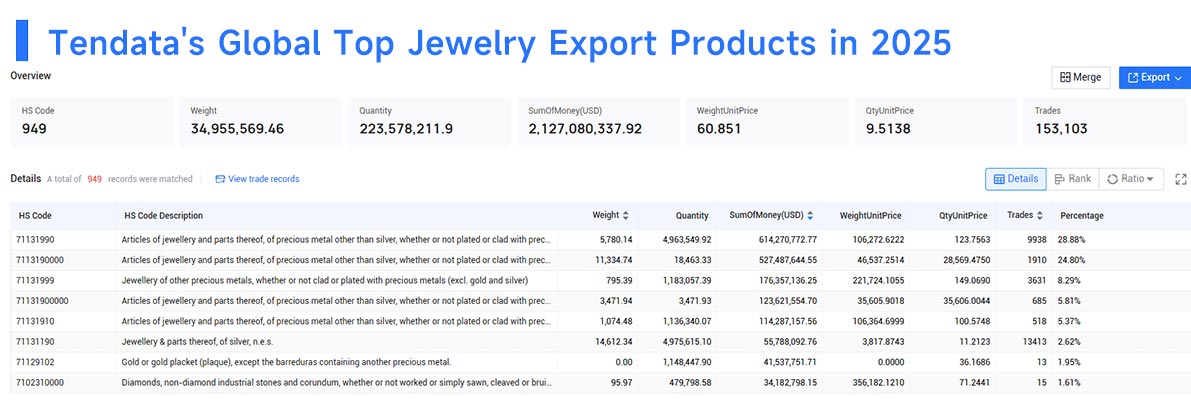
The global jewelry exporting market is highly diversified, covering a wide range of product categories from high-value gold and diamond jewelry to silver ornaments and imitation accessories. According to Tendata global trade data, the leading jewelry exporter segments in 2025 are dominated by HS Code 71131990, which alone accounts for 28.88% of total export value ($614.27 million), reflecting strong global demand for precious metal jewelry excluding silver. This is followed by HS Code 71131999 (8.29%, $176.36 million), highlighting the growing importance of alternative precious metal jewelry in international trade.
Gold jewelry remains a core driver of jewelry exporting activities, with HS Codes 71131910 and 71131919 collectively representing significant shares of the market, while silver jewelry (HS Code 71131190) continues to maintain stable demand across multiple regions. Additionally, niche segments such as imitation jewelry (HS Code 71171920) and diamond-mounted gold jewelry (HS Code 71131911) indicate expanding opportunities for both premium and cost-effective product lines.
For any jewelry exporter looking to expand globally, understanding these HS Code structures is essential to identify high-demand categories, track buyer preferences, and optimize product positioning. Using AI-enhanced trade database such as Tendata allows jewelry exporting businesses to pinpoint active importers, analyze market trends, and develop more targeted export strategies in a competitive global landscape.
Top Jewelry Exporting Countries
According to Tendata global trade data, below is the list of major jewelry exporting countries in 2025:
1.United Arab Emirates (25.33%, $538.87 Million)
2.United States (22.43%, $477.03 Million)
3.Italy (16.01%, $340.53 Million)
4.Vietnam (8.76%, $186.31 Million)
5.Hong Kong, China (4.83%, $102.72 Million)
6.Thailand (3.16%, $67.29 Million)
7.South Korea (1.43%, $30.46 Million)
8.United Kingdom (1.15%, $24.51 Million)
9.Germany (1.09%, $23.23 Million)
10.Mexico (1.08%, $23.02 Million)
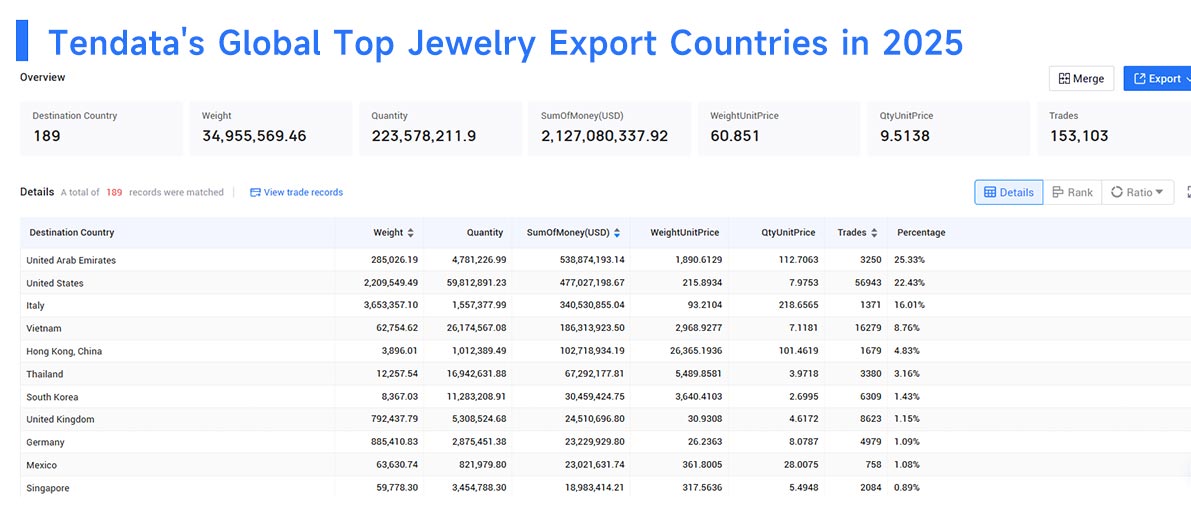
The global jewelry export landscape in 2025 highlights a strong concentration of value among a few leading jewelry exporter countries, reflecting both manufacturing capacity and international trade hubs. According to Tendata global trade data, the United Arab Emirates ranks as the top jewelry exporter, accounting for 25.33% of total exports ($538.87 million), driven by its role as a global trading and re-export center for precious metals and high-end jewelry. The United States follows with 22.43% ($477.03 million), supported by strong domestic brands and high-value product segments.
Italy, with 16.01% ($340.53 million), remains a key jewelry exporter known for its premium craftsmanship and design-oriented exports, while emerging manufacturing hubs such as Vietnam (8.76%, $186.31 million) are gaining momentum due to cost advantages and expanding production capabilities. Meanwhile, Hong Kong, China (4.83%) and Thailand (3.16%) continue to serve as important regional trading and processing centers in jewelry exporting supply chains.
Other countries including South Korea, the United Kingdom, Germany, and Mexico contribute smaller but stable shares, indicating a diversified global jewelry export market. For any jewelry exporter, understanding the geographic distribution of exports is essential to identify competitive markets, optimize supply chains, and capture growth opportunities in both established and emerging regions.
Top Global Jewelry Exporter in 2025
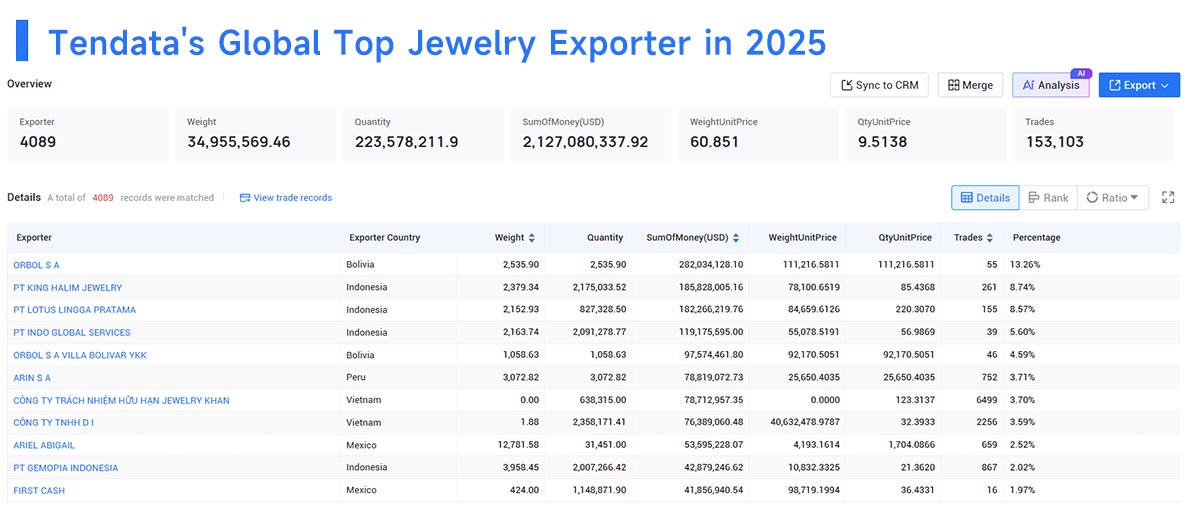
According to Tendata global trade data, here is the list of top jewelry exporter worldwide in 2025:
1.ORBOL S A (13.26%, $282.03 Million)
2.PT KING HALIM JEWELRY (8.74%, $185.83 Million)
3.PT LOTUS LINGGA PRATAMA (8.57%, $182.27 Million)
4.PT INDO GLOBAL SERVICES (5.60%, $119.18 Million)
5.ORBOL S A VILLA BOLIVAR YKK (4.59%, $97.57 Million)
6.ARIN S A (3.71%, $78.82 Million)
7.CÔNG TY TRÁCH NHIỆM HỮU HẠN JEWELRY KHAN (3.70%, $78.71 Million)
8.CÔNG TY TNHH D I (3.59%, $76.39 Million)
9.ARIEL ABIGAIL (2.52%, $53.60 Million)
10.PT GEMOPIA INDONESIA (2.02%, $42.88 Million)
How to Find jewelry exporter Data with Tendata?
For any jewelry exporter, accessing accurate and actionable trade data is the foundation of successful global expansion. While traditional sources such as customs statistics or international databases provide general market trends, they often lack the depth needed for real business development. In contrast, professional platforms like Tendata enable jewelry exporting companies to move beyond surface-level analysis and directly identify real buyers, competitors, and transaction patterns.
With Tendata, a jewelry exporter can search global trade data by product name or HS Code (such as 7113 for jewelry) and instantly access detailed shipment records, including importer/exporter names, quantities, prices, and trade frequencies across more than 200 countries. This allows businesses to pinpoint high-frequency buyers, analyze demand trends by market, and understand competitor activities with precision. Instead of relying on guesswork, exporters can target companies that have proven purchasing behavior, significantly improving conversion efficiency.
Moreover, Tendata integrates buyer contact information, company profiles, and AI-driven insights, enabling jewelry exporting businesses to build accurate customer lists and conduct personalized outreach. By making good use of these capabilities, a jewelry exporter can transform raw trade data into actionable strategies—identifying the right markets, connecting with verified buyers, and accelerating growth in the highly competitive global jewelry industry.
Bottom Line
In conclusion, the global jewelry exporter market is both large in scale and highly competitive, driven by strong international demand and diversified supply chains. Leading countries account for a significant share of worldwide trade and Asia dominates export activity . At the same time, the detailed data above shows that thousands of active exporters, multiple destination markets, and segmented HS Code categories together shape a complex but opportunity-rich landscape for any business involved in jewelry exported products.
For a jewelry exporter aiming to stand out in this environment, relying on precise and real-time trade intelligence is no longer optional. This is where Tendata plays a critical role. By providing granular shipment-level data—covering exporters, importers, transaction values, frequencies, and product classifications—Tendata enables businesses to move beyond macro trends and directly identify verified buyers and high-potential markets. Instead of blindly exploring markets, exporters can track which companies are consistently purchasing, which countries show rising demand, and how competitors are positioning their products.
FAQ
1. How can a jewelry exporter find reliable global trade data for jewelry exporting?
jewelry exporter can access global trade data through professional platforms like Tendata, which provide shipment-level records across multiple countries. Unlike traditional statistics, Tendata allows jewelry exporting businesses to search by HS Code (such as 7113 for jewelry) and instantly view real transaction data, including importer/exporter names, trade value, frequency, and destination markets. This helps exporters identify active buyers and high-demand regions more efficiently.
2.How can Tendata improve conversion rates for jewelry exporting?
By using Tendata, a jewelry exporter can focus on companies that are already importing similar products, rather than cold outreach. This data-driven approach significantly improves lead quality and conversion rates, as exporters engage with buyers who have proven demand and consistent purchasing behavior.
3.Is Tendata suitable for both new and experienced jewelry exporters?
Yes. For new jewelry exporting businesses, Tendata helps quickly identify target markets and buyers. For experienced exporters, it provides deeper insights into trade trends, competitor movements, and market shifts—supporting more advanced and scalable export strategies.
Category
Leave Message for Demo Request or Questions