 Tendata AI
  Exhibition
 B2B Platforms
 Standalone Website
 Social Media
 Emails
 Export News
 2026-04-07
Located in southeastern Europe, Serbia is a landlocked nation with strategic access to the Black Sea through the Danube River. In 2025, Serbia's exports reached a total value of approximately US$36.2 billion, reflecting the country's growing role in global trade.
This export figure represents a 41.6% increase compared to $25.6 billion in 2021. On a year-over-year basis, Serbia's exports also recorded solid growth, rising by 9.7% from $33 billion in 2024.
Exchange rate movements played a role as well. The Serbian dinar depreciated by 4.1% against the US dollar compared to 2021, but appreciated by 4.4% between 2024 and 2025. Overall, the relatively weaker currency has made Serbia's exports more competitively priced for international buyers using US dollars.
Main Trade Partners Driving Serbia's Exports
Recent data shows that a significant portion of Serbia's exports is concentrated among key trading partners. About 64.9% of total shipments were absorbed by countries such as Germany (15.6%), Italy (7%), Bosnia and Herzegovina (6.4%), China (4.8%), Hungary (4.7%), Montenegro (4.5%), Romania (4.3%), Czech Republic (4.1%), Turkey (3.6%), Bulgaria (3.5%), North Macedonia (3.3%), and Croatia (3.2%).
From a regional perspective, Europe dominates Serbia's exports, accounting for 83.6% of total value. Asia follows with 12.1%, while North America represents 2.4%. Smaller shares go to Africa (1.6%), Latin America (0.2%), and Oceania (0.1%), including markets like Australia and New Zealand.
With a population of around 6.53 million, Serbia's exports in 2025 translate to approximately $5,550 per capita, up from $4,750 in 2024.
Top Product Categories in Serbia's Exports
The structure of Serbia's exports in 2025 shows a diversified industrial base. The leading export categories include:
1.Electrical machinery and equipment: $5.5 billion (15.2%)
2.Machinery including computers: $3 billion (8.2%)
3.Vehicles: $2.4 billion (6.6%)
4.Copper: $1.9 billion (5.3%)
5.Rubber and rubber products: $1.86 billion (5.1%)
6.Ores, slag, and ash: $1.6 billion (4.5%)
7.Plastics and plastic articles: $1.41 billion (3.9%)
8.Mineral fuels including oil: $1.4 billion (3.9%)
9.Furniture, lighting, and prefabricated buildings: $1.2 billion (3.2%)
10.Fruits and nuts: $915.7 million (2.5%)
These top 10 categories together account for 58.4% of Serbia's exports, highlighting their importance in the country's trade portfolio.
Among them, vehicles recorded the fastest growth, increasing by 69.8% from 2024 to 2025. Rubber products followed with a 22.9% rise, while fruits and nuts grew by 13.4%. The only declining category was ores, slag, and ash, which fell by 6.7%.
Detailed Insights into Serbia's Exports
At a more detailed level based on Harmonized Tariff System (HTS) codes, Serbia's exports are led by:
1.Insulated wires and cables (6.8%)
2.Refined copper and alloys (4.3%)
3.Copper ores and concentrates (4.2%)
4.New rubber tires (3.6%)
5.Passenger vehicles (2.9%)
6.Auto parts and accessories (2.8%)
7.Electrical energy (2.5%)
8.Electric motors and generators (2.2%)
9.Packaged pharmaceutical products (1.7%)
10.Frozen fruits and nuts (1.7%)
These products further illustrate the industrial and resource-based strengths behind Serbia's exports.
Export Companies and Market Opportunities
For companies exploring opportunities within Serbia's exports, identifying reliable suppliers is crucial. Platforms like Tendata provide efficient tools such as keyword search and HS code filters, enabling businesses to find verified partners, analyze buying behavior, and access key contact information.
For example, when researching motor-related demand, Tendata can quickly identify leading suppliers in Serbia, including:
1.JAGUAR LAND ROVER LTD
2.MAGYAR SUZUKI ZRT
3.MICHELIN POLSKA SP Z O O 10 545 OLSZLYN LEONHARDA STR 9 POLAND
4.WUERTH ELETRONIK ICS GMBH AND CO KG
5.STANDARD FURNITURE SERBIA D O O
6.D SWAROVSKI DISTRIBUTION GMBH
7.BLACK HORSE FAS DOO BEOGRAD
8.MAGYAR SUZUKI
9.BMW A G
10.POWER TOOLS DISTRIBUTION N V
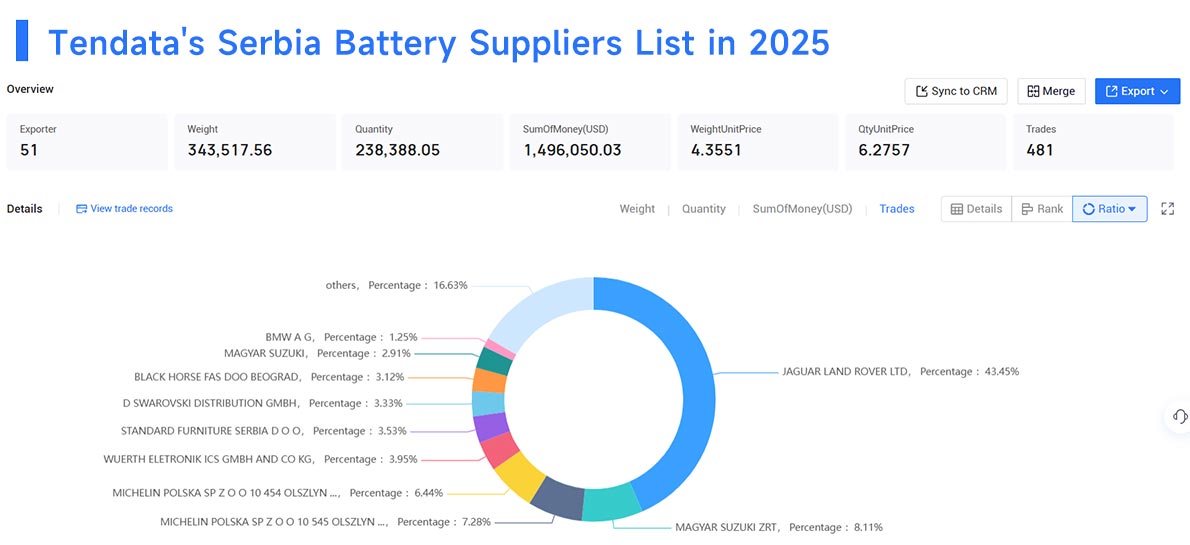
Whether you are an experienced exporter or new to international trade, leveraging insights from Serbia's exports can help uncover valuable opportunities.
FAQ
1. What are Serbia's exports mainly composed of?
Serbia's exports are largely driven by industrial and manufacturing sectors. Key export categories include electrical machinery, general machinery, vehicles, copper, rubber products, plastics, and mineral fuels. Agricultural goods such as fruits and nuts also play an important role in Serbia's exports.
2. Which countries are the biggest buyers of Serbia's exports?
The largest importers of Serbia's exports are Germany, Italy, and Bosnia and Herzegovina. Other important markets include China, Hungary, and Romania, showing that Europe dominates as the main destination for Serbian goods.
3. Which export sector is growing the fastest in Serbia's exports?
The vehicle sector has shown the fastest growth among Serbia's exports, with a significant year-over-year increase. Rubber products and agricultural exports such as fruits and nuts have also demonstrated strong growth trends.
4. What are the most valuable individual products in Serbia's exports?
At a detailed level, top products include insulated wires and cables, refined copper, copper ores, rubber tires, automobiles, and auto parts. These items represent a significant share of Serbia's exports and highlight its strengths in manufacturing and raw materials.
5. How can businesses find reliable suppliers in Serbia's exports market?
Companies can use professional trade data platforms like Tendata to identify verified suppliers, analyze trade flows, and access contact details. These tools help reduce the time and risk involved in entering the Serbian market.
Category
Leave Message for Demo Request or Questions