
 Tendata AI
  Exhibition
 B2B Platforms
 Standalone Website
 Social Media
 Emails
 Trade Data Provider
 2026-07-21
Expanding into overseas markets is no longer just about choosing a country with strong economic growth. Businesses also need to understand where products are moving, which industries are expanding, and how global supply chains are changing. This is where import export data becomes one of the most valuable resources for international trade.
Unlike general market reports, import export data is based on actual customs transactions. It provides businesses with factual information about cross-border trade, allowing exporters, manufacturers, distributors, and sourcing professionals to make decisions based on real commercial activity instead of assumptions.
Whether you're exploring a new market or optimizing an existing export strategy, import export data helps reduce uncertainty and improve decision-making.

What Is Import Export Data?
Import export data refers to customs records and international trade information generated when goods move between countries. Governments and customs authorities collect these records to monitor trade, enforce regulations, and compile official statistics.
Depending on the source, import export data may include product descriptions, HS codes, shipment values, quantities, origin and destination countries, ports, reporting periods, and other trade-related information. Some commercial databases also organize shipment records by company, making it easier to analyze business relationships and purchasing activity.
Because import export data reflects real trade transactions, it has become an essential tool for market analysis, competitor research, and international business development.
10 Free Platforms to Access Import Export Data
Many organizations provide free access to customs statistics and trade information. Although these platforms mainly focus on official statistics rather than company-level shipment records, they are useful for understanding international trade patterns.
1. TradeMap.org Country Trade Profiles
Website: https://www.trademap.org/Country_SelProduct.aspx
Trade Map allows users to compare countries by product, export performance, import demand, and global market share.
2. UNdata
Website: https://data.un.org/
UNdata brings together multiple United Nations statistical databases, including international trade indicators and economic statistics.
3. World Bank Open Data
Website: https://data.worldbank.org/
The World Bank provides free economic and trade datasets covering global imports, exports, tariffs, logistics performance, and development indicators.
4. OECD Data Explorer
Website: https://data-explorer.oecd.org/
OECD Data Explorer offers international trade statistics together with broader economic indicators for member countries.
5. CEPII BACI International Trade Database
Website: https://www.cepii.fr/
BACI is a harmonized international trade database widely used in academic research and global trade analysis.
6. European Free Trade Association (EFTA) Trade Statistics
Website: https://www.efta.int/
EFTA publishes trade statistics and reports covering member countries and international trade agreements.
7. International Monetary Fund Data Portal
Website: https://www.imf.org/en/Data
The IMF provides access to global economic indicators, including international trade and balance of payments statistics.
8. Bangladesh Export Promotion Bureau
Website: https://www.epb.gov.bd/
Bangladesh's Export Promotion Bureau publishes official export statistics and trade reports for key industries.
9. Sri Lanka Department of Commerce
Website: https://www.doc.gov.lk/
Sri Lanka's Department of Commerce provides trade statistics, export information, and import regulations.
10. Pakistan Bureau of Statistics – External Trade
Website: https://www.pbs.gov.pk/
Pakistan's official statistics agency publishes merchandise trade data, import and export reports, and commodity-level statistics.
Why Import Export Data Matters for Business Growth
Successful international businesses rarely make decisions based on instinct alone.
By studying import export data, companies can identify markets where demand is increasing, evaluate product performance across different countries, and understand how trade patterns evolve over time.
Historical import export data also reveals seasonal purchasing cycles, allowing exporters to contact buyers before peak buying periods rather than after demand has already peaked.
For manufacturers, this information supports production planning, inventory management, and long-term market expansion.
What Public Trade Databases Can't Tell You
Official trade databases are highly reliable, but they are designed primarily to report national trade statistics.
Imagine discovering that imports of industrial machinery have doubled in a particular region. Public import export data can confirm that trend, but it usually cannot explain which businesses are responsible for those purchases, whether they buy regularly, or who currently supplies them.
Without company-level information, businesses often spend considerable time searching for buyers manually across multiple websites.
For companies focused on customer acquisition, statistical data alone is rarely enough.
How Tendata Helps Businesses Unlock the Full Value of Import Export Data
Tendata is a professional global trade intelligence platform built to transform import export data into actionable business intelligence.
Rather than requiring users to collect information from multiple sources, Tendata integrates customs records, market analysis, competitor intelligence, and buyer discovery into one platform.
This enables businesses to move from research to customer development much more efficiently.
Identify the Right Markets With Confidence
Not every growing market is equally attractive.
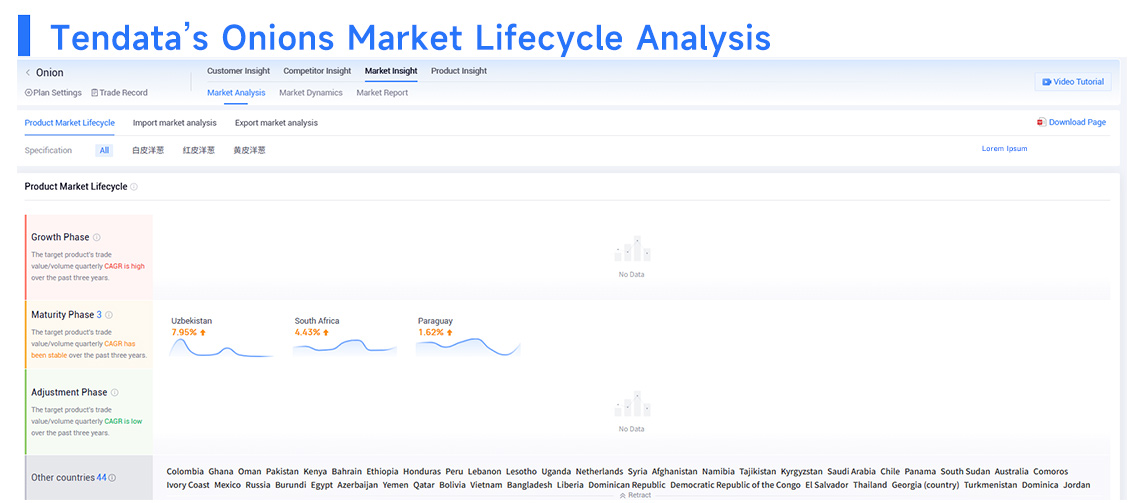
Tendata allows businesses to analyze import export data by country, product, industry, and HS code to compare demand across multiple markets.
For example, exporters of onions can analyze HS Code 070310 to identify countries with stable import demand, compare long-term purchasing trends, and prioritize markets with sustainable growth.
This reduces uncertainty when planning international expansion.
>>> Tendata’s Onions Market Lifecycle Analysis <<<
Data Source: Tendata Platform
Understand Competitor Performance
One of the greatest advantages of professional import export data is competitor visibility.
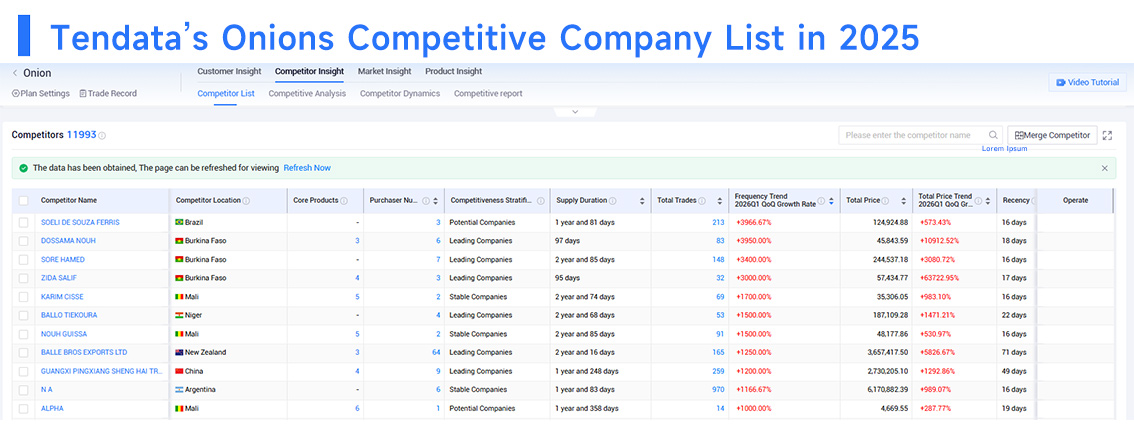
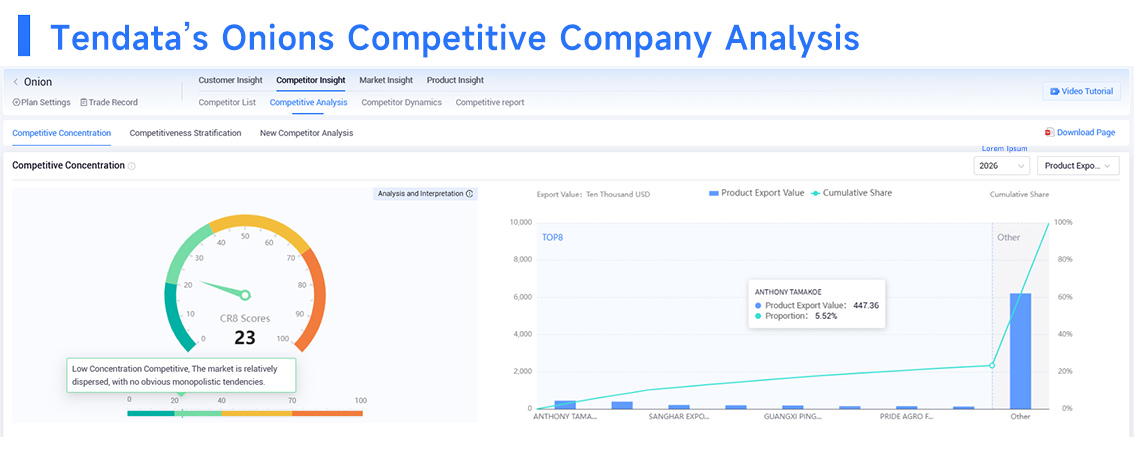
Tendata enables users to monitor competitor shipment activity, export destinations, product categories, and historical trading performance.
These insights help businesses identify competitive advantages, uncover underserved markets, and refine their international sales strategies based on actual trade activity.
>>> Tendata’s Onions Competitive Company List in 2025 <<<
Data Source: Tendata Platform
>>> Tendata’s Onions Competitive Company Analysis <<<
Data Source: Tendata Platform
Build Better Customer Lists
Finding companies that genuinely purchase your products is much easier when using verified trade records.
Tendata allows businesses to search buyers through comprehensive import export data, helping users identify importers with consistent purchasing histories instead of relying on general business directories.
Sales teams can evaluate shipment frequency, purchasing volume, supplier relationships, and procurement behavior before initiating contact.
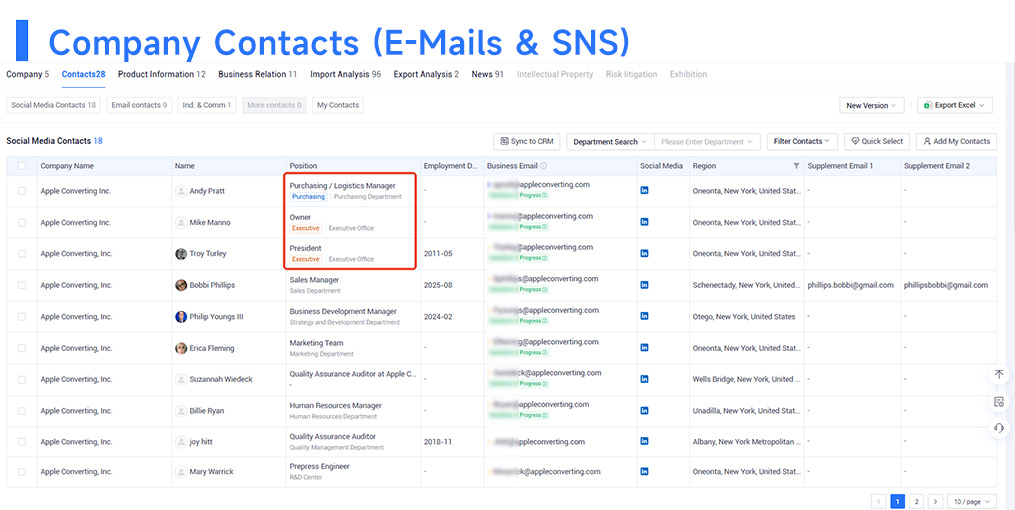
To simplify outreach, Tendata also provides access to available company contact information, including business email addresses, LinkedIn profiles, Facebook pages, and other public business resources.
>>> Obtaining Customer Contact Information from Tendata <<<
Data Source: Tendata Platform
Summary
Import export data provides businesses with a reliable foundation for market research, competitor analysis, and international customer development. Free resources such as UNdata, the World Bank Open Data portal, OECD Data Explorer, BACI, and other official trade platforms help businesses understand global trade trends and evaluate international opportunities.
For companies seeking deeper commercial intelligence, Tendata combines comprehensive import export data with market analysis, competitor monitoring, buyer identification, and business contact information. By transforming customs records into practical business insights, Tendata helps exporters and manufacturers identify qualified customers, enter new markets, and achieve sustainable international growth.
Category
Leave Message for Demo Request or Questions