 Import News
 2026-06-24
Global tea imports reached approximately US$6.96 billion in 2025, reflecting a slight contraction in worldwide demand compared to previous years. Despite tea remaining one of the most widely consumed beverages globally, import values have shown a modest downward trend.
Compared with 2021, when global tea imports were valued at US$7.14 billion, total purchases declined by -2.6% over the five-year period. On a year-over-year basis, the market also weakened, falling by -4.7% from US$7.3 billion in 2024 to US$6.96 billion in 2025.
The global tea import market remains concentrated among a small group of large consuming nations. The top five import markets—Pakistan, the United States, the United Kingdom, Saudi Arabia, and Germany—accounted for approximately 32.5% of total global tea import value in 2025.
In terms of product composition, black tea dominated global imports, representing around 82.9% of total tea purchases, while green tea accounted for 17.1%, down from 25.3% in the previous year.
From a regional perspective, Asia remained the largest tea-importing region, with total imports reaching approximately US$2.72 billion, or 39.3% of global demand. Europe followed with 28.9%, while Africa accounted for 16.7% of global tea imports.
Smaller shares were recorded in North America (11.6%), Latin America (1.8%), and Oceania (1.7%), where demand is largely concentrated in countries such as Australia and New Zealand.
For trade classification, tea is categorized under HS Code 0902.

Top Tea Importing Countries in 2025
Pakistan remained the world's largest tea importer in 2025, with import spending of approximately US$629.9 million, representing 9.1% of global tea imports.
The United States followed closely with US$620.4 million (8.9%), while the United Kingdom ranked third with US$393.4 million (5.7%).
Other major tea-importing countries included:
· Saudi Arabia (4.5%, $310.4 Million)
· Germany (4.4%, $308.4 Million)
· Morocco (4.2%, $289.3 Million)
· Egypt (3.7%, $257.9 Million)
· United Arab Emirates (3.4%, $233.3 Million)
· China (2.7%, $184.5 Million)
· Japan (2.5%, $176 Million)
· France (2.5%, $174.8 Million)
· Canada (2.4%, $165.1 Million)
· Poland (2.3%, $162.1 Million)
· Netherlands (2.3%, $161.2 Million)
· Russia (2.2%, $154.8 Million)
Collectively, these 15 countries accounted for 60.7% of total global tea imports, highlighting a moderately concentrated global demand structure.
Fastest-Growing and Declining Tea Import Markets
Several countries recorded notable growth in tea imports between 2024 and 2025.
Germany led growth with an increase of 25%, followed by Morocco at 18.2%. Mainland China also posted strong expansion of 17.1%, while Canada recorded a 12.6% increase, reflecting steady demand in North America.
In contrast, some markets experienced significant declines. Russia recorded the steepest drop at -63.1%, followed by the United Arab Emirates (-10%), Egypt (-5.5%), and Pakistan (-0.7%). These shifts reflect changing consumption patterns, pricing pressures, and trade adjustments in key importing regions.
Leading Tea Importers in 2025
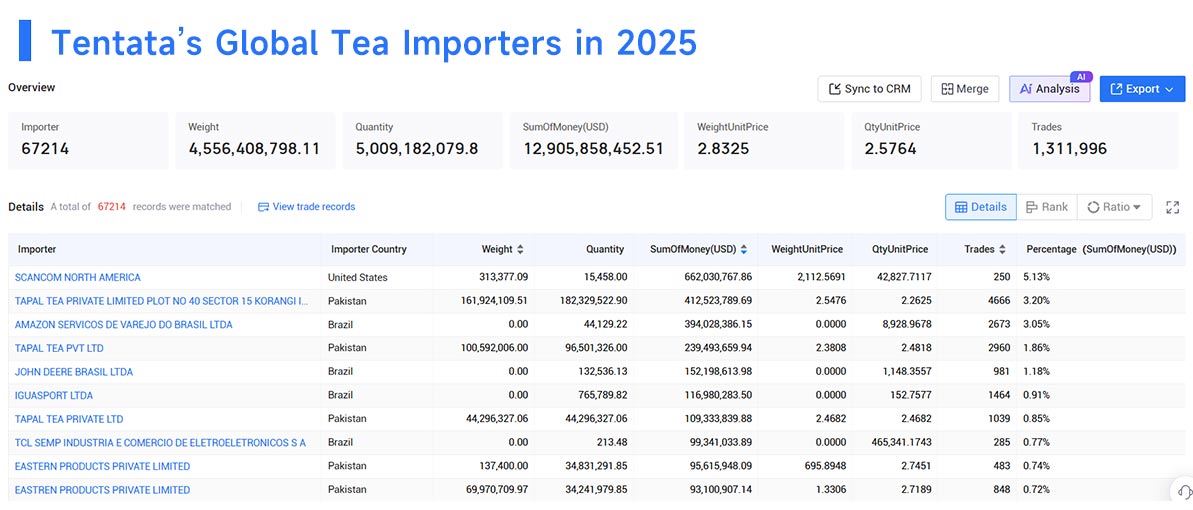
According to Tendata trade intelligence, the leading tea importers in 2025 included:
1. SCANCOM NORTH AMERICA (5.13%, $662.03 Million)
2. TAPAL TEA PRIVATE LIMITED PLOT NO 40 SECTOR 15 KORANGI INDUSTRIAL AREA KARACHI (3.2%, $412.52 Million)
3. AMAZON SERVICOS DE VAREJO DO BRASIL LTDA (3.05%, $394.03 Million)
4. JOHN DEERE BRASIL LTDA (1.18%, $152.2 Million)
5. IGUASPORT LTDA (0.91%, $116.98 Million)
6. TCL SEMP INDUSTRIA E COMERCIO DE ELETROELETRONICOS S A (0.77%, $99.34 Million)
7. EASTERN PRODUCTS PRIVATE LIMITED (0.74%, $95.62 Million)
8. AL MOKHA FOR PRODUCTION AND PACKAGING OF TEA AND COFFEE (0.68%, $87.84 Million)
9. ORIMI LLC (0.57%, $73.74 Million)
10. MUQEET BROTHERS (0.56%, $71.64 Million)
>>Find More Tea Importers via Tendata<<
The global tea import market in 2025 shows a slightly cooling demand environment, despite tea’s continued role as a staple global beverage. While Asia remains the largest consuming region, shifting consumption trends, regional economic conditions, and changing beverage preferences are reshaping global import flows.
Category
Leave Message for Demo Request or Questions