 Tendata AI
  Import News
 2026-07-07
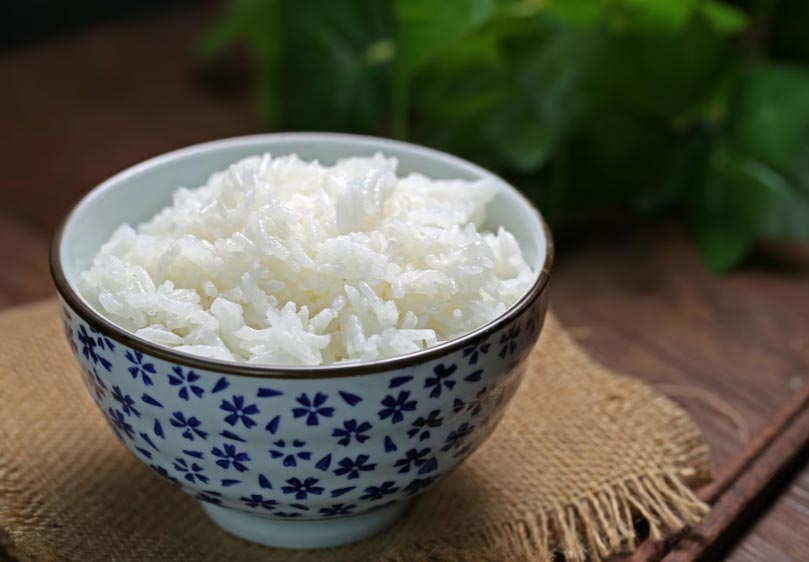
Rice remained one of the world's most important staple food commodities in 2025, with global imports reaching US$34.6 billion.
Compared with US$29.2 billion in 2021, worldwide spending on imported rice increased by 18.2% over the five-year period. However, compared with 2024, global rice imports declined 12.2%, falling from US$39.3 billion.
The five largest rice-importing countries were the Philippines, Saudi Arabia, the United States, mainland China, and Iraq. Together, these markets accounted for 22.7% of total global rice import value, making them the primary drivers of international rice demand.
Regional Distribution of Rice Imports
Asia continued to dominate global rice consumption through imports, purchasing rice worth US$15.4 billion, equivalent to 44.6% of worldwide imports.
The regional distribution of rice imports in 2025 was:
· Asia — 44.6%
· Africa — 25.7%
· Europe — 14.9%
· North America — 7.4%
· Latin America and the Caribbean — 5.6%
· Oceania — 1.6%
Australia, Papua New Guinea, and New Zealand remained the largest rice importers within Oceania.
For customs classification purposes, imported rice is identified under HS Code 1006.
Top Rice Importing Countries
The following countries imported the highest value of rice during 2025:
1. Philippines — US$1.7 billion (5.0%)
2. Saudi Arabia — US$1.7 billion (4.9%)
3. United States — US$1.6 billion (4.7%)
4. Mainland China — US$1.44 billion (4.2%)
5. Iraq — US$1.36 billion (3.9%)
6. Vietnam — US$1.22 billion (3.5%)
7. Ivory Coast — US$1.1 billion (3.2%)
8. Benin — US$864.2 million (2.5%)
9. United Arab Emirates — US$783.8 million (2.3%)
10. Malaysia — US$776.9 million (2.2%)
11. Bangladesh — US$760.1 million (2.2%)
12. Iran — US$749.8 million (2.2%)
13. France — US$728.4 million (2.1%)
14. United Kingdom — US$681 million (2.0%)
15. Japan — US$669.6 million (1.9%)
Combined, these fifteen countries accounted for 46.8% of global rice imports in 2025, demonstrating that demand for imported rice is broadly distributed across both developed and emerging markets.
Fastest-Growing Rice Import Markets
Several countries recorded particularly strong import growth compared with 2024.
The fastest-growing rice importers included:
· Bangladesh — +671.8%
· Mainland China — +56.2%
· Benin — +21.8%
· United Arab Emirates — +21.3%
At the same time, a number of major importing countries reduced their purchases.
The largest year-over-year declines were reported by:
· Philippines — -31.9%
· Malaysia — -29.3%
· Vietnam — -19.8%
· Iraq — -18.4%
Top Rice Import Companies
Based on Tendata's Global Trade Intelligence Platform, the following companies ranked among the world's leading rice importers in 2025:
1. PADIBERAS NASIONAL BERHAD (BERNAS) — 2.54% (US$821.07 million)
2. STE DE DISTRIBUTION DE TOUTE M — 1.78% (US$573.79 million)
3. LOUIS DREYFUS COMPANY ASIA PTE LTD — 1.36% (US$438.52 million)
4. DIRECTORATE OF FOOD — 1.35% (US$435.18 million)
5. BEATUS GRAIN EMPORIUM CORPORATION — 0.78% (US$252.96 million)
6. ABDULRAHMAN AND MOHD A AZIZ — 0.67% (US$215.52 million)
7. BUNGE ALIMENTOS S A — 0.63% (US$202.03 million)
8. KUWAIT SUPPLY CO SAKC — 0.59% (US$189.96 million)
9. OLAM GLOBAL AGRI PTE LTD — 0.58% (US$186.28 million)
10. LUCKY BUY AND SELL — 0.48% (US$155.28 million)
>>Find More Rice Importers via Tendata<<
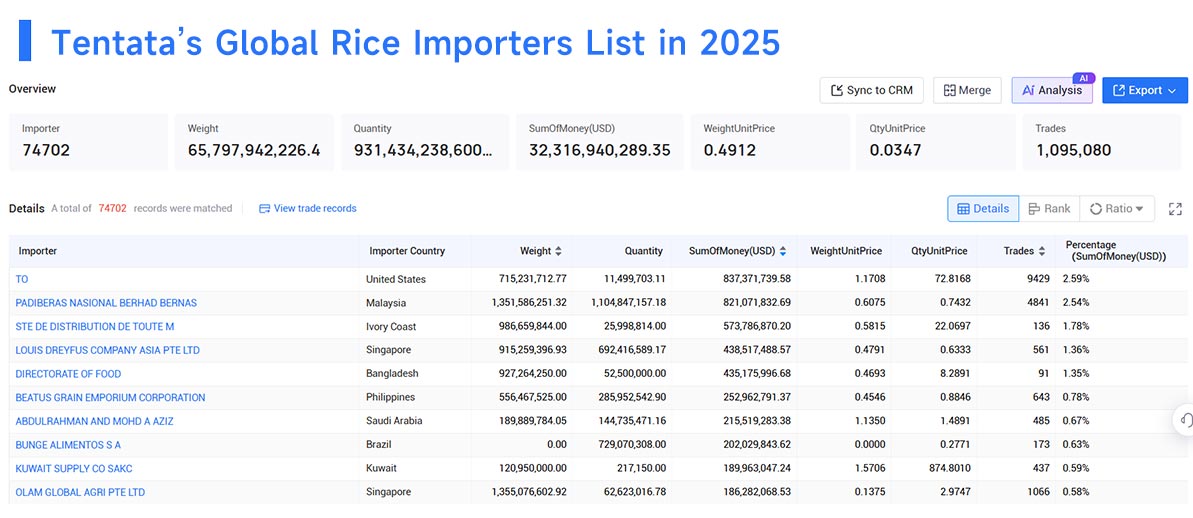
With Tendata's verified customs data and trade intelligence tools, businesses can identify active rice importers, evaluate buyers' purchasing history, monitor global sourcing trends, and discover new business opportunities across international rice markets.
Category
Leave Message for Demo Request or Questions