 Tendata AI
  Exhibition
 B2B Platforms
 Standalone Website
 Social Media
 Emails
 Trade Data Provider
 2026-06-05
Key Points
· Traditional export data provides only a partial picture of the market.
· Official customs statistics often lack visibility into global competition.
· Export records rarely identify the actual purchasing decision-makers.
· Trade figures can sometimes create misleading impressions of market demand.
· Tendata combines global trade intelligence, buyer insights, and contact information to turn raw data into actionable opportunities.

Overview
For many exporters, the first step in market research is analyzing export data. The common assumption is simple: if a country imports a large volume of products from China, it must be a promising market.
However, relying solely on traditional export data can lead to misleading conclusions.
While export statistics can show how much product leaves a country, they often fail to reveal the true dynamics of market demand, competitive pressure, and buyer behavior. As a result, businesses may enter saturated markets, overlook emerging opportunities, or spend valuable resources targeting the wrong customers.
This article explores the three major blind spots of traditional export data and explains how Tendata helps businesses gain a complete view of global trade opportunities.
The Three Major Blind Spots of Traditional Export Data
Many exporters consider official customs export data to be objective and comprehensive. In reality, it has several inherent limitations that can significantly affect strategic decisions.
1. Export Data Only Shows One Country's Perspective
Perhaps the most overlooked issue with traditional export data is that it only reflects shipments originating from a specific country.
For example, Chinese customs data can tell you how much China exported to a particular market. However, it cannot reveal how much product is simultaneously being supplied by competitors from Vietnam, India, Turkey, or other exporting nations.
The Consequence
Imagine seeing strong Chinese export data for a market and assuming demand is growing rapidly. You decide to enter that market, only to discover that competitors have already flooded it with low-priced products.
The missing piece is global competitive intelligence. Without understanding the complete import landscape, exporters risk making decisions based on incomplete information.
Transition
To accurately assess market potential, businesses need more than export figures from a single country—they need visibility into the entire global supply chain.
2. Export Data Does Not Reveal the Real End Buyers
Another major weakness of traditional export data is its inability to identify the actual purchasing decision-makers.
Customs records typically list the shipper and consignee. However, the consignee is often:
· A customs broker
· A freight forwarder
· An import agent
· A logistics service provider
In many cases, the consignee is not the brand owner, manufacturer, distributor, or end user that ultimately drives purchasing decisions.
The Consequence
Exporters frequently spend time contacting companies listed in customs records, only to discover that these organizations have little or no influence over procurement decisions. As a result, sales teams waste significant effort chasing intermediaries rather than engaging genuine buyers.
Transition
Knowing that a company imported a product is valuable. Knowing who actually made the purchasing decision is far more valuable.
3. Statistical Distortions Can Create a False Sense of Demand
Not all recorded exports reflect genuine market consumption. Certain trade activities, such as bonded warehouse transfers, temporary exports, re-exports, or other customs arrangements, may appear in official export data even when products never reach end consumers.
The Consequence
A market may appear to be growing rapidly based on customs statistics, while actual end-user demand remains relatively weak.
This can create a misleading impression of market size and profitability.
Businesses relying solely on raw export data may overestimate opportunities and allocate resources inefficiently.
How Professional Data Providers Enhance Export Data
The limitations of traditional export data do not mean businesses should ignore customs statistics.
Instead, they should supplement those statistics with broader trade intelligence.
Professional trade intelligence platforms help companies move beyond basic export records by providing:
· Global Import Verification
Cross-referencing import data from destination countries to verify whether products are actually entering and being consumed within target markets.
· Supply Chain Transparency
Identifying the real buyers, distributors, brands, and decision-makers behind trade transactions.
· Competitive Intelligence
Monitoring competitor shipments, customer relationships, pricing trends, and market expansion activities.
Together, these capabilities transform ordinary export data into meaningful business intelligence.
Common Trade Data Providers in the Market
Several companies provide trade data solutions and customs intelligence services.
Provider A
Known for strong technical capabilities and frequent data updates. However, pricing can be challenging for many small and medium-sized exporters.
Provider B
Offers comprehensive enterprise-level supply chain and risk management solutions. While powerful, these platforms are often designed for large multinational corporations and may include features that smaller exporters rarely use.
The Challenge
Many solutions are either expensive, overly complex, or difficult for sales teams to convert into practical customer development activities. This is where Tendata offers a different approach.
Why More Exporters Are Choosing Tendata
Unlike traditional platforms that simply provide raw export data, Tendata focuses on helping exporters identify opportunities, understand competition, and directly reach buyers.
1. Gain a Complete View of Global Competition
Many platforms only provide country-specific export data.
Tendata integrates import and export information from 228 countries and regions, enabling businesses to compare:
· China's exports
· Competitor country exports
· Market share distribution
· Import demand trends
· Price positioning
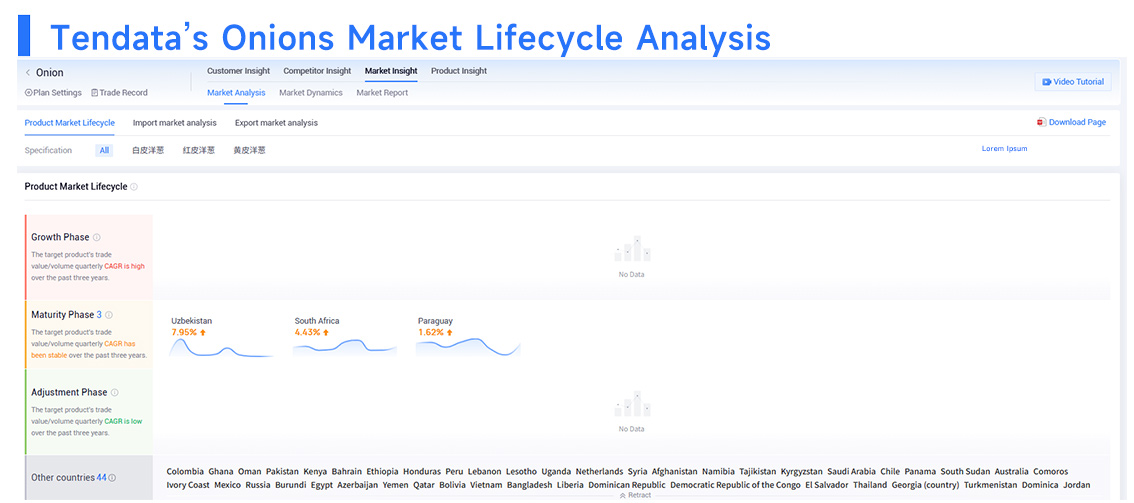
Instead of guessing whether a market is attractive, exporters can evaluate opportunities based on a comprehensive global trade perspective. Example: Using HS code 070310 (onions) to explore trade dynamics.
>>> Tendata’s Onions Market Lifecycle Analysis <<<
Business Impact
Companies can quickly determine whether a market is emerging, mature, highly competitive, or underserved.
2. Monitor Competitors with Precision
Understanding competitor activity is essential for market expansion.
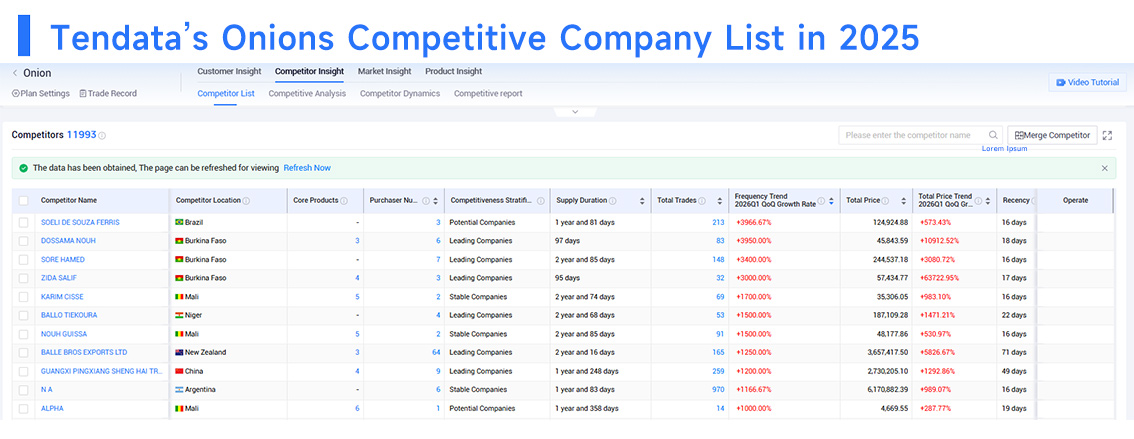
With Tendata, users can search for competitor companies and analyze:
· Export history
· Major customers
· Shipment frequency
· Product categories
· Trade destinations
· Pricing patterns
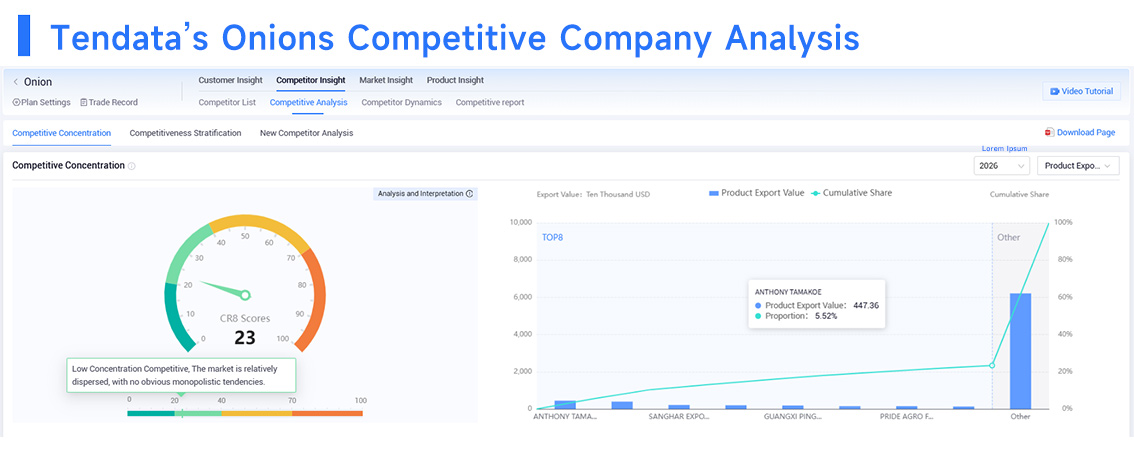
This level of visibility helps businesses identify market shifts, discover new opportunities, and develop more effective sales strategies.
Rather than simply reviewing their own export data, exporters can understand the broader competitive landscape.
>>> Tendata’s Onions Competitive Company List in 2025 <<<
>>> Tendata’s Onions Competitive Company Analysis <<<
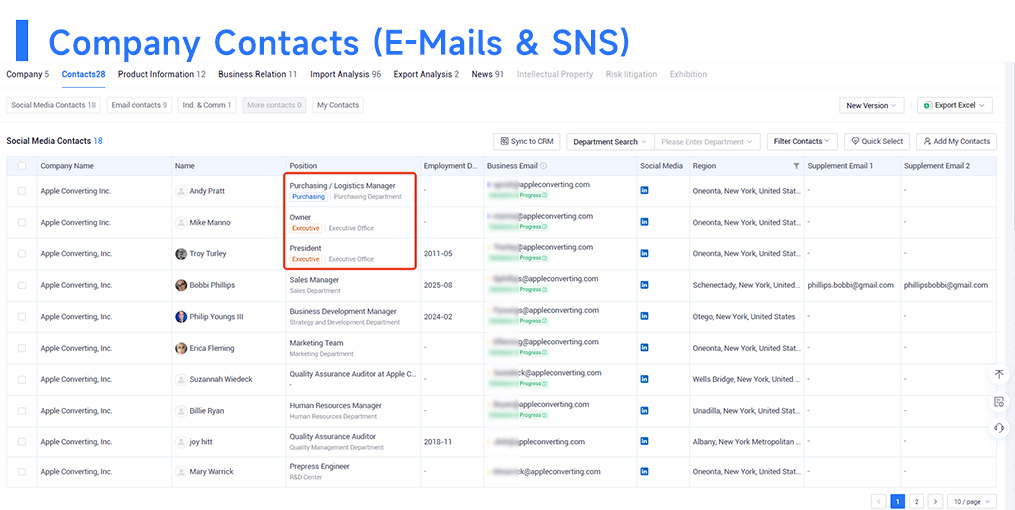
3. Reach Real Purchasing Decision-Makers
Perhaps the most valuable advantage of Tendata is its ability to bridge the gap between trade records and customer acquisition.
Traditional export data typically provides company names but offers little information about who to contact.
Tendata combines:
· Trade data
· Business intelligence data
· Internet-sourced corporate information
· to help users identify:
· Procurement managers
· Purchasing directors
· CEOs
· Technical decision-makers
along with available business contact information.
>>> Obtaining Customer Contact Information from Tendata <<<
Business Impact
Instead of spending hours searching through LinkedIn or company websites, sales teams can move directly from market analysis to customer outreach. This dramatically shortens the sales cycle and improves prospecting efficiency.
Summary
Raw export data remains a valuable starting point for international market analysis, but it is no longer sufficient on its own.
Official customs statistics can reveal shipment volumes, yet they often fail to provide:
· Global competitive visibility
· End-buyer identification
· Accurate demand verification
· Actionable customer intelligence
In today's highly competitive global trade environment, success depends on turning information into insight.
By combining worldwide trade records, competitive intelligence, buyer identification, and decision-maker contact information, Tendata transforms traditional export data into a powerful trade intelligence platform that helps exporters identify opportunities faster, target the right buyers, and grow their international business more efficiently.
The companies that win in modern global trade are not necessarily those with access to more data—they are the ones that can extract more value from the same data. Tendata is designed to make that advantage accessible to exporters of all sizes.
Category
Leave Message for Demo Request or Questions