 Tendata AI
  Exhibition
 B2B Platforms
 Standalone Website
 Social Media
 Emails
 Trade Data Provider
 2026-07-22
Expanding into international markets requires more than ambition—it requires reliable information. Many businesses spend months researching new markets, contacting potential buyers, and analyzing competitors, only to discover that demand is weaker than expected. By using customs data, companies can replace assumptions with facts and make decisions based on actual international trade activity.
Today, customs data is widely used by exporters, manufacturers, wholesalers, sourcing companies, and logistics providers. It reveals how products move across borders, where demand is growing, and which markets deserve closer attention. Whether you're evaluating a new country or planning your next sales campaign, customs data provides valuable insights that support smarter business decisions.
Although many businesses begin with free government databases, professional trade intelligence platforms offer much deeper analysis and customer discovery capabilities.

What Is Customs Data?
Customs data consists of the records generated when goods are declared to customs during international import and export procedures. Customs authorities collect this information to enforce regulations, calculate duties, and compile national trade statistics.
Depending on the country, customs data may include product descriptions, HS codes, shipment values, quantities, countries of origin and destination, transportation methods, ports, and reporting periods. Some commercial databases also organize customs data by company, making it easier to analyze buyers, suppliers, and historical trade relationships.
Because it is based on real customs declarations, customs data provides businesses with an accurate picture of global trading activity.
10 Free Platforms to Explore Customs Data
Businesses that are new to international trade can begin their research with a variety of official customs and government resources. These platforms mainly provide statistical information rather than detailed commercial shipment intelligence, but they remain valuable for understanding market trends.
1. U.S. Customs and Border Protection (CBP)
Website: https://www.cbp.gov/
CBP provides customs regulations, trade guidance, import procedures, and resources related to U.S. international trade.
2. European Commission TARIC Database
Website: https://ec.europa.eu/taxation_customs/dds2/taric/
The TARIC database provides tariff classifications, customs measures, and trade regulations applicable within the European Union.
3. Canada Border Services Agency (CBSA)
Website: https://www.cbsa-asfc.gc.ca/
CBSA publishes customs procedures, tariff information, and import/export guidance for Canadian trade.
4. Australian Border Force
Website: https://www.abf.gov.au/
Australia's Border Force provides customs regulations, import requirements, and international trade information.
5. New Zealand Customs Service
Website: https://www.customs.govt.nz/
New Zealand Customs offers customs regulations, import/export procedures, and trade compliance information.
6. Dubai Customs
Website: https://www.dubaicustoms.gov.ae/
Dubai Customs provides customs services, tariff information, and trade facilitation resources for businesses operating in the UAE.
7. Saudi Zakat, Tax and Customs Authority (ZATCA)
Website: https://zatca.gov.sa/
ZATCA publishes customs regulations, tariff schedules, and import/export procedures for Saudi Arabia.
8. South African Revenue Service Customs
Website: https://www.sars.gov.za/
SARS provides customs legislation, tariff information, and trade compliance resources for South African importers and exporters.
9. India Central Board of Indirect Taxes and Customs (CBIC)
Website: https://www.cbic.gov.in/
CBIC offers customs notifications, tariff information, and official import/export regulations.
10. Brazil Federal Revenue Customs
Website: https://www.gov.br/receitafederal/
Brazil's customs authority provides customs procedures, tariff regulations, and official guidance for international trade.
Why Customs Data Is Valuable Across the Entire Supply Chain
The benefits of customs data extend well beyond export sales.
Manufacturers use customs data to understand where demand for their products is increasing. Procurement departments analyze sourcing patterns before selecting suppliers. Logistics providers monitor international shipping activity to anticipate transportation demand, while investment firms study trade movements to evaluate industry performance.
Because customs data reflects actual commercial transactions, it offers businesses a practical way to monitor changes across the global supply chain.
The Difference Between Customs Information and Commercial Intelligence
Public customs platforms are designed to support compliance and statistical reporting, not customer acquisition.
For example, official customs data may show that imports of packaging materials into a particular country have increased substantially over the past two years. However, these resources generally do not reveal which companies purchased those products, how frequently they buy, or whether they continue importing today.
Businesses trying to develop new customers often need answers at the company level rather than the national level.
That's where professional trade intelligence platforms provide much greater value.
How Tendata Helps Businesses Get More From Customs Data
Tendata is an all-in-one global trade intelligence platform that transforms customs data into actionable business intelligence.
Instead of searching across multiple government databases, businesses can access market analysis, competitor research, buyer discovery, and trade records within one integrated platform.
Evaluate Markets Before Entering Them
Selecting the right market is one of the most important decisions in international trade.
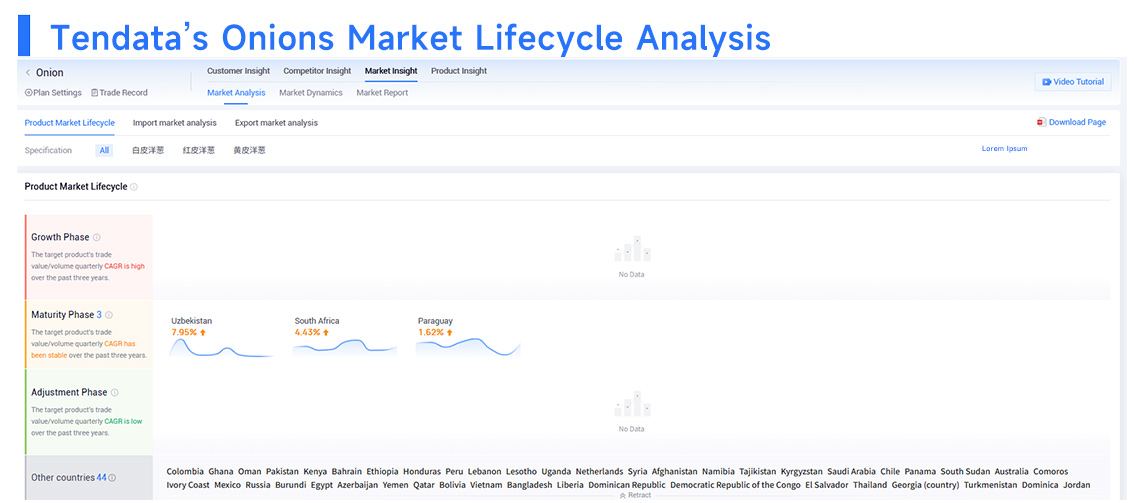
Tendata enables businesses to analyze customs data by product, country, industry, and HS code to compare demand across multiple regions.
For example, companies exporting onions can analyze HS Code 070310 to identify countries with stable import demand, compare historical purchasing trends, and focus on markets with long-term growth potential.
This reduces risk before investing in market expansion.
>>> Tendata’s Onions Market Lifecycle Analysis <<<
Data Source: Tendata Platform
Analyze Competitor Activity
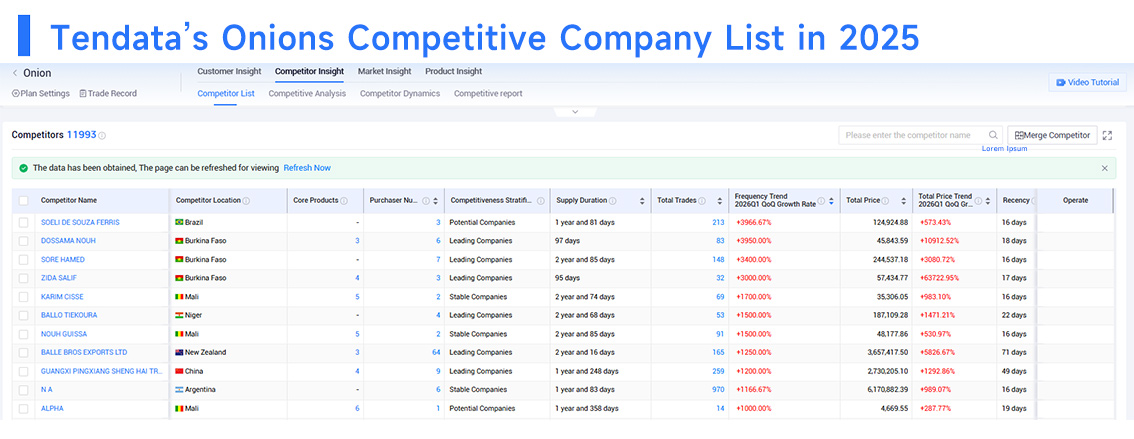
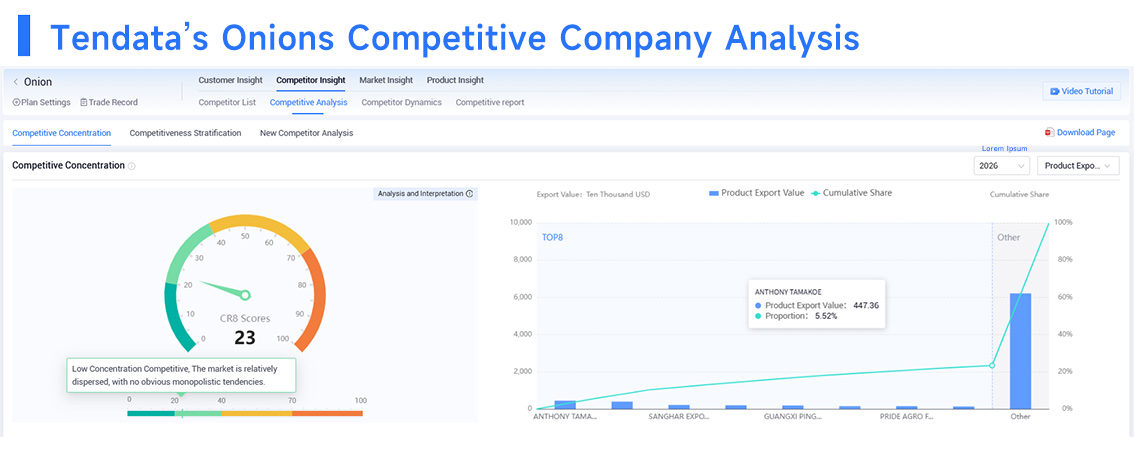
Trade records can reveal valuable information about competitor strategies.
Using Tendata's customs data, businesses can monitor shipment frequency, export destinations, product categories, and historical trade performance.
These insights help companies benchmark their own international activities while identifying underserved markets that competitors may have overlooked.
>>> Tendata’s Onions Competitive Company List in 2025 <<<
Data Source: Tendata Platform
>>> Tendata’s Onions Competitive Company Analysis <<<
Data Source: Tendata Platform
Reach Buyers Based on Verified Trade Records
Rather than relying on generic business directories, Tendata enables companies to identify buyers through verified customs data.
Users can evaluate purchasing frequency, shipment history, supplier relationships, and procurement behavior before contacting potential customers.
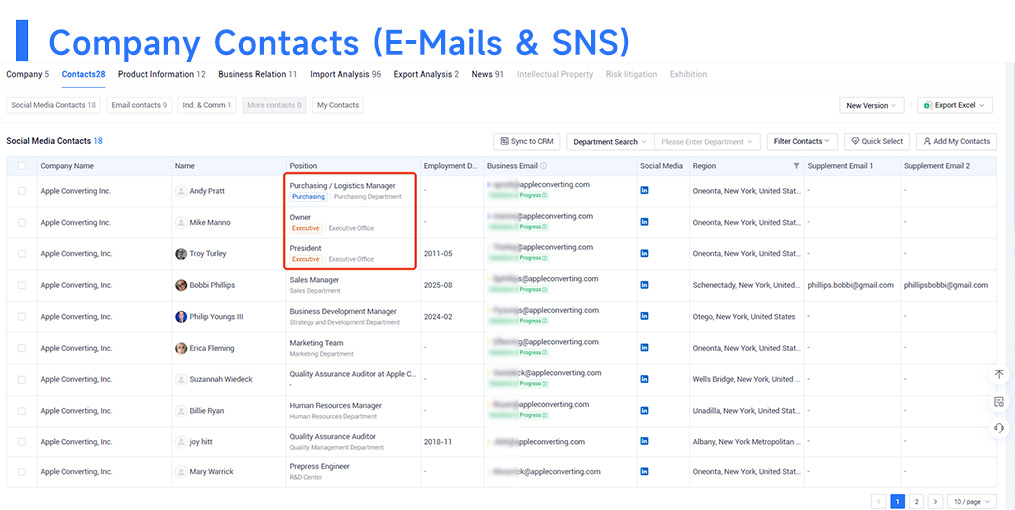
To support efficient business development, Tendata also integrates available company contact information, including business email addresses, LinkedIn profiles, Facebook pages, and other public business resources.
>>> Obtaining Customer Contact Information from Tendata <<<
Data Source: Tendata Platform
Summary
Customs data provides businesses with reliable insights into international trade, helping them evaluate markets, monitor competitors, understand supply chains, and identify business opportunities based on real customs records. Free resources such as CBP, CBSA, TARIC, CBIC, Dubai Customs, and other official customs authorities are useful for trade research, compliance, and market analysis.
For businesses seeking deeper commercial intelligence, Tendata combines comprehensive customs data with market analysis, competitor monitoring, buyer identification, and business contact information. By converting customs records into actionable business insights, Tendata helps exporters, manufacturers, and trading companies expand internationally with greater confidence and efficiency.
Category
Leave Message for Demo Request or Questions