 Tendata AI
  Exhibition
 B2B Platforms
 Standalone Website
 Social Media
 Emails
 Trade Trends News
 2026-01-21
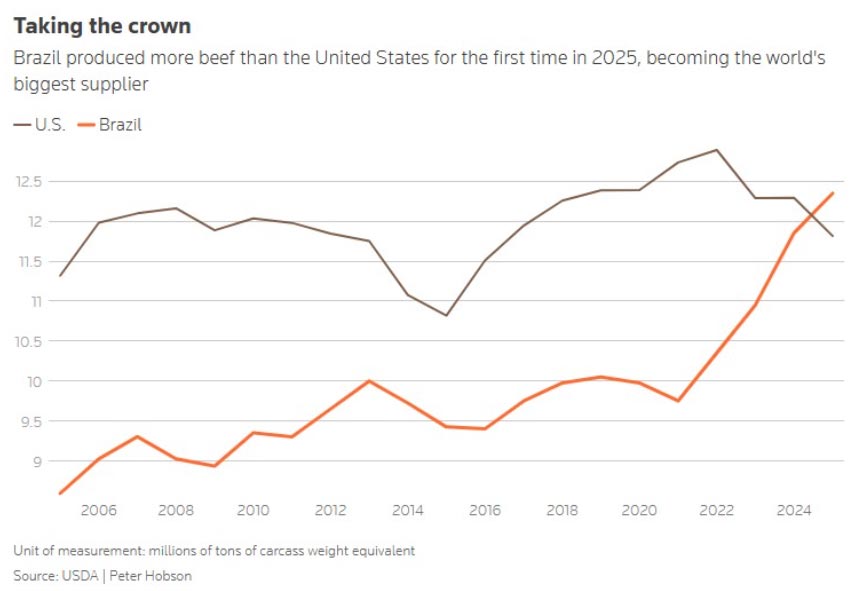
According to Reuters market estimates, Brazil overtook the United States last year to become the world’s largest beef producer, as output in the South American country exceeded expectations by several hundred thousand tons. This helped ease tight global supplies and curb surging meat prices.
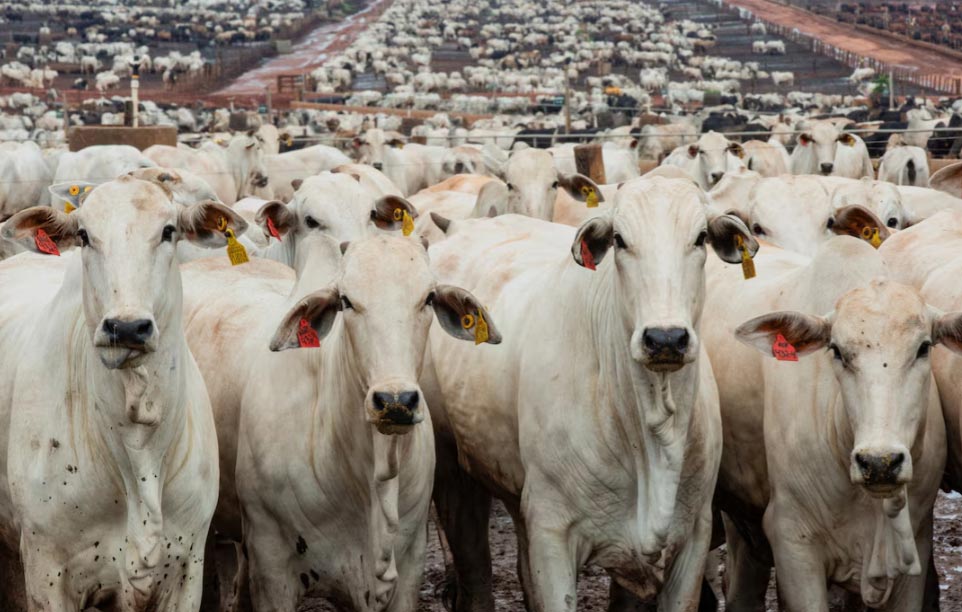
Government trade data released on Tuesday show that Brazil is already the world’s largest beef exporter, with beef export revenues expected to approach USD 17 billion in 2025. Official production data will not be released until February next year, but analysts have recently revised their forecasts upward. Beef prices have climbed to record highs due to supply shortages in countries such as China and the United States, prompting farmers to increase slaughter rates to meet strong export demand.
Typically, higher slaughter rates are followed by a period of declining output, as producers retain cattle for breeding and herd rebuilding. However, industry participants say productivity gains in Brazil may limit—or even prevent—such a decline. They point to faster adoption of artificial insemination, accelerated feedlot finishing, and shorter slaughter cycles.
“Ten years ago, the average slaughter age in Brazil was five years,” said Vinicius Barbosa, commercial manager at the CMA feedlot in Barretos, about 420 kilometers (260 miles) north of São Paulo, which manages tens of thousands of cattle. “Now it’s 36 months, and it’s quickly moving toward 24 months,” he added.
Mauricio Nogueira, head of livestock consultancy Athenagro, said Brazil’s beef output far exceeded his 2025 forecast. Production rose by 4% instead of the 2.7% decline he had previously projected. The increase of roughly 800,000 tons is comparable to the annual export volume of Argentina, the world’s fifth-largest beef exporter.
Rabobank had previously expected Brazil’s beef production to decline in 2025, but now forecasts growth of 0.5% to 12.5 million tons (carcass weight equivalent). In December, the U.S. Department of Agriculture (USDA) raised its estimate of Brazil’s beef production by 450,000 tons to 12.35 million tons.
If official data confirm market estimates, 2025 will mark the first year Brazil’s production exceeds that of the United States. According to the USDA, U.S. beef output fell 3.9% in 2025 to 11.8 million tons due to years of drought.
Feedlots and heavier carcasses lift output
The USDA expects U.S. beef production to decline a further 0.9% in 2026 to 11.7 million tons. While both the USDA and Rabobank also forecast a decline in Brazil’s beef output, Nogueira said productivity gains could instead lift production by about 300,000 tons.
Consultancy Scot Consultoria estimates that by 2027, nearly 28% of cattle slaughtered in Brazil will be feedlot-finished, up from 22% in 2025.
“A feedlot can do in 100 days what a pasture does in 18 to 24 months,” Barbosa said, adding that CMA’s Barretos feedlot will handle 80,000 head of cattle by 2026, up from 65,000 last year.
Analysts note that Brazil’s booming corn ethanol industry produces a byproduct known as distillers dried grains, which contain more protein than corn and help cattle gain weight faster.
As farmers adopt more efficient artificial insemination techniques, pregnancy rates among cows are rising, allowing producers to slaughter more animals without shrinking herd sizes. Scot Consultoria expects Brazil’s pregnancy rate—the share of females that become pregnant during the breeding season—to rise from an estimated 50% in 2026 to 54% in 2027.
Analysts also say improved genetics are supporting faster growth and better meat quality. However, Brazil’s feedlot finishing rate still lags that of the United States at 90% and Australia at 40%.
Consultancy Datagro estimates that if Brazil’s cow pregnancy rate were to rise to 66%, matching neighboring Argentina, annual calf births would increase from about 32 million to 40 million head. By comparison, Canada’s pregnancy rate is 96%.
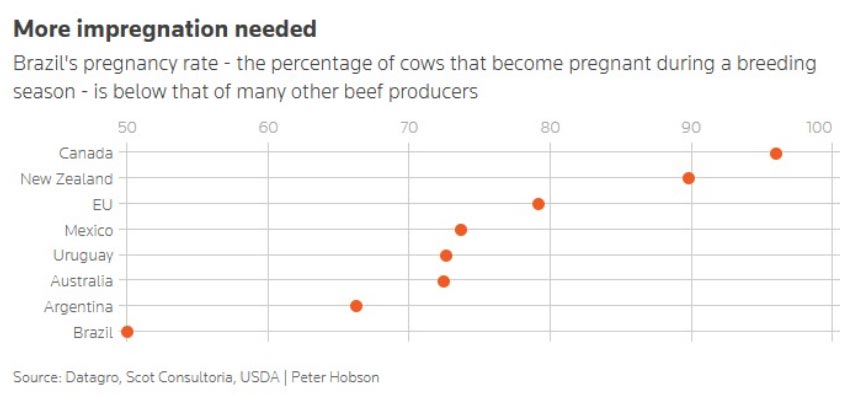
Government data show Brazil has a cattle herd of 238 million head—more than double the United States’ 94 million. Higher productivity would allow output to grow without expanding herd size or pastureland, potentially easing one of the economic drivers of deforestation in the Amazon.
According to the Brazilian Beef Exporters Association (ABIEC), Brazil’s cattle herd is expected to grow by just 4% between 2024 and 2034, while beef production is projected to rise by 24%. Over the same period, the USDA estimates U.S. beef production will increase by 3.5%, with herd size growing 5%.
Brazil becomes pivotal as top producers scale back
Global beef prices will hinge on whether Brazil can avoid a production decline this year.
The USDA forecasts that after a 0.4% increase in 2025, combined beef output among the world’s six largest producers will fall 2.4% in 2026—the biggest annual drop in decades. The six are Brazil, the United States, China, the European Union, Argentina, and Australia. India is excluded from the list, even though it produces buffalo meat rather than beef, though the USDA still counts it among major producers.
The USDA expects Brazil’s beef output to fall 5.3% this year to 11.7 million tons (carcass weight equivalent). If Nogueira’s forecast proves correct and production instead rises to about 12.6 million tons, the decline among the top six producers would be limited to just 0.2%.
“International demand for Brazilian beef has never been stronger,” said Guilherme Jank, an analyst at Datagro, noting that local meatpackers have also expanded capacity.
“We are witnessing a major transformation in Brazil’s beef supply system in terms of quality, scale, efficiency, and productivity,” he said.
Category
Leave Message for Demo Request or Questions