 Tendata AI
  Exhibition
 B2B Platforms
 Standalone Website
 Social Media
 Emails
 Trade Data Provider
 2025-09-24
Why Import-Export Trade Data Differs Across Countries?
A common misconception in international business is that trade data looks the same worldwide and can always be used to “find customers.” In reality, the level of transparency varies greatly between countries, and the information available is far from uniform.
For instance, China's trade data does not disclose buyer or seller details, let alone contact information. What businesses can access are macro-level statistics, such as product categories, trade volumes, or port data. These insights are useful for market trend analysis—for example, discovering that hardwood furniture exports from East China rose by 20% in the past six months and mainly went to Southeast Asia. However, it is impossible to identify which Chinese exporter sold to which foreign buyer directly from this data.
In contrast, some countries like the United States, the United Kingdom, and Australia make company names available in their trade records. You might see something like: “A U.S. company imported 10 containers of textiles from a Chinese supplier.” Still, even in these cases, direct contact details (emails or phone numbers) are almost never included—company names are typically the maximum disclosure.
On the stricter side, many EU countries follow GDPR regulations, which limit access to even company names. Instead, data may only show product categories and general trade volumes. That's why if you purchase trade data and cannot locate customer details, it often has to do with the country's own disclosure rules.

Where Do Contact Details in Trade Data Software Come From?
This is one of the biggest questions businesses ask: if many countries don't publish contact details, how do trade data platforms provide them?
In most cases, the contacts are added later by the software provider, not part of the raw trade data itself. Here's how:
Automated Web Scraping: Once a company name appears in trade data, the platform's system crawls the web—Google, LinkedIn, company directories, or official websites—to extract emails and phone numbers. For example, if the importer is listed as “ABC Trading,” the system searches for its official website and scrapes the contact details from the “Contact Us” page.
Secondary Data Integration: Some companies, especially in India, collect trade data from multiple countries, then enrich it with information purchased from directories or scraped online. They repackage these datasets—including emails, phone numbers, and sometimes buyer names—and resell them to local data providers, who then market them to exporters.
The problem? Quality is inconsistent. Sometimes the email is just a generic inbox ([email protected] or [email protected]), which rarely reaches the right buyer. Other times, the contacts are outdated, leading to bounced emails or disconnected phone numbers.
How to Ensure Trade Contacts Are Reliable
To avoid wasting time on bad leads, it's essential to choose a professional platform. Trusted providers like Dun & Bradstreet or Tendata verify their data repeatedly and offer validated contacts rather than scraped information.
For example, if you search for BOPETNO SA DE CV on Tendata, you'll find not just trade records but also detailed company background, product lists, supply chain links, and port activities. This allows exporters to analyze the company from multiple angles before making contact.
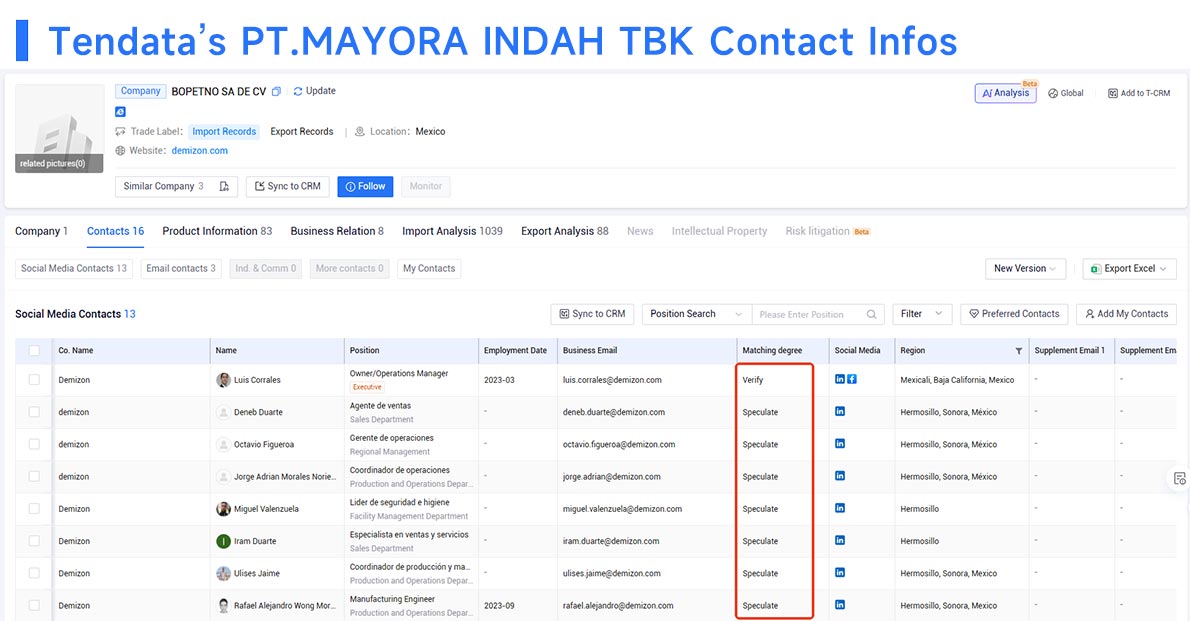
Another sample is PT.MAYORA INDAH TBK Using Tendata, you can access its trade history along with verified contact details—such as buyer names, positions, emails, and phone numbers—plus indicators showing whether those contacts have been recently validated. Exporters can directly reach out to decision-makers, avoiding the inefficiency of generic company emails.
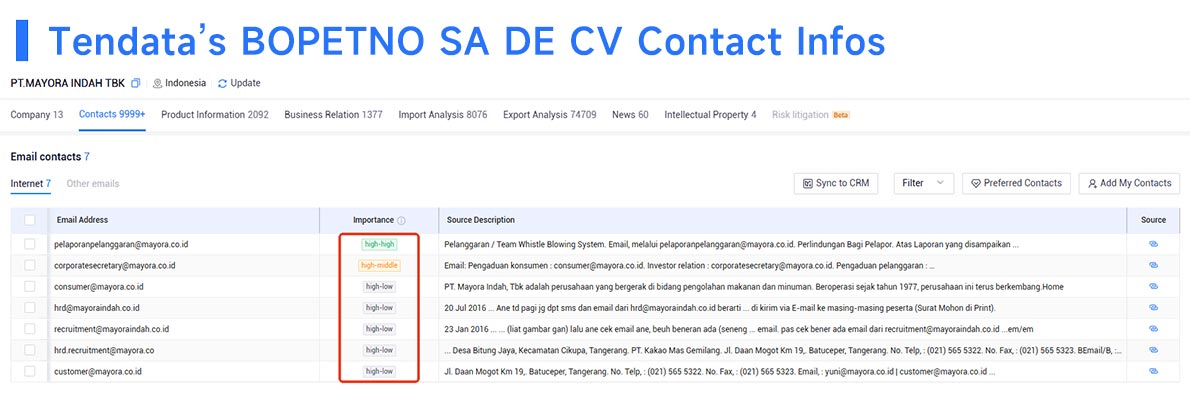
This verification process significantly improves the chances that your outreach actually reaches real buyers instead of bouncing back or disappearing into a general inbox.
Category
Leave Message for Demo Request or Questions