 Tendata AI
  Exhibition
 B2B Platforms
 Standalone Website
 Social Media
 Emails
 Trade Data Provider
 2026-07-17
Winning customers in international trade is no longer just about offering competitive prices or high-quality products. Companies that understand market movements faster than their competitors are often the ones that identify new opportunities first.
This is where trade data becomes a powerful business resource. Instead of relying on assumptions or outdated market reports, companies can use trade data to understand global demand, monitor industry trends, evaluate competitors, and discover potential customers based on real trade activities.
Whether you're an exporter entering a new country, an importer searching for suppliers, or a manufacturer exploring overseas markets, trade data can help you make more confident and informed decisions.

What Is Trade Data?
Trade data refers to the information generated from international import and export transactions. Every time goods cross a border, customs authorities record details about the shipment. These records are collected into databases that provide valuable insights into global trade.
Depending on the source, trade data may include product descriptions, HS codes, shipment dates, trade values, quantities, countries involved in the transaction, ports, and sometimes information about importers and exporters.
Because it reflects real business activities, trade data is widely used to analyze market demand, identify trading partners, and understand supply chain movements.
Unlike market forecasts or industry surveys, trade data shows what companies are actually buying and selling, making it a reliable foundation for international business decisions.
10 Free Trade Data Platforms You Can Use
If you're new to international trade research, there are many free resources that provide access to trade data and official trade statistics. While these platforms mainly focus on macro-level analysis rather than detailed company shipment records, they are excellent tools for understanding global markets.
1. General Administration of Customs of China (GACC)
Website: https://stats.customs.gov.cn/
China's official customs statistics platform provides import and export data that can be searched by HS code, trading partner, and reporting period. Users can also download statistical reports for further analysis.
2. UN Comtrade
Website: https://comtradeplus.un.org/
UN Comtrade is one of the world's largest public trade data databases. Managed by the United Nations, it contains import and export statistics from more than 200 countries and regions.
3. ITC Trade Map
Website: https://www.trademap.org/
Trade Map, developed by the International Trade Centre, provides detailed trade statistics together with visualization tools for market analysis, product research, and export performance comparisons.
4. ImportYeti
Website: https://www.importyeti.com/
ImportYeti offers free access to U.S. ocean shipment records. Users can search importers, suppliers, shipment histories, and trading relationships based on bill of lading data.
5. USITC DataWeb
Website: https://dataweb.usitc.gov/
Operated by the U.S. International Trade Commission, DataWeb provides official U.S. import and export statistics with flexible search options based on products, countries, and HS classifications.
6. UK Trade Info
Website: https://www.uktradeinfo.com/
The UK's official trade statistics website provides detailed import and export information, allowing businesses to analyze British trade by commodity and trading partner.
7. Eurostat
Website: https://ec.europa.eu/eurostat
Eurostat publishes official trade statistics for European Union member states and provides comprehensive data on trade between the EU and global markets.
8. Observatory of Economic Complexity (OEC)
Website: https://oec.world/
OEC offers highly visual presentations of global trade data, helping businesses quickly understand international trade flows, product competitiveness, and market structures.
9. Japan Customs Trade Statistics
Website: https://www.customs.go.jp/
Japan Customs provides official trade statistics covering imports and exports by product category and trading partner.
10. Korea International Trade Association (KITA)
Website: https://stat.kita.net/
KITA offers detailed South Korean trade statistics, making it easier for businesses to analyze product demand, trading partners, and market performance.
What Can You Learn From Trade Data?
Access to trade data allows businesses to answer many important questions before entering a new market.
For example, companies can compare import and export volumes between countries, identify products with increasing demand, and understand how international trade has changed over time.
Historical trade data is also useful for identifying seasonal purchasing patterns. Businesses can analyze whether demand is consistent throughout the year or concentrated during specific periods, helping them improve production planning and inventory management.
Trade statistics also help businesses evaluate market potential before investing significant resources in international expansion.
Why Free Trade Data Has Its Limits
Although free trade data platforms provide valuable information, they are primarily designed for statistical analysis rather than customer development.
Suppose a company discovers that imports of industrial valves have increased significantly in a particular country. Public databases can confirm the market trend, but they usually cannot identify which companies are responsible for those purchases or whether they continue to import regularly.
For exporters, these details matter far more than overall market size.
Sales teams need to know which buyers are active, how frequently they purchase, whether they have stable suppliers, and how purchasing behavior changes over time.
This level of commercial intelligence generally requires a professional trade intelligence platform.
How Tendata Makes Trade Data More Valuable
Tendata is a global trade data platform designed to help businesses transform trade records into actionable market intelligence.
Instead of searching multiple databases separately, users can analyze international trade activities through one integrated platform.
The platform combines customs records with business insights, making it easier to understand markets, evaluate competitors, and identify qualified buyers.
Identify Markets With Strong Business Potential
Choosing the right market is often the first challenge for exporters.
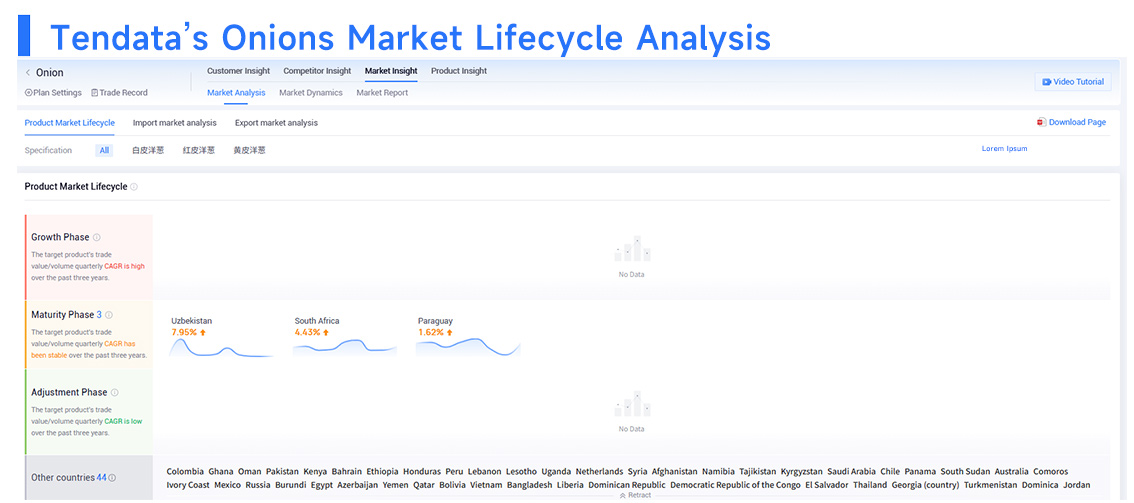
Tendata allows users to analyze trade data by country, product, industry, and HS code, making it easier to compare markets before making investment decisions.
For example, businesses exporting onions can use HS Code 070310 to examine global trade flows, identify countries with growing demand, and understand long-term purchasing patterns.
This helps companies focus their resources on markets with greater commercial potential instead of relying on guesswork.
>>> Tendata’s Onions Market Lifecycle Analysis <<<
Understand Competitor Strategies
Competitor analysis is another area where trade data provides significant value.
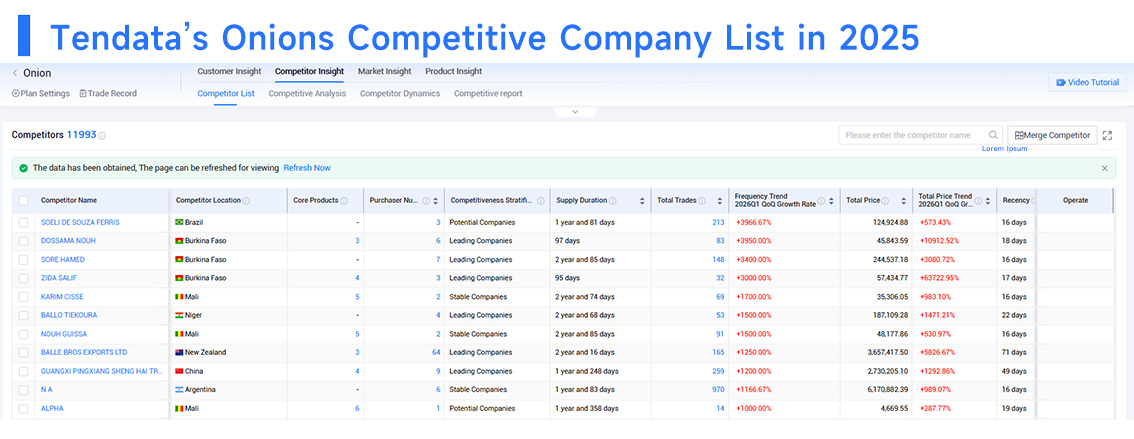
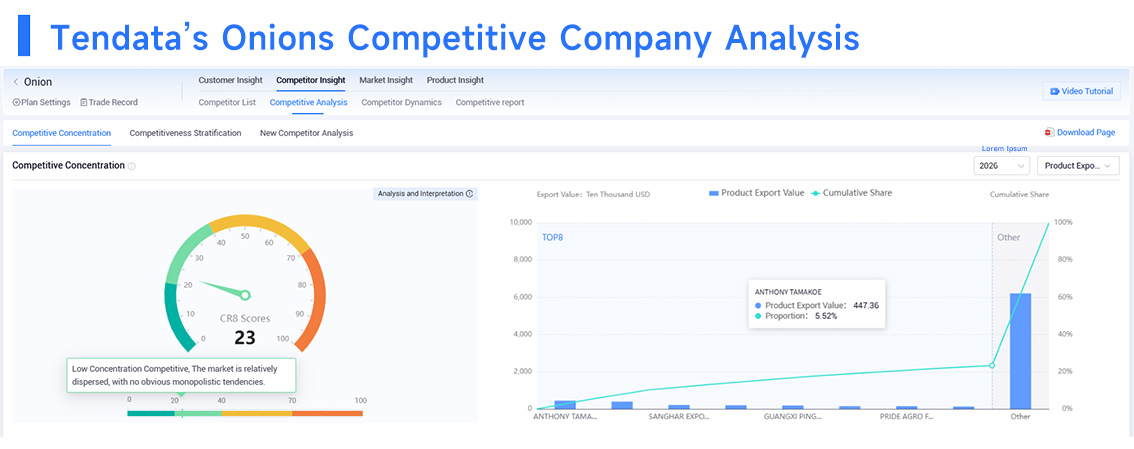
Rather than relying only on public information, businesses can review actual trading activities to understand where competitors are expanding, how frequently they ship products, and which markets generate the most business.
Tendata organizes this information into easy-to-analyze reports, allowing companies to identify competitive advantages and discover opportunities that competitors may have overlooked.
>>> Tendata’s Onions Competitive Company List in 2025 <<<
>>> Tendata’s Onions Competitive Company Analysis <<<
Find Buyers Based on Verified Trade Activity
Finding buyers is much easier when businesses know who is already purchasing similar products.
Tendata enables users to search companies through actual trade data, helping identify importers with verified purchasing histories instead of relying solely on business directories.
Users can review buying frequency, shipment history, order volumes, and supplier relationships before contacting potential customers.
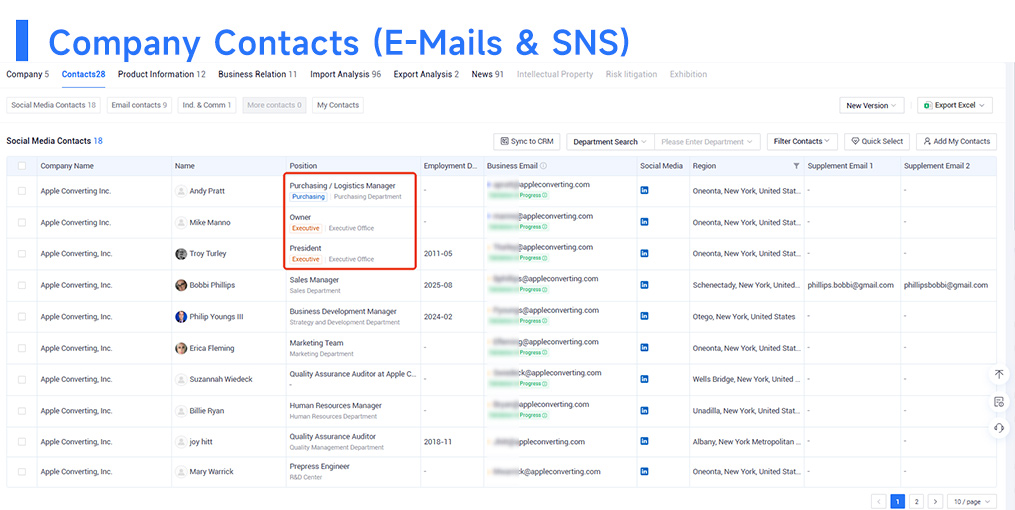
The platform also provides access to available company contact information, including emails, LinkedIn profiles, Facebook pages, and other business resources, helping sales teams connect with decision-makers more efficiently.
>>> Obtaining Customer Contact Information from Tendata <<<
Why Trade Data Should Be Part of Every International Growth Strategy
Successful international expansion requires more than market intuition.
Companies that regularly analyze trade data are better equipped to recognize new opportunities, respond to market changes, and build stronger customer development strategies.
Rather than reacting after competitors enter new markets, businesses can identify changing demand earlier and make more proactive decisions.
As global trade becomes increasingly competitive, trade data is no longer simply a research tool—it has become an important strategic asset for companies seeking sustainable international growth.
Summary
Trade data provides valuable insights into international markets, helping businesses understand demand, evaluate competitors, and identify commercial opportunities. Free resources such as UN Comtrade, ITC Trade Map, USITC DataWeb, Eurostat, and other government databases are excellent for market research and trade analysis.
For businesses looking to identify active buyers, monitor competitors, and develop overseas customers, professional trade intelligence platforms provide much deeper insights.
Tendata combines comprehensive trade data with market analysis, competitor research, buyer discovery, and business contact information, enabling companies to transform trade information into practical growth strategies and achieve greater success in international markets.
Category
Leave Message for Demo Request or Questions