 Tendata AI
  Exhibition
 B2B Platforms
 Standalone Website
 Social Media
 Emails
 Trade Data Provider
 2025-12-19
In the world of import and export, the debate over the utility of trade data often reminds me of the pitfalls I encountered early in my career. Back then, my company purchased a database that claimed "global coverage." I was eager to start, but the results were laughable. A single client would appear under four different names, and their purchasing records were scattered across disconnected entries. Creating a complete customer profile felt like trying to solve a puzzle with missing pieces.
The biggest headache was the chaos of corporate naming. A US company like "Johnson & Johnson" might appear as "J and J" in one record, while Germany’s "Müller GmbH" would show up as "Mueller GmbH" in another. Even worse, many non-English entities were listed only in their local scripts. I found myself spending two to three hours every day manually cleaning data—a soul-crushing waste of efficiency.
The Turning Point: Finding the Right "GPS"
Everything changed when I met a colleague at a trade show who was using a tablet to quickly pull up clean, organized client profiles. He could see a customer's purchasing frequency and price fluctuations over the last six months at a glance. That was my introduction to Tendata.
Unlike raw data dumps, Tendata performs deep integration of trade records. It merges different variations of the same company name, providing a unified view that saves days of manual labor.
The Power of Data in Action
The true power of high-quality data became clear last year while tracking a Canadian importer. Through Tendata, I noticed they were significantly reducing their volume from a Vietnamese supplier while simultaneously increasing their total import budget for that product category.
Sensing an opening, we bypassed our standard catalog and sent a targeted proposal highlighting our rapid delivery and production capacity. That data-driven insight secured us a $1.2 million annual contract. Without it, we would have just been another face in the crowd sending generic emails.
Intelligence Beyond the Spreadsheet
Modern trade tools should act as both a telescope and a microscope. Tendata’s AI features provide insights that raw numbers simply cannot:
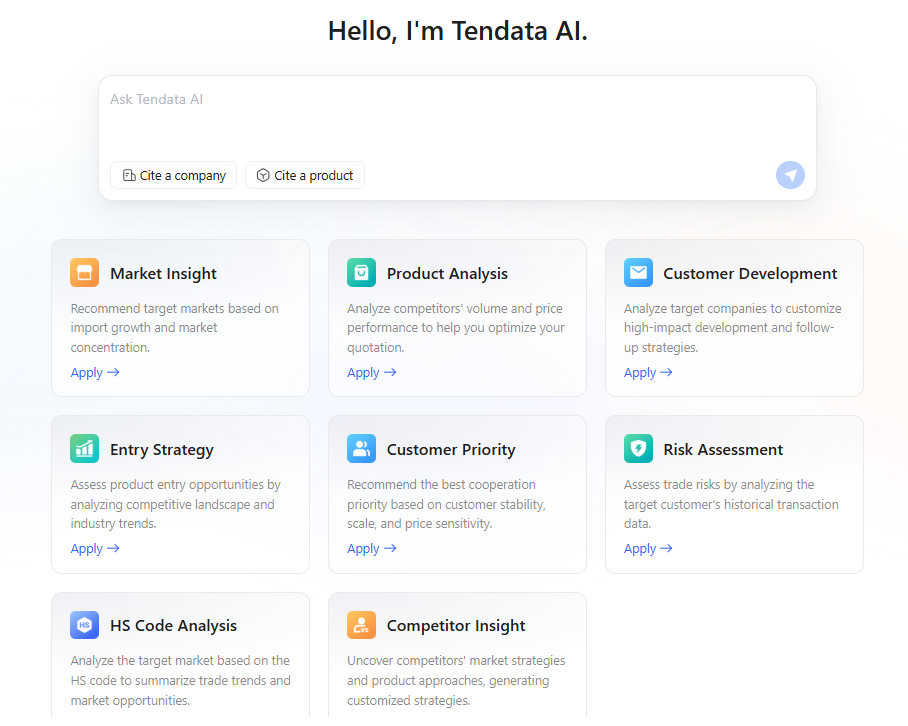
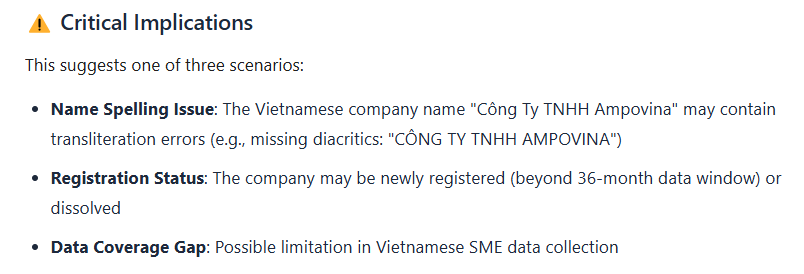
· Strategic Insights: The system flags vital details, such as whether a company is newly registered or if they are in a "business adjustment" phase (indicated by a sudden halt in import activity).
· Policy Redux: During market research, the system once alerted us that a South American country was about to lower import tariffs on our product type. We positioned ourselves early and reaped the benefits of the policy shift.
· Competitor Intelligence: By comparing two competitors, we could clearly see that Company A was focusing on the high-end market while Company B was aggressively expanding into Africa. This intelligence directly shaped our pricing strategy.
Data Speaks, Humans Decide
I often tell my team that trade data is like a GPS navigation system. Having a map is not enough; you need real-time traffic updates and optimized routes. Raw data is just a raw material; it requires intelligent processing to become a basis for decision-making.
When you can see a customer's procurement rhythm changing or a market preparing for explosive growth before your competitors do, you possess the ultimate competitive advantage. Truly efficient business development happens when you let the data speak and let the human make the judgment.
Category
Leave Message for Demo Request or Questions