
 Tendata AI
  Exhibition
 B2B Platforms
 Standalone Website
 Social Media
 Emails
 Trade Data Provider
 2026-01-14
Product selection is a term commonly used in domestic and cross-border e-commerce, but it is just as critical in foreign trade. In simple terms, it answers one fundamental question: what should you sell when doing international business?
When choosing products for foreign trade, I personally focus on two core factors:
· Proximity to the supply source or industrial base
· The product life cycle
These two points can largely determine whether a product is suitable for long-term and scalable foreign trade business.

(1)Stay Close to the Supply Source and Industrial Base
Many products have a strong regional concentration effect. Certain regions naturally form industrial clusters for specific products. When choosing a product, it is best if the factories are located not too far from you.
If the supply source is too far away, problems become harder to solve. Face-to-face communication is often necessary, especially for:
· Customized products
· OEM and private-label manufacturing
Without visiting factories in person, it is almost impossible to fully understand their production capacity, quality control, and hardware conditions. Trust and strong relationships with suppliers are also built through repeated, real interactions—not just online chats. As the saying goes, seeing is believing.
Choosing products with a local supply advantage also means:
· Easier access to better pricing
· Shorter lead times
· Backup suppliers available when demand suddenly increases
These advantages are crucial in foreign trade, where delivery reliability often determines long-term cooperation.
(2)The Product Life Cycle
If you are unsure whether a product is worth doing, the best approach is to analyze its product life cycle.
A complete product life cycle usually includes four stages:
1. Introduction stage
2. Growth stage
3. Maturity stage
4. Decline stage
The key question is: how do you judge which stage a product is in?
Method One: Google Trends
One simple way is to use Google Trends.
By entering a product name into Google Trends and adjusting the time range and region, you will get a curve showing how search interest has changed over time. Google Trends reflects search volume, not actual sales, but the two are positively correlated.
Google Trends cannot predict the future with certainty, nor can it tell you exactly which product will become the next big opportunity. However, it is extremely useful for looking backward—helping you avoid entering products or industries that are already clearly declining.
In other words, it helps you reduce the risk of choosing the wrong direction.
Method Two: Trade Data Analysis
Trade data offers a more direct and accurate way to analyze product life cycles. Instead of search interest, trade data measures actual import and export volumes in different countries.
Through trade data, you can:
· Evaluate a product's life cycle in each market
· Identify countries where import volumes are growing rapidly
· Spot real opportunities for foreign trade companies
It is important to note that trade data is more accurate in countries with open and transparent customs data. In countries where trade data is less accessible, the figures should be used as a reference rather than absolute values.
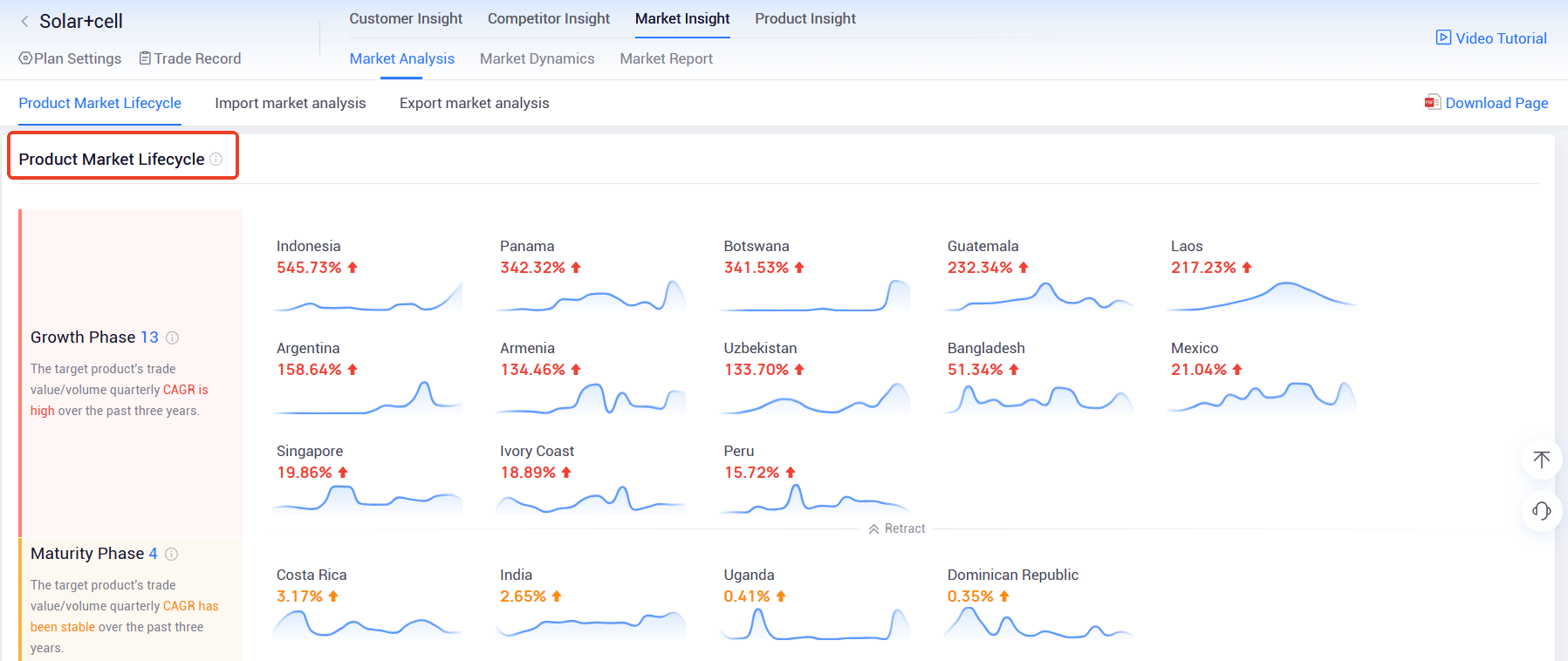
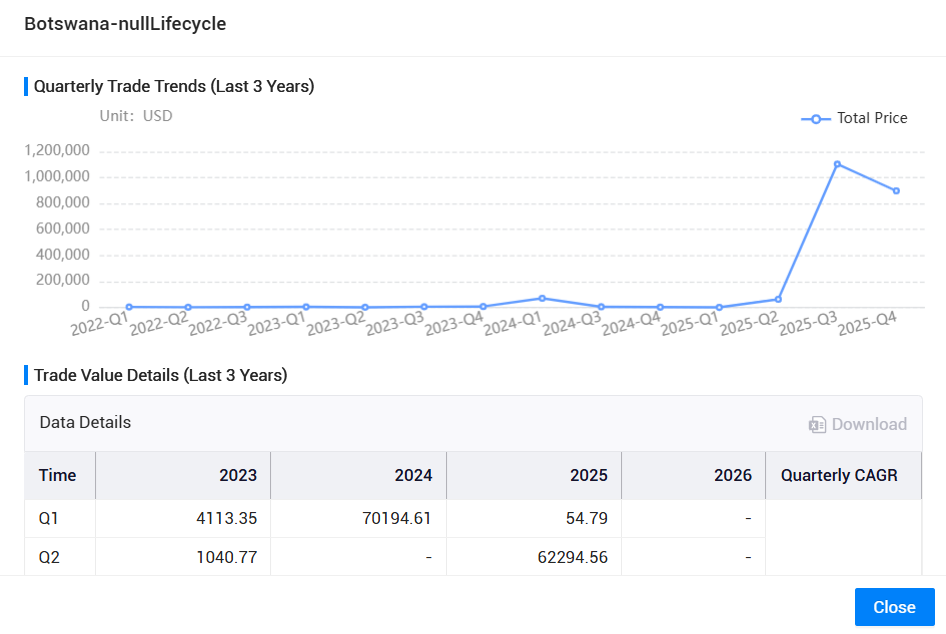
Platforms like Tendata provide clear product life cycle curves based on real trade records. For example, the life cycle of solar cells differs significantly from one country to another. A product that is in decline in one market may still be in the growth stage in another.
When Is the Best Time to Enter a Product?
If you plan to develop a product for foreign trade, the ideal timing is:
The second half of the introduction stage, or The first half of the growth stage
This period is often what people refer to as the “window of opportunity” or “market trend.” Entering too early means the market is not ready; entering too late means fierce competition and shrinking margins.
If trade data shows that a product has clearly entered the maturity or decline stage, it is usually best to avoid it. At these stages:
· Competition is intense
· Profit margins are thin
· Large and stable orders are harder to secure
For new foreign trade companies, mature products often feel like a “chicken rib”—not worth abandoning, but no longer profitable enough to justify the effort.
Conclusion
Choosing the right product is one of the most critical decisions in foreign trade. By focusing on supply chain proximity and product life cycle analysis, you can significantly reduce risks and improve your chances of success.
Combining tools like Google Trends with trade data platforms such as Tendata allows you to make more rational, data-driven decisions—helping you enter the right market, at the right time, with the right product.
Category
Leave Message for Demo Request or Questions