 Tendata AI
  Exhibition
 B2B Platforms
 Standalone Website
 Social Media
 Emails
 Trade Data Provider
 2026-05-27
Key Points
· Shipment data helps companies identify real market demand and trade flow trends
· Shipment data reveals competitor shipping behavior and supply chain changes
· Shipment data allows exporters to identify active and reliable buyers
· Tendata integrates shipment data, business data, and contact databases into one platform
· Intelligent shipment data analysis improves customer acquisition efficiency and market positioning

Overview
In global trade, many companies still treat shipment data as a simple logistics tool used to track vessels, verify bills of lading, or check estimated arrival times. However, the real value of shipment data goes far beyond transportation management.
Behind every shipment record lies valuable business intelligence: who is buying, who is selling, purchase frequency, shipment volume, pricing levels, sourcing countries, destination ports, and supply chain changes. When analyzed correctly, shipment data becomes one of the most powerful tools for market expansion, competitor analysis, and buyer development.
Today, more exporters are using shipment data not only to manage logistics, but also to understand market trends, monitor competitors, and identify high-value buyers. Platforms like Tendata are helping businesses transform massive global shipment data into actionable trade intelligence.
Shipment Data Helps You Understand Market Trends
Many exporters choose target markets based on assumptions, industry rumors, or temporary trends. This often leads companies into highly competitive markets with shrinking demand.
Shipment data provides a much clearer picture of actual global trade activity. By analyzing shipment data over time, businesses can identify which countries are importing specific products, whether shipment volumes are increasing or declining, how seasonal demand changes throughout the year, and which supplier regions dominate particular markets.
For example, when users enter a product HS code into the Tendata platform, the system analyzes massive amounts of shipment data and presents a global trade flow overview. This helps exporters identify growing markets while avoiding oversaturated regions.
With shipment data, companies no longer rely on guesswork when selecting markets. Instead, they make decisions based on real global shipping activity and verified trade flows.
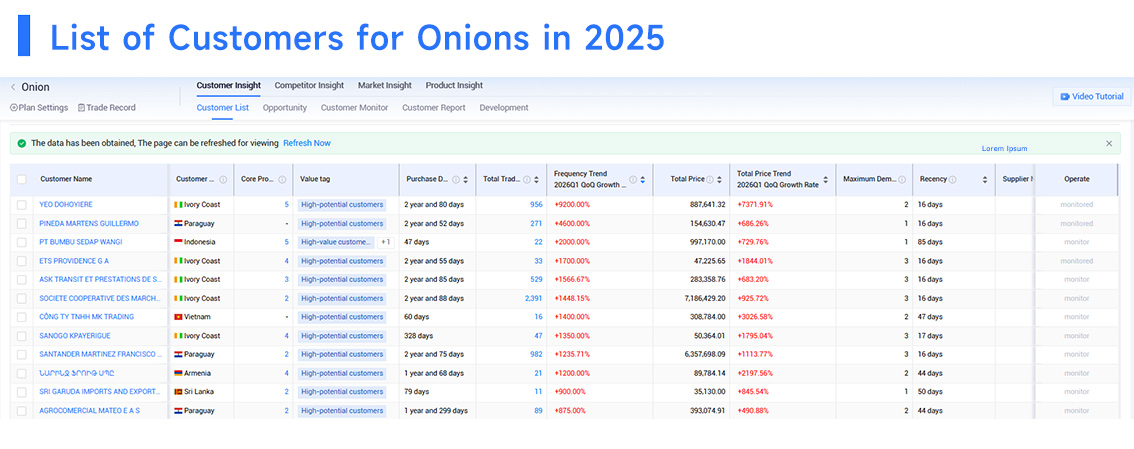
Example: Using HS code 070310 (onions) to explore trade dynamics.
>>> Click to Explore Customer List <<<
Shipment Data Helps You Monitor Competitors
Do you know how many shipments your competitors make every month? Which countries are they exporting to? Have their shipment frequencies changed recently? Are they entering new markets or facing supply chain disruptions?
Shipment data can answer all of these questions.
Using the Tendata platform, businesses can track competitor shipment data directly and analyze their pricing ranges, shipping frequency, destination markets, and buyer relationships.
For example, if shipment data shows that a major competitor has continuously reduced shipments to a specific port over several months, this may indicate supply chain issues or weakening market demand. At the same time, it may create an opportunity for your company to enter that market and gain market share.
This is why shipment data has become an important competitive intelligence tool in international trade. Instead of competing blindly, exporters can use shipment data to identify market gaps and strategic opportunities.
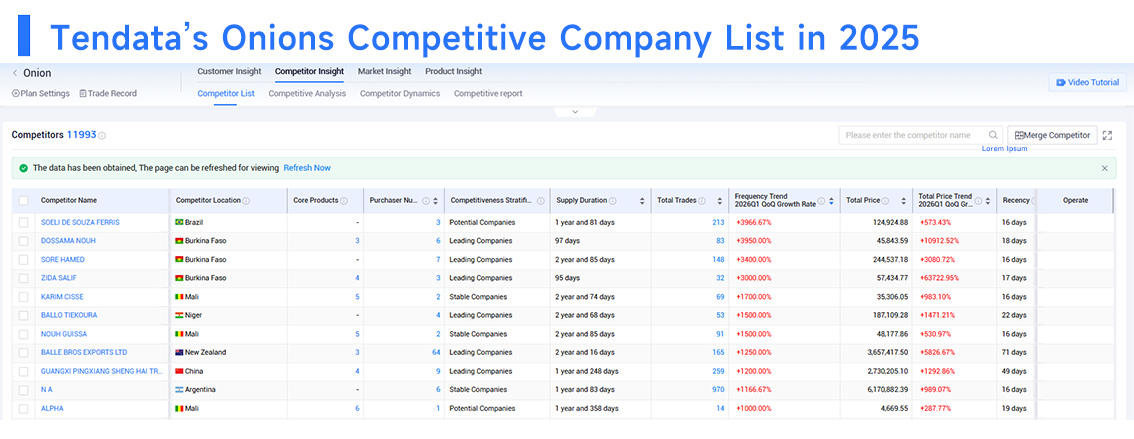
>>> Tendata’s Onions Competitive Company List in 2025 <<<
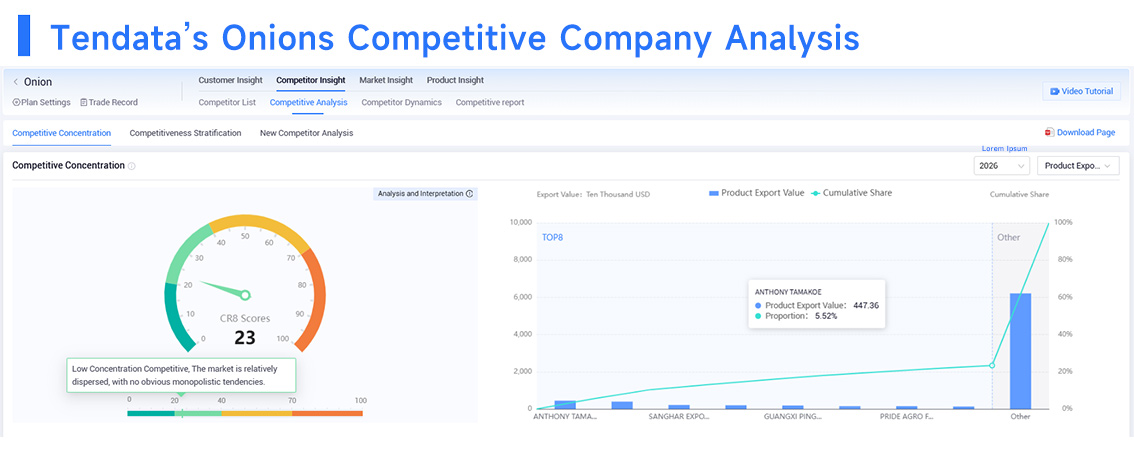
>>> Tendata’s Onions Competitive Company Analysis <<<
Shipment Data Helps You Find High-Quality Buyers
Customer development remains one of the biggest challenges in foreign trade. Even after identifying potential buyers, many exporters still struggle with two key issues:
· First, how can you determine whether a buyer is truly worth pursuing?
· Second, how can you directly reach the purchasing decision-maker?
Shipment data helps solve both problems.
By analyzing buyer shipment data, companies can evaluate procurement frequency, average order volume, sourcing patterns, supplier stability, and purchasing cycles. Buyers with stable purchasing frequency, large shipment volumes, and diversified supplier networks are often high-potential targets.
For example, the Tendata iTrader V6.0 platform uses shipment data to help businesses identify active buyers and understand their purchasing behavior. This allows exporters to focus on buyers with genuine procurement demand instead of wasting time on low-quality leads.
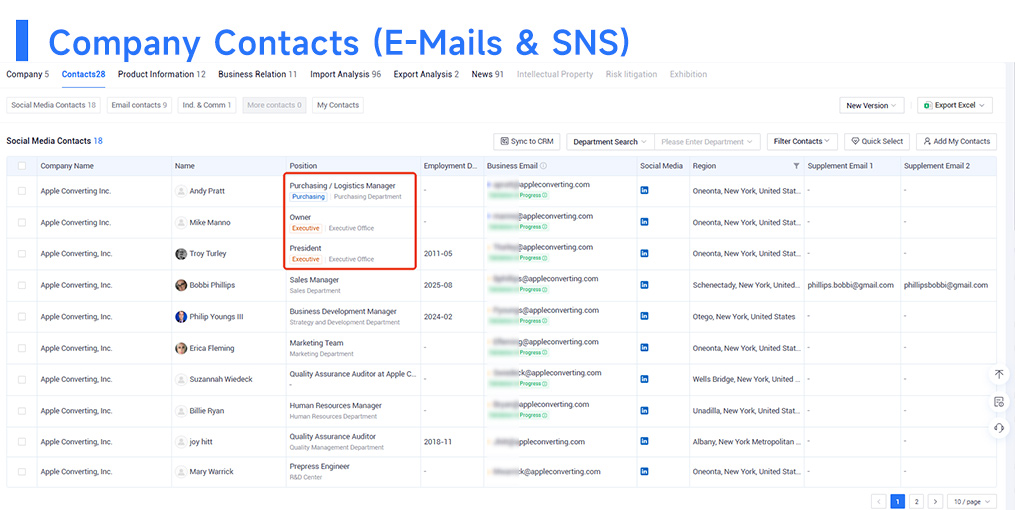
More importantly, Tendata integrates a large contact database containing verified emails, LinkedIn profiles, Facebook accounts, and other decision-maker contact information. Once a target buyer is identified through shipment data, businesses can directly connect with procurement managers and executives without manually searching for contacts.
With shipment data, customer development becomes a precise and data-driven process instead of a “needle in a haystack” approach.
>>> Obtaining Customer Contact Information from Tendata <<<
Low-Efficiency vs High-Efficiency Use of Shipment Data
Many companies still use shipment data inefficiently. They only review their own shipping records, ignore broader market trends, manually clean incomplete data, and rely on basic search tools. In many cases, they can identify buyer names but cannot access reliable contact information. Shipment data is treated only as a logistics reference instead of a business intelligence resource.
Efficient shipment data usage is completely different.
Using Tendata as an example, the platform integrates trade data from 228 countries, business data from 198 countries, and internet data from 172 countries. Users can analyze global shipment flows, monitor competitor activities, identify market demand changes, and directly access decision-maker contact information.
The platform also includes more than 850 million company profiles, 10+ billion shipment data and trade records, 500 million in-depth enterprise records, and continuously updated shipment data intelligence. All data is cleaned, de-duplicated, and filtered to remove freight forwarder noise, helping exporters improve targeting accuracy and efficiency.
Instead of using shipment data as a passive logistics record, modern exporters are transforming shipment data into a complete commercial intelligence system.
About Tendata iTrader V6.0
Through the Tendata iTrader V6.0 platform, Tendata integrates:
· 10+ billion shipment data and trade records covering 228 countries
· 850 million company profiles
· 500 million in-depth enterprise records
· Massive verified email and social media contact databases
All of these resources are combined into one intelligent shipment data solution that helps businesses:
· Understand global trade flows and market demand trends
· Monitor competitor pricing, shipment frequency, and target market changes
· Identify high-quality buyers and analyze procurement behavior
· Reach purchasing decision-makers directly through integrated contact databases
By combining shipment data with AI-powered analysis tools, Tendata enables exporters to convert trade intelligence into real business opportunities.
Summary
The value of shipment data is far greater than simple logistics tracking. Shipment data helps businesses understand market demand, monitor competitors, identify high-value buyers, and improve customer acquisition efficiency. Companies that only use shipment data for vessel tracking or bill of lading verification are utilizing only a small portion of its real value.
The most effective way to use shipment data is to treat it as a complete business intelligence system — one that reveals where products are flowing, how competitors are moving, and which buyers are actively purchasing.
Tendata iTrader V6.0 was built around this concept. It not only provides shipment data, but also transforms shipment data into market insights, competitive intelligence, and customer development opportunities.
Do not let your shipment data remain trapped inside the logistics department. Use data-driven intelligence to strengthen your global trade competitiveness and turn shipment data into real business growth.
Category
Leave Message for Demo Request or Questions