
 Tendata AI
  Exhibition
 B2B Platforms
 Standalone Website
 Social Media
 Emails
 Trade Data Provider
 2026-06-03
Key Points
· Lithium battery Japanese imports are strongly driven by EV, hybrid vehicle (HV/PHV), and electronics sectors
· Official Japanese data reveals macro trends but not buyer identities
· B2B directories provide company lists but lack verified trade volume validation
· Tendata enables reverse-engineering of real importers through shipment-level data
· Real trade records are the most effective way to identify active buyers

Overview: Understanding the Opportunity in Lithium Battery Japanese Imports
The topic of lithium battery Japanese imports represents a highly strategic entry point for global exporters aiming to penetrate Japan’s advanced energy storage and EV supply chain. Japan is not only a global leader in lithium battery R&D, but also an active importer of lithium-ion cells and battery systems—especially for automotive, industrial storage, and consumer electronics applications.
Analyzing lithium battery Japanese imports allows exporters to understand demand structure, supply origin countries, and downstream buyer behavior. At the same time, combining official statistics with commercial trade intelligence platforms such as Tendata enables companies to move from macro-level insights to actionable buyer identification.
In practice, lithium battery Japanese imports should be studied across three layers: government trade data, enterprise directories, and real transaction-level shipment intelligence.
Tool 1: Japan Official Trade Statistics (Macro Insight Layer)
For analyzing lithium battery Japanese imports, Japan’s official statistical system provides the foundational macro view.
Data Source Links
Japan e-Stat Trade Statistics Database
https://www.e-stat.go.jp/en/stat-search/database?toukei=00350300
Japan Customs Trade Data Files
https://www.e-stat.go.jp/en/stat-search/files?toukei=00350300&tstat=000001013144
Core Value
The e-Stat system provides official import/export statistics at HS code level (up to 9-digit detail). For lithium battery Japanese imports, the key HS code is:
HS 8507.60 — Lithium-ion batteries (Japan 9-digit: 850760000)
This dataset helps answer:
Is lithium battery Japanese imports growing or declining?
Which countries dominate supply?
Which product segments (EV batteries vs consumer batteries) are expanding?
However, it cannot identify specific importing companies or buyers behind lithium battery Japanese imports.
Tool 2: Japanese B2B Directories (Company Identification Layer)
Once macro demand is understood, the next step in analyzing lithium battery Japanese imports is identifying potential importers via business directories.
Example Data Sources
Japan Battery Importers Directory
http://electrical.beiei.com/battery/japan.html
Japan Electrical Industry Database
https://international.emagecompany.com/big5/japan/electrical/dianchi.html
Core Value
These directories provide structured company information for firms involved in batteries, including:
· Lithium-ion battery traders
· Distributors and wholesalers
· Industrial battery suppliers
· Potential import/export operators
For lithium battery Japanese imports, these platforms help answer:
· Who are the battery-related companies in Japan?
· Where are they located (Tokyo, Osaka, Aichi, etc.)?
· What categories of batteries do they handle?
Limitation
While useful for building a prospect list, these directories cannot confirm whether a company is actively engaged in lithium battery Japanese imports at scale or provide shipment-level validation.
Tool 3: Tendata Platform (Transaction Intelligence Layer)
The most actionable approach to lithium battery Japanese imports is using shipment-based trade intelligence from Tendata.
Core Value
Unlike macro statistics or static directories, Tendata reconstructs real trade flows from customs shipment data across 200+ countries. This allows users to directly identify real buyers involved in lithium battery Japanese imports.
How Tendata Works for Lithium Battery Japanese Imports
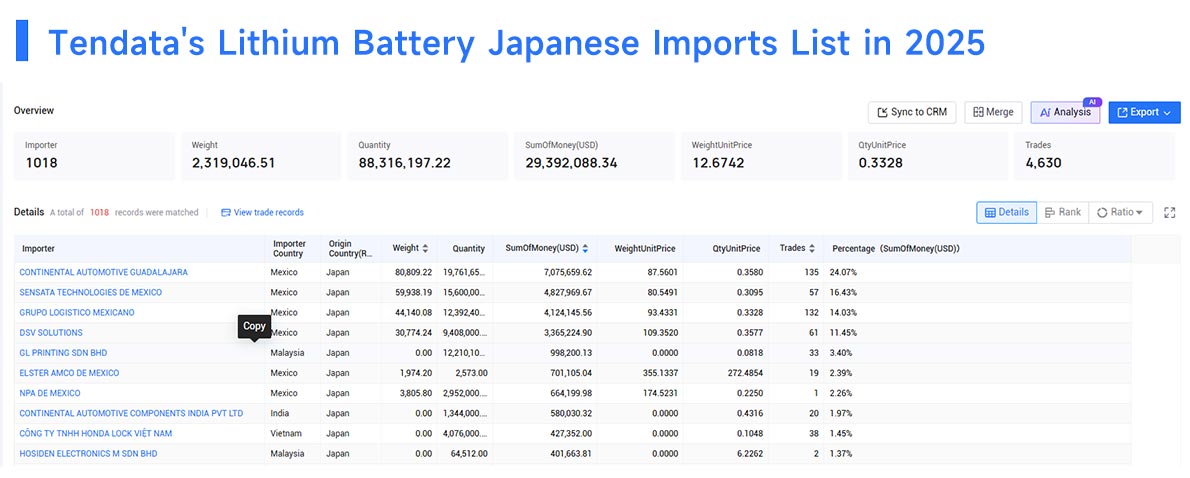
Method 1: Reverse Export Analysis
By filtering:
Product: lithium battery / HS 8507.60
Origin country: Japan
You can directly extract active Japanese importers participating in lithium battery Japanese imports, including:
· Import frequency
· Shipment volume
· Supplier relationships
· Transaction history
This transforms lithium battery Japanese imports from a market concept into a list of real buyers.
>>> Click to View the Full List <<<
Method 2: Buyer Procurement Behavior Analysis
Tendata allows deep profiling of companies involved in lithium battery Japanese imports, including:
· Purchasing cycle (monthly / quarterly patterns)
· Import volume trends
· Multi-country sourcing structure
· Supplier switching behavior
· Competitive supplier mapping
This helps exporters understand whether a buyer is stable, growing, or switching suppliers within lithium battery Japanese imports supply chains.
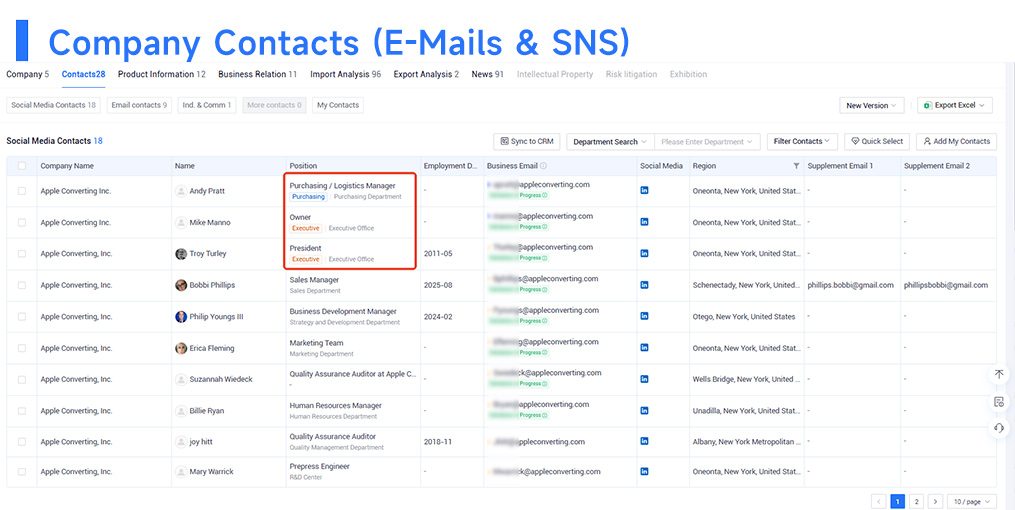
Method 3: Contact-Level Intelligence & Monitoring
For advanced lithium battery Japanese imports targeting, Tendata also provides:
· Verified procurement contacts (emails, phone numbers)
· Importer decision-maker identification
· Real-time alert system for new shipments
This allows exporters to track newly emerging opportunities in lithium battery Japanese imports in near real time.
>>> Obtaining Customer Contact Information from Tendata <<<
Integrated Workflow: From Data to Deals
A structured approach to lithium battery Japanese imports development should follow four stages:
Step 1: Market Sizing (e-Stat)
Use official Japanese statistics to understand the overall scale and trend of lithium battery Japanese imports.
Step 2: Structural Analysis (HS-Level Deep Dive)
Use HS 9-digit breakdown to analyze product segmentation within lithium battery Japanese imports.
Step 3: Buyer Identification (Tendata)
Use Tendata to reverse-map real Japanese importers actively participating in lithium battery Japanese imports.
Step 4: Direct Outreach
Contact verified procurement teams and position product advantages such as:
· Higher energy density
· Longer lifecycle
· Stable supply capability
Summary
The opportunity behind lithium battery Japanese imports is not just about understanding market size, but about identifying real, active buyers within Japan’s high-value energy ecosystem.
Exporters can move from generic market analysis to precise buyer targeting in the lithium battery Japanese imports sector.
Ultimately, lithium battery Japanese imports become not just a keyword for research, but a structured pathway for identifying real demand, real companies, and real transaction opportunities in Japan’s battery supply chain.
Category
Leave Message for Demo Request or Questions