
Unlocking Japanese Imports Data in 2023

tendata blogTrade Data Provider

ten data blog2024-11-15

Japan, one of the world's largest economies, is a key player in global trade. As a country with limited natural resources, Japan relies heavily on imports to meet the needs of its industrial and consumer markets. For businesses looking to enter or expand in Japan, understanding Japanese imports data is critical to identifying market opportunities, optimizing supply chains, and staying ahead of competitors.


japanese import,japanese imports,japanese imports data


1. Why Japanese Imports Data Matters

Japan imports a wide range of goods, from raw materials and machinery to food and consumer products. By analyzing Japanese imports data, businesses can gain insights into:

· Market Demand: Import data reveals which products are in demand, helping you tailor your offerings to the needs of Japanese consumers or industries.

· Competitive Landscape: By examining the volume and value of imports, you can identify key players in the market and assess the level of competition.

· Supply Chain Strategy: Japanese imports data can help you understand logistics, popular trade routes, and potential bottlenecks, which are crucial for smooth operations.

· Regulatory Insight: Japan has stringent import regulations. By studying Japanese imports data, you can identify products subject to tariffs or trade restrictions.


2. Key Components of Japanese Imports Data

To make the most of Japanese imports data, it’s important to focus on the following components:

Product Categories

The data is often segmented into various product categories, such as:

· Electronics and Machinery: Japan is a major importer of high-tech products and machinery, including semiconductors, robots, and industrial equipment.

· Food and Beverages: Japan imports agricultural products like meat, fruits, and grains to meet domestic demand.

· Raw Materials: With limited natural resources, Japan imports significant quantities of oil, metals, and chemicals for its manufacturing sector.

Import Value and Volume

The import value and volume help businesses track market size and trends. For example, an increase in the import value of a specific category suggests growing demand, while declining volumes may indicate market saturation or shifting consumer preferences.

Source Countries

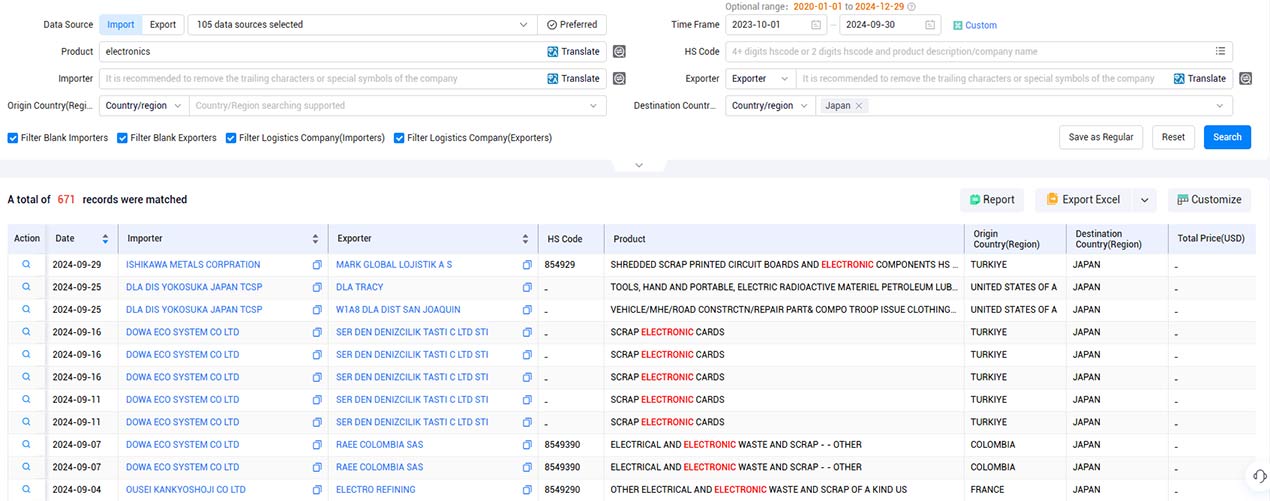
Japanese imports data reveals where Japan sources its goods, such as:

· China and the U.S. are Japan's largest import partners, especially for electronics, machinery, and raw materials.

· European Union countries provide luxury goods, food, and automotive parts, while Southeast Asia is a major supplier of agricultural products.

Knowing where Japan imports from allows businesses to target markets and identify potential suppliers or partners.
  

japanese import,japanese imports,japanese imports data

>>Contact Tendata for a free demo<<


3. Japan's Top Imports in 2023:

· HS Code 2709 (10.7%, $80 billion): Petroleum oils and oils obtained from bituminous minerals, crude

· HS Code 2711 (7%, $52 billion): Petroleum gases and other gaseous hydrocarbons

· HS Code 2701 (5.55%, $41 billion): Coal; briquettes, ovoids and similar solid fuels manufactured from coal

· HS Code 8542 (3.8%, $28 billion): Electronic integrated circuits and microassemblies

· HS Code 8517 (3.49%, $26 billion): Electrical apparatus for line telephony or line telegraphy, including line telephone sets with cordless handsets and telecommunication apparatus for carrier-current line systems or for digital line systems; videophones

· HS Code 2710 (2.36%, $17.7 billion): Petroleum oils and oils from bituminous minerals, not crude; preparations n.e.c. containing by weight 70% or more of petroleum oils or oils from bituminous minerals; these being the basic constituents of the preparations; waste oils

· HS Code 3004 (2.05%, $15.4 billion): Medicaments (excluding goods of heading 30.02, 30.05 or 30.06) consisting of mixed or unmixed products for therapeutic or prophylactic uses, put up in measured doses (including those in the form of transdermal administration systems) or in forms or packings for retail sale

· HS Code 8471 (2.01%, $15.1 billion): Automatic data processing machines and units thereof; magnetic or optical readers, machines for transcribing data onto data media in coded form and machines for processing such data, not elsewhere specified or included

· HS Code 3002 (1.85%, $13.9 billion): Human blood; animal blood for therapeutic, prophylactic or diagnostic uses; antisera, other blood fractions, immunological products, modified or obtained by biotechnological processes; vaccines, toxins, cultures of micro-organisms (excluding yeasts) etc

japanese import,japanese imports,japanese imports data


About Tendata

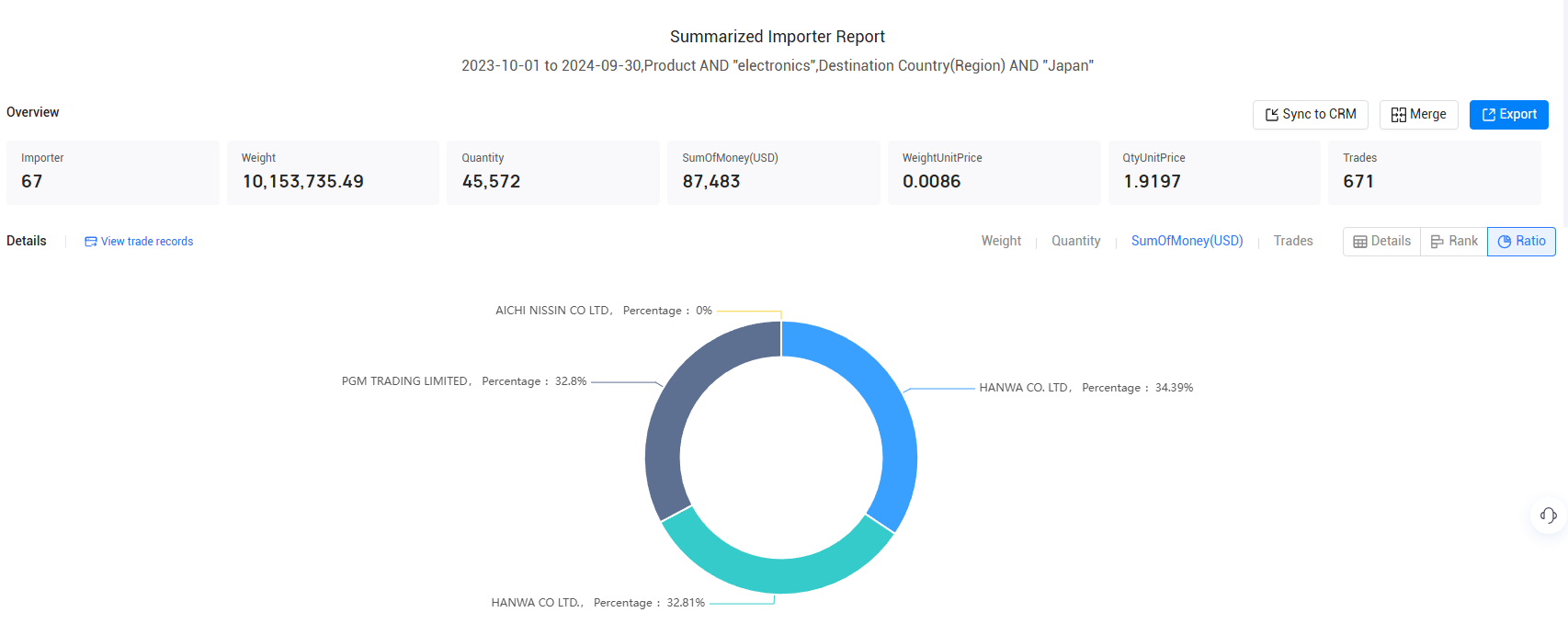
Tendata iTrader has 210 million global enterprise information, 10 billion data scrolling every day, can quickly and intelligently screen out 700 million executives, decision makers contact information, including email, phone, social media, etc., but also can synchronize the display of the company's yellow pages, product images and web site.

At the same time, Tendata provides 19 visualization reports to help foreign trade enterprises accurately locate and analyze the market, so that you can quickly find the precise buyers and suppliers you need.

japanese import,japanese imports,japanese imports data


4. How to Use Japanese Imports Data Effectively

Once you have access to Japanese imports data, here are a few ways to use it strategically:

· Identify Market Trends: Look for patterns in growing import categories. For example, a rise in imports of sustainable products or certain technologies can signal market opportunities for similar offerings.

· Optimize Supply Chains: By understanding the volume of imports and the logistics involved, you can identify efficient suppliers and minimize shipping or customs delays.

· Assess Pricing and Competitors: Import data can help you analyze pricing trends in the Japanese market and position your products competitively.

· Target Marketing: Use Japanese imports data to refine your marketing strategy by identifying which countries or industries are importing specific goods, helping you tailor your messaging.


Conclusion

For businesses looking to expand into Japan or improve their existing operations, understanding Japanese imports data is a powerful tool. It provides critical insights into market demand, competitor activity, pricing strategies, and supply chain dynamics. By analyzing this data, you can make informed decisions, reduce risks, and better position your business for success in one of the world’s most lucrative markets.

>>Contact Tendata for a free demo<<


Category

Leave Message for Demo Request or Questions

We always appreciate your visit at tendata.com. We'd love to hear your suggestions, feedback & queries. Please contact us to schedule a demo or learn more about our services. We will respond to your query within 1 working day.

More Popular Blogs

These related articles may also be of interest to you

Geting Price

Global Trade Data Leader
Get Pricing
Privacy and Data Protection Policy
Effective Date: 01/07/2026

1. Introduction

Tendata (Shanghai Tendata Tech Co., Ltd., hereinafter referred to as “Tendata”, “we”, “us”, or “our”) is committed to protecting your privacy and data security. This Privacy and Data Protection Policy (“Policy”) explains how we collect, use, store, share, and protect your information when you visit our websites, use our customs data query systems, softwareasaservice (SaaS) platforms, or otherwise engage with our services.

2. Scope

This Policy applies to:
Tendata’s official website and related mobile applications;
Tendata’s customs data analytics software and SaaS offerings;
Communications via phone, email, or offline meetings.
Special Note: The “customs data” referred to in this Policy primarily involves commercial business information in international trade (e.g., importer/exporter names, transaction values, quantities, product descriptions). Tendata does not actively collect sensitive personal information of natural persons (such as biometric or health data), unless you voluntarily provide such information as our client representative.

3. Categories of Information We Collect

We collect information in three main categories:
3.1 Information You Voluntarily Provide
Account Information: name, job title, company name, corporate email address, phone number, and office address.
Communication Content: inquiries, feedback, and attachments submitted through online forms, customer service chats, or email subscriptions.
3.2 Information Generated During Service Use
Search and Query Records: keywords, HS codes, product descriptions, and browsing history entered into our system.
Log Data: IP address, browser type, operating system, access times, and page clickstreams.
Transaction and Contract Information: details of purchased service packages, payment records, and invoice information.
3.3 Information from Third-Party Sources
We may verify your corporate background information from publicly available commercial channels to ensure compliance with our service terms.

4. How We Use Your Information

We use your information for the following legitimate purposes:
Service Provision and Support: account activation, generation of data analytics reports, processing refunds, and handling technical support requests.
Product Improvement: analysing user behaviour patterns to optimise our data algorithms and user interface.
Marketing and Notifications: sending industry insight reports, product updates, or event invitations, subject to your prior consent.
Legal Compliance and Security: detecting and preventing fraud, maintaining system security, and fulfilling antimoney laundering and export control compliance obligations.

5. Data Storage and Protection

5.1 Storage Location
Your personal and business data are primarily stored on servers located in Shanghai, China, and on Alibaba Cloud’s secure infrastructure. We strictly comply with applicable data localisation requirements.
5.2 Security Measures
Tendata employs industryleading security measures to protect your data:
Transport Layer Security: fullsite TLS 1.3 encryption to ensure secure data transmission.
Storage Encryption: sensitive fields are encrypted using AES256 encryption.
Access Control: a strict internal permission hierarchy, granting access only to authorised personnel on a “minimum necessary” basis.
Backup and Disaster Recovery: automated daily backups to ensure high data availability.

6. Sharing, Transfer, and Disclosure of Your Information

6.1 Sharing with ThirdParty Partners
We only share your data when necessary:
Service Providers: such as cloud service providers (Alibaba Cloud), email delivery services, and payment gateways. These partners are bound by strict data processing agreements.
Legal Requirements: disclosure in response to mandatory requests by Chinese laws, administrative regulations, or judicial authorities.
6.2 Business Transfers
If Tendata is involved in a merger, acquisition, or asset restructuring, your data will be transferred as part of the business assets. We will notify you in advance and require the new entity to continue to comply with this Policy.
6.3 Prohibition on Sale
Tendata explicitly undertakes that we will never sell, trade, or rent your personal data or business secrets to any unrelated third party.

7. Your Data Subject Rights

Under the Personal Information Protection Law (PIPL) and the GDPR, you have the following rights:
Right to be Informed and Right of Access: you may contact us at any time to confirm whether we are processing your personal data and request a copy of that data.
Right to Rectification: you may request correction of inaccurate or incomplete data.
Right to Erasure (“Right to be Forgotten”): under certain circumstances (e.g., when the purpose of processing has been fulfilled or you withdraw consent), you may request deletion of your personal data.
Right to Withdraw Consent: you may withdraw your consent for marketing communications at any time.
Right to Data Portability: you have the right to request that the structured data you provided be transferred to another controller.
How to Exercise Your Rights: Please send an email to [[email protected]] . We will respond within 15 business days.

8. Cookies and Similar Technologies

We use strictly necessary cookies to maintain login sessions and improve page loading speed. You may disable cookies in your browser settings, but this may affect the functionality of certain features. We do not use cookies to track your crosssite behaviour for profiling.

9. Protection of Minors

Our services are designed for businesses and professionals and are not intended for individuals under the age of 14. If we discover that we have inadvertently collected information from a child, we will delete it promptly.

10. Policy Updates

We reserve the right to update this Policy from time to time. For material changes (e.g., changes in the purposes of data processing), we will notify you prominently via inapp messages or email.

11. Contact Us

If you have any questions, complaints, or suggestions regarding this Policy or data security, please contact our Data Protection Officer:
Shanghai Tendata Tech Co., Ltd.
Address: 8th Floor, Building 1, No. 20, Lane 91, Eshan Road, Pudong New Area, Shanghai
Data Protection Email:[[email protected]]
Phone: +021-60898388-8111
Free Demo
X

'Target Customer
'Acquisition & Intelligent
'Decision-Making

'Global Trade Marketing Intelligent'
Decision-Making SaaS Platform

Welcome Tendata iTrader

Please fill in the infos to get free demo

  • *

  • *

  • *

  • *

  • *

  • *

  • *
  • *

Success!

A rep will contact you within 10 minutes to get your demo.If you need a faster answers around features, pricing, etcplease scan to add Whatsapp online customer service.

Scan the QR code or click here for immediate consultation.
tendata